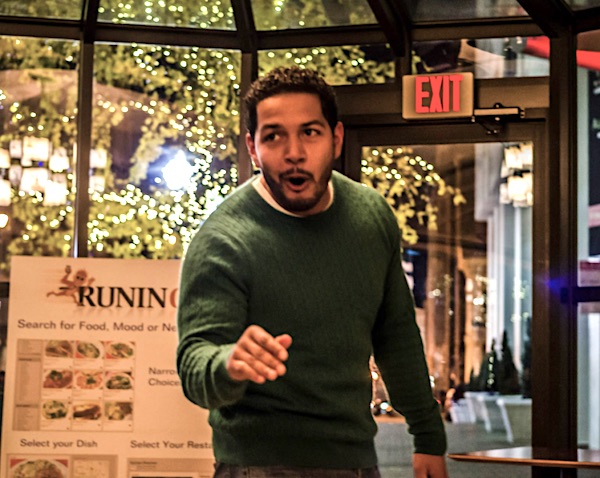
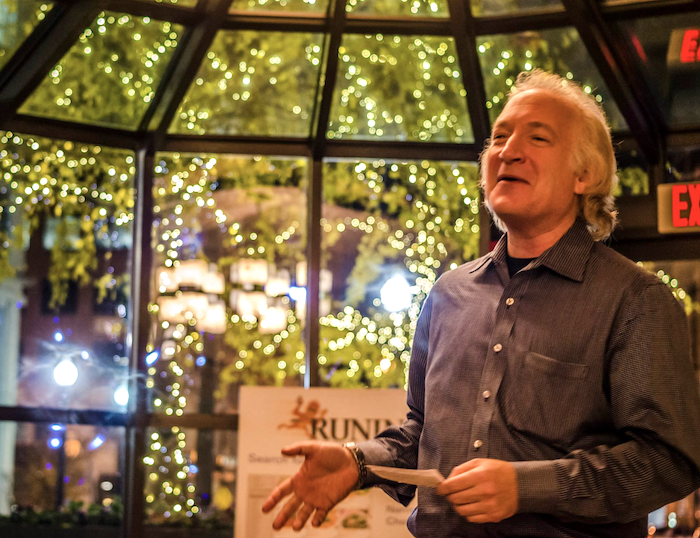
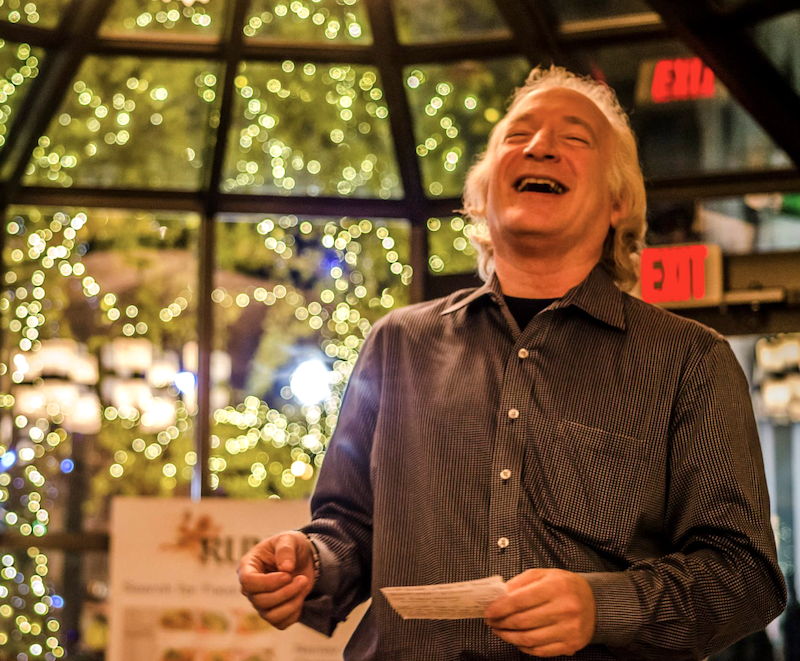
I met Wirut just outside the Irish Channel a year ago when he was opening up a noodle and sushi bar next door.
“sah-wah-dee.”
“Have you been to Thailand, the ‘Land of Smiles’?”
“Yes, Phuket, twice, both times by boat — when I was 5, living on a sailboat and at 17 on a frigate with the Navy.”
Wirut came over to show me some pictures of the beautiful island. “I’m from Bangkok but enjoy visiting Phuket. So much to see and do there just like D.C. and the cuisine is out of this world.”
“Couldn’t agree with you more. And I think it’s a wonderful idea to open up an Asian noodle bar here this side of Chinatown. There’s lots of noodle shops here, but almost all are Chinese – so an Asian fusion noodle shop will do well next to an Irish pub. They’ll come here to work off their drunk.”
And I would go to Absolute Noodle and Sushi to work on their website while slurping on udon noodles with bulgogi and sipping on Asian pear sake.
Like with many restaurants, I worked for a paycheck and a tab, so this was an excellent way to invite my friends for a meal and a chance for them to meet the manager and chef.
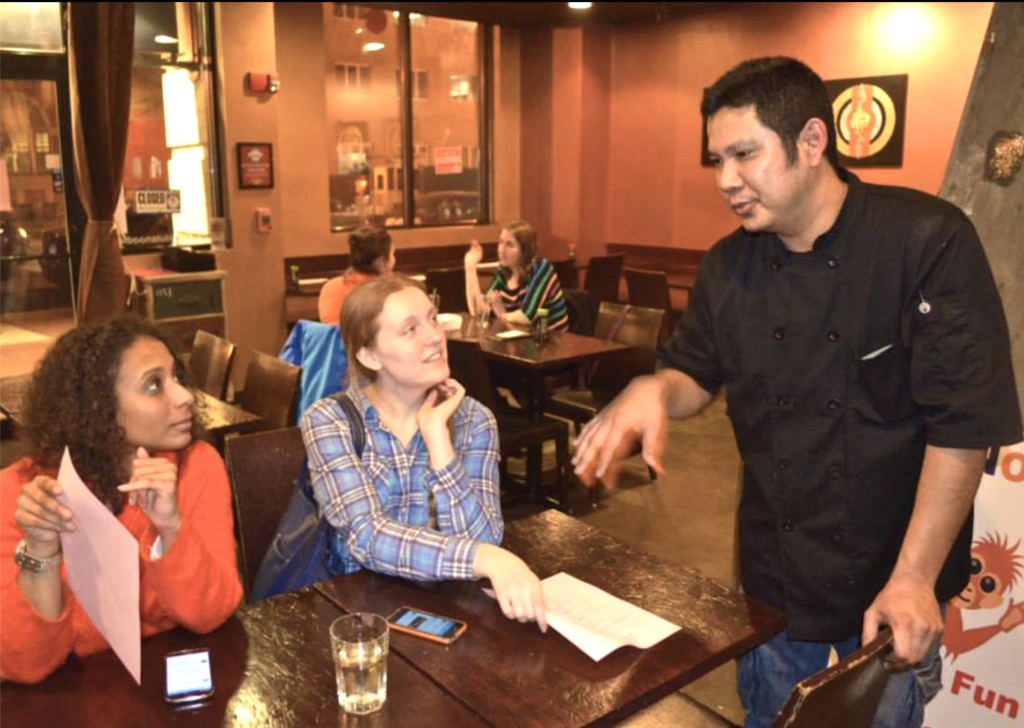
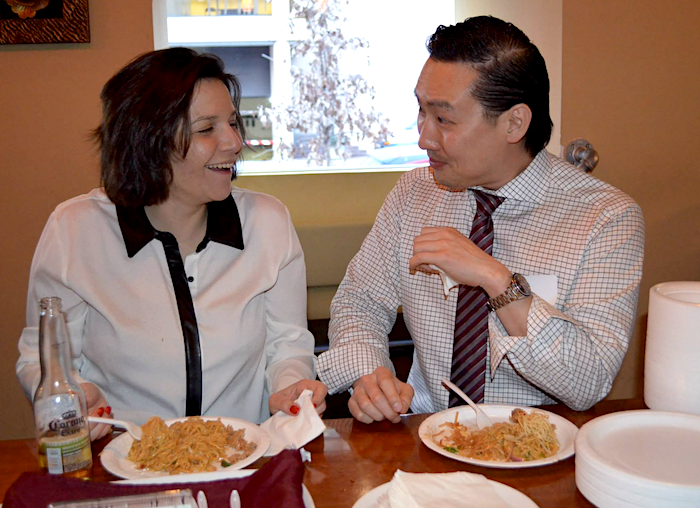
In early February, I invited food bloggers Jackie Woodbury, Bindesh Shrestha, and Simone Griffin, whom I had worked with on a writing project eons ago. I had not seen her since she spent a year working in China, and Simone loved Asian noodles.
Simone & Jackie reviewing menu with Wirut at Absolute Noodle
Working with Wirut also opened the door to working with their sister restaurant, Absolute Thai, down the road and owned by the couple Nay and Poupee.
Poupee showed me their outdated website. “We need to photograph all the dishes on our menu. Americans find Thai names long and confusing.”
March 11, 2014
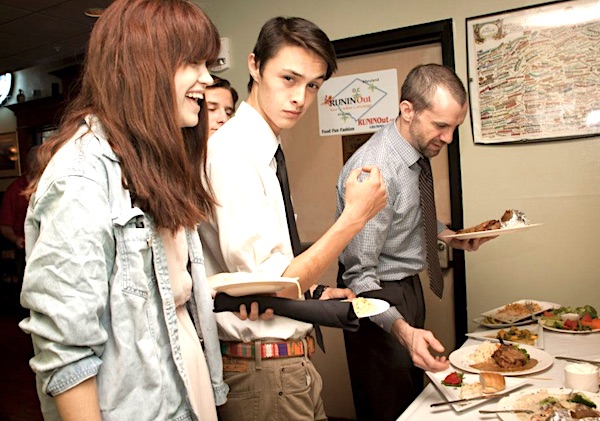
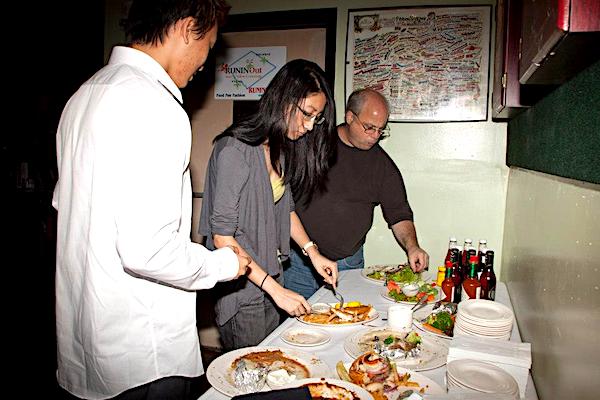
I was expecting a large turnout. I invited a lot of friends as well as marketed the event on Meetup. For $5, you got a good sample of a wide variety of dishes from the menu.
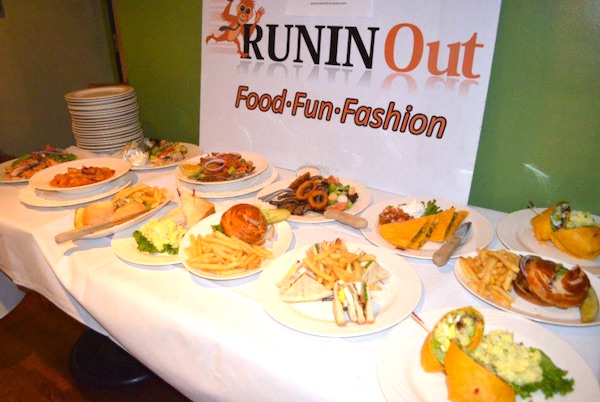
The drunken noodles were perfectly spicy, smothered in basil chili oil. The pad see ew’s sauce was sweet and savory. The red curry with roasted duck was creamy with big chunks of pineapple. The curry puffs were crispy and flaky and stuffed with flavorful chunks of goodness.
Owners Nay and Poupee were happy to showcase their savory, spicy flavors to an eclectic group of desk jockeys who were delighted to get out of their cubicles and into the mix.
And I was pleased to greet every one of them.
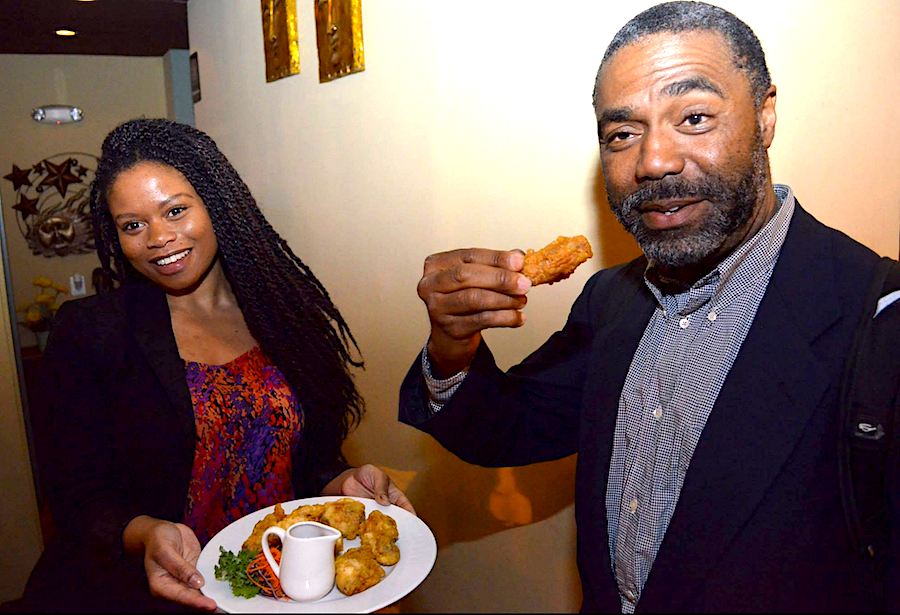
Kanita serving Orlando Thai crispy wings
Kanita Williams enjoyed the Thai basil fried rice, and the crispy chicken wings with sweet chili sauce poured on top. “Helped a client get a DUI case dismissed today. It wasn’t easy, so everybody here, please catch a train or taxi home.”
“I’m walking, but if I ever get busted for a DUI, I want to be represented by you,” Orlando Darden said as he picked up a piece of chicken wing.”
Quentin Edwards took a bite of his shrimp spring roll dipped in peanut sauce. “Hey, Orlando, careful; those wings may be loaded with MSG.”
“That’s ok, cuz tomorrow, Kanita and I are going for a long run. She’s getting close to fulfilling her 10 lbs weight loss challenge. So I’ll allow her to splurge on special occasions.”
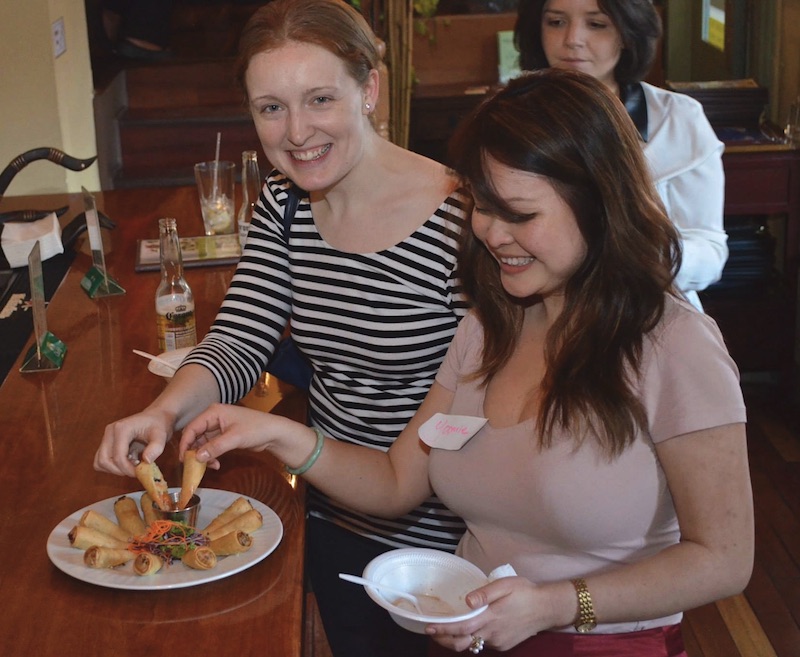
Jackie, Sophie & Yoomie
Jackie took a bite of her crispy vegetarian spring roll. “I’ll say this is a special occasion — a lot larger than the noodle place down the street. We must host an event together sometime.”
This event proved that Thai cuisine is loved by people from all around the world.
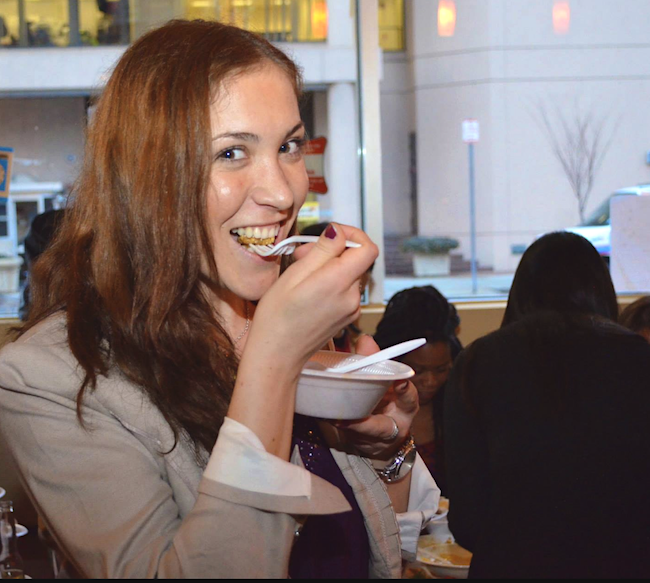
Natalia from Ukraine
There was Natalia, a woman from Ukraine, a graduate student at GWU who worked as a bartender at the Tabard Inn, a classic boutique hotel near Dupont Circle.
Sophie Mebarki & Timothy Kim
And Anne-Sophie Mebarki, a French girl who would be completing her bachelor’s from Catholic University this May. “I would like to work for a startup, and I love food. Are you hiring?”
“Absolutely, we have internships available. You should meet Suzannah, who speaks French fluently.
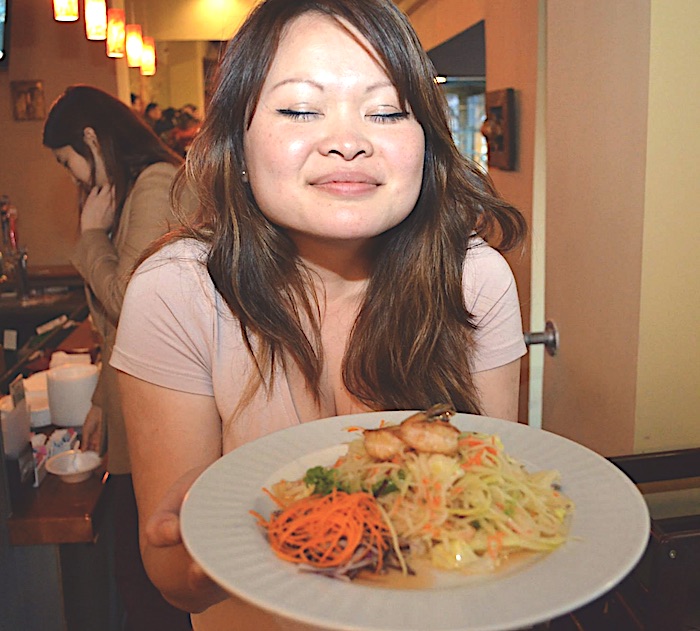
Yoomie Huynh admiring the shrimp noodles
Yoomie Huynh immigrated to Sioux City, Iowa, from South Vietnam with her family in 1985 due to the economic and social aftermaths of the Vietnam War. “Have you heard of Four Sisters in Virginia? Their family serves amazing Vietnamese dishes beyond pho.”
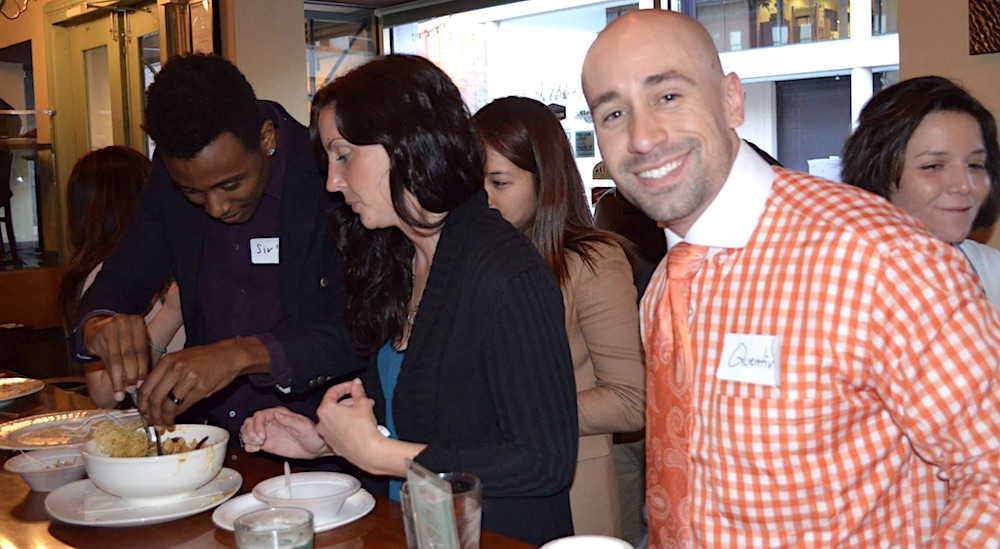
Then there was Quentin Edwards, who lived just a block from me in Anacostia. His Federal Emergency Management Agency (FEMA) office was a block from the Smithsonian Air & Space Museum. “I work only seven blocks from Chinatown, so I can come to more of your events.”
Quentin Edwards @ Absolute Thai
“Well since you love to run, you are welcome to join our EU Embassy Run this May? It’s kind of like a half marathon combined with an adventure race.”
“Absolutely, I’m planning to do a Tough Mudder this fall, so this will be a good forerunner.”
As I walked Georgia towards the park on Meridian Hill, we could hear the sound of the drums reverberating louder and louder embracing body and soul.
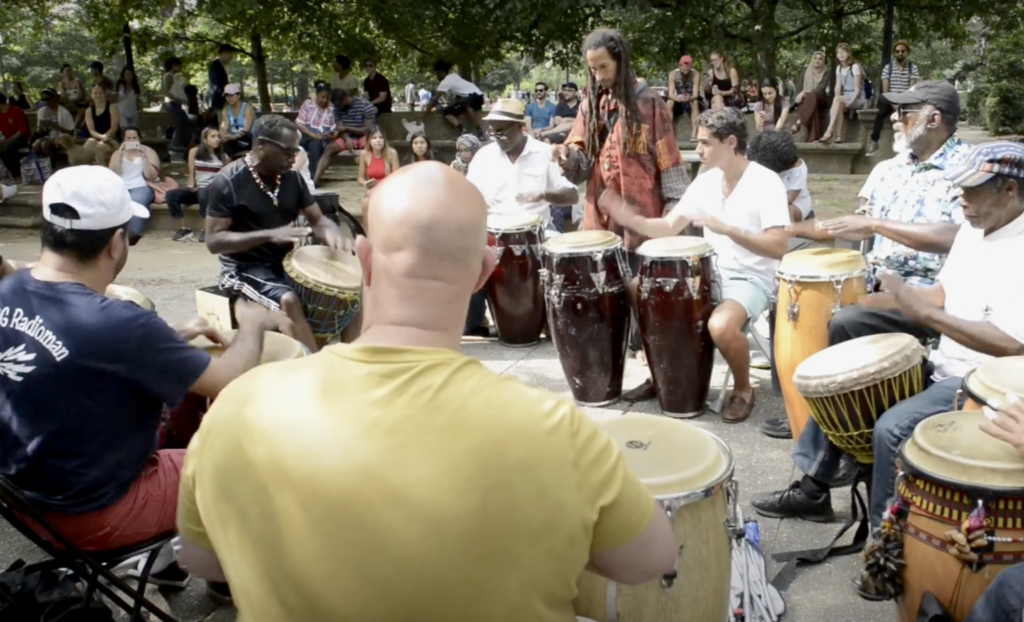
We passed a 13-basin cascade fountain at the bottom of the park, then climbed up the staircase. Once we arrived at the upper garden, we were mesmerized by an energetic group of drummers gathered loosely around a tight circle. There was a broad range of musicians with instruments of all shapes and sizes, such as cowbells, wooden sticks, gourd rattle, and egg shakers weaving West African rhythms together like an elaborate African tribal dress.
It was a kaleidoscope of drummers, dancers, acrobats, and artists. Nearby, merchants set up shop by the equestrian statue of Joan of Arc riding into battle. Hippie chicks with locs selling cannabis-infused baked goods. Yogis communed in restorative meditation. Friends and family held light conversation, listening, reflecting, collaborating, relaxing. People riding bikes, flipping skateboards, walking dogs – plenty of action to keep Georgia enthralled.
The drum circle originated during the civil rights movement in the 1960s as a celebration of black liberation. On February 12, 1965, the day that Malcolm X was assassinated, drummers joined in the park to memorialize him, and since then the kaleidoscope of drummers, dancers, jugglers, acrobats, and artists has been called the Malcolm X Park Drum Circle. Today, drumming has provided a way for Black Washingtonians to connect with African culture. And for White Washingtonians, a way to embrace the long history of the Civil Rights struggle in the city.
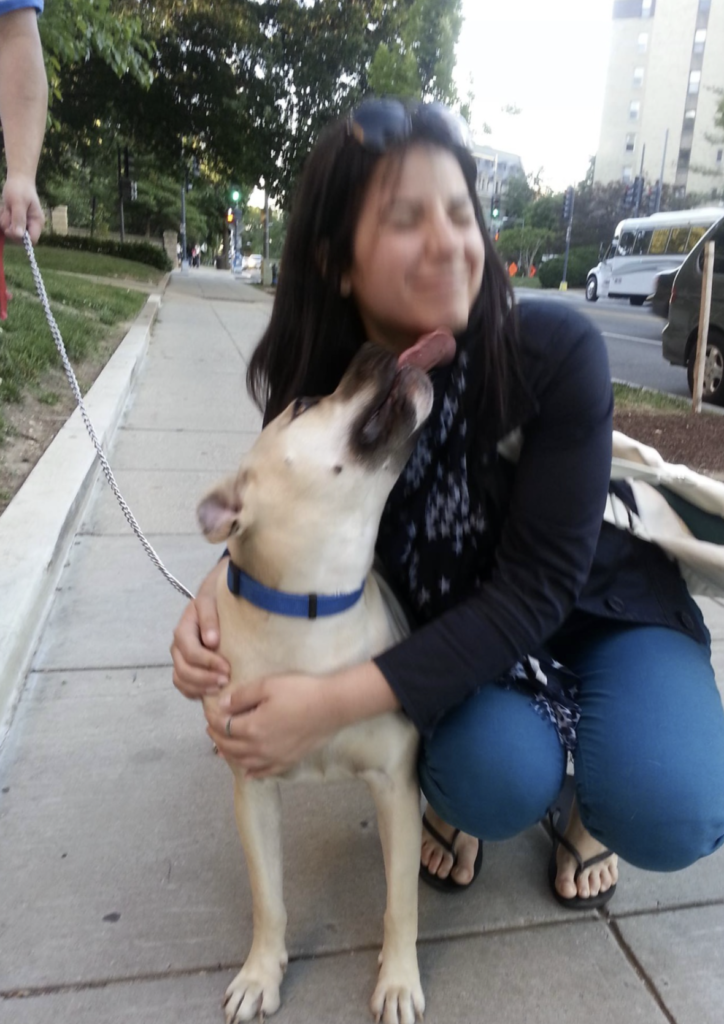
Sonia was happy to see Georgia, and my Pitbull Lab mix was thrilled to greet her, frantically wagging her tail and giving her bestie a long, wet, sloppy embrace.
Georgia smooching Sonia
I couldn’t help but move to the beat as I felt the rhythm of the drums reverberate down my spine “So many different people from different backgrounds and walks of life coming together on a Sunday afternoon to unite as one.”
Sonia moved fluidly, her arms emulating undulating waves of the ocean. “Absolutely…Drumming is uplifting for me. It’s great for my heart… it’s a wonderful art form. I’m in my joyous place.”
“This is why I love D.C. It’s such a diverse city effusing boundless energy.”
“Yes, and I do love going for a stroll with your mutt.” Or was it the other way around?
Georgia enjoyed taking Sonia for high-energy walks along the (National) Mall, where she always led the way, chasing squirrels and interacting with anyone that passed by. And, of course, Apollo loved interacting with others, too both but preferred to have Sonia for himself.
“Wish I could take Georgia camping to Great Falls.”
“You’re more than welcome to pick her up anytime. But Apollo might get a tad bit jealous.”
“But I live so far away in Bowie (M.D.).”
“Then you should stay at my house. I’ve got a spare room in the basement.”
“I will never live in Anacostia; it’s an art and craft desert there.”
“Maybe in the past, but the talent stream is rising. Young people are moving in droves, and there’s a big art movement afoot.”
“But isn’t it dangerous? Has anything bad ever happened to you?”
“Yes, I was mugged in 2008. I was stepping from my car when I saw a guy walking in front of my house. I gave him eye contact and said, ‘Hi.’ The next thing I know, he put a pistol behind my head and followed me inside my house where he grabbed my laptop and both my house and car keys.”
“Wow! Did he ever come back?”
“Thankfully, I never saw him again.”
“Surprised you didn’t move out?”
“Though it was unfortunate, I condemn the act, but not the person.”
“So, if you saw him again, what would you do?”
“I would say ‘Hi’ again and ask him how he’s doing. Tell him I forgive him and ask how I can help. People are building bridges in my neighborhood now and in areas east of the Anacostia River. We’re products of circumstances and history. And the same problems that exist in Anacostia apply everywhere. My community is a place where people are reaching out, and it shows the possibility of change and a beacon of hope.”
“That’s the most beautiful thing I’ve heard you say.”
“Well, I didn’t say it. I credit Arthur Magee from Belfast, Northern Ireland.”
Since we brought Georgia to Meridian Hill Park last week, it was Apollo’s turn for a night out.
April 14, 2012:
A little after 9 pm the following Friday, Sonia and I walked into a run-down building on Shannon Place S.E. called the Lightbox.
Sonia had low expectations, but she was blown away by the vibrant atmosphere upon entry. There was live music, dancing, performance art on display, a Busboys and Poets pop-up restaurant, and a tight-knit community in an old police storage warehouse. Just like in Meridian Hill Park, the beat and rhythm of the music were entertaining and stimulating.
“Lumen8, what an interesting title.”
“It’s quite symbolic. Lumen is a measure of light equal to one candle’s intensity. The number 8 represents Ward 8, the city’s poorest and most deprived ward. But phonetically, it also brings to mind ‘illuminate.’ Based on other all-night arts events throughout the country.”
Anacostia may have a bad reputation, and the residents long to shed our rugged image. Some people across the river treat us like we’re second-class citizens. But we’re no different than anyone else. We enjoy quality art and music, and on April 14, the community brought that talent across the river to Ward 8.
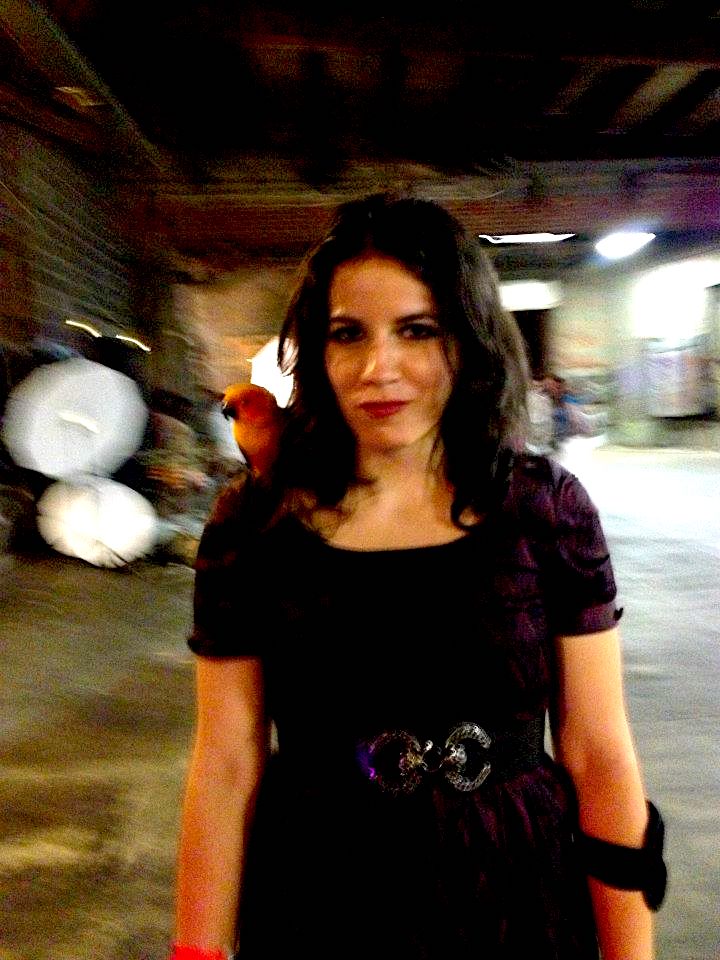
And Apollo, as usual, served as the friendly ambassador flying around the warehouse, uniting people together like birds of a feather.
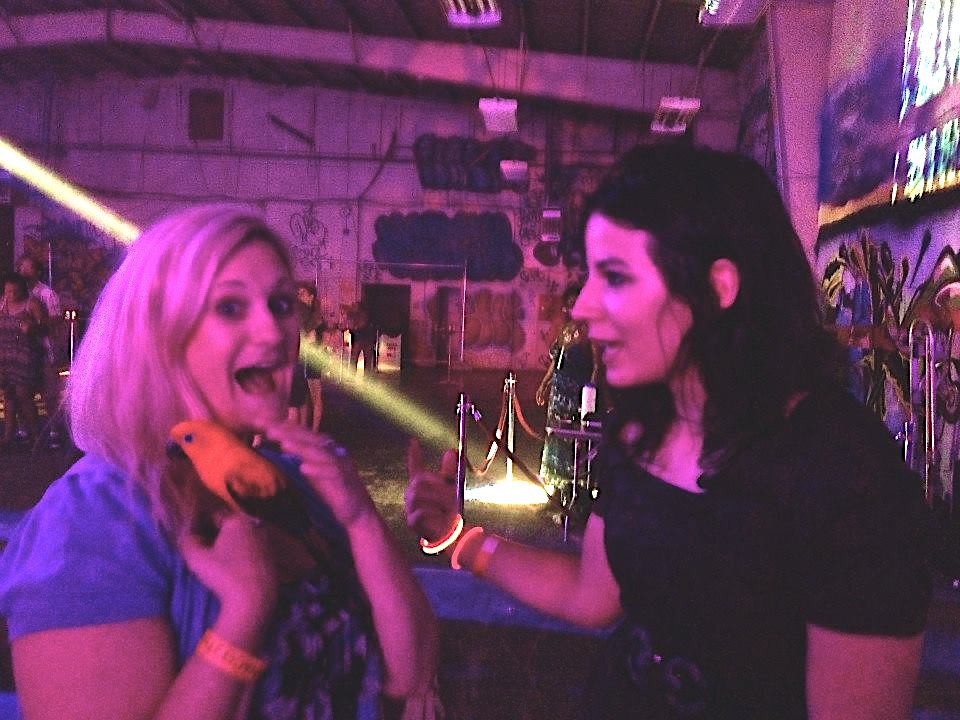
I was on the way to the cash bar to grab some rum punch when a high-pitched shriek startled me. I turned around to see Apollo had jumped on Sonia’s friend, Warrie.
“I knew I would be hit on tonight, but I wasn’t expecting to be dive-bombed by a parrot.”
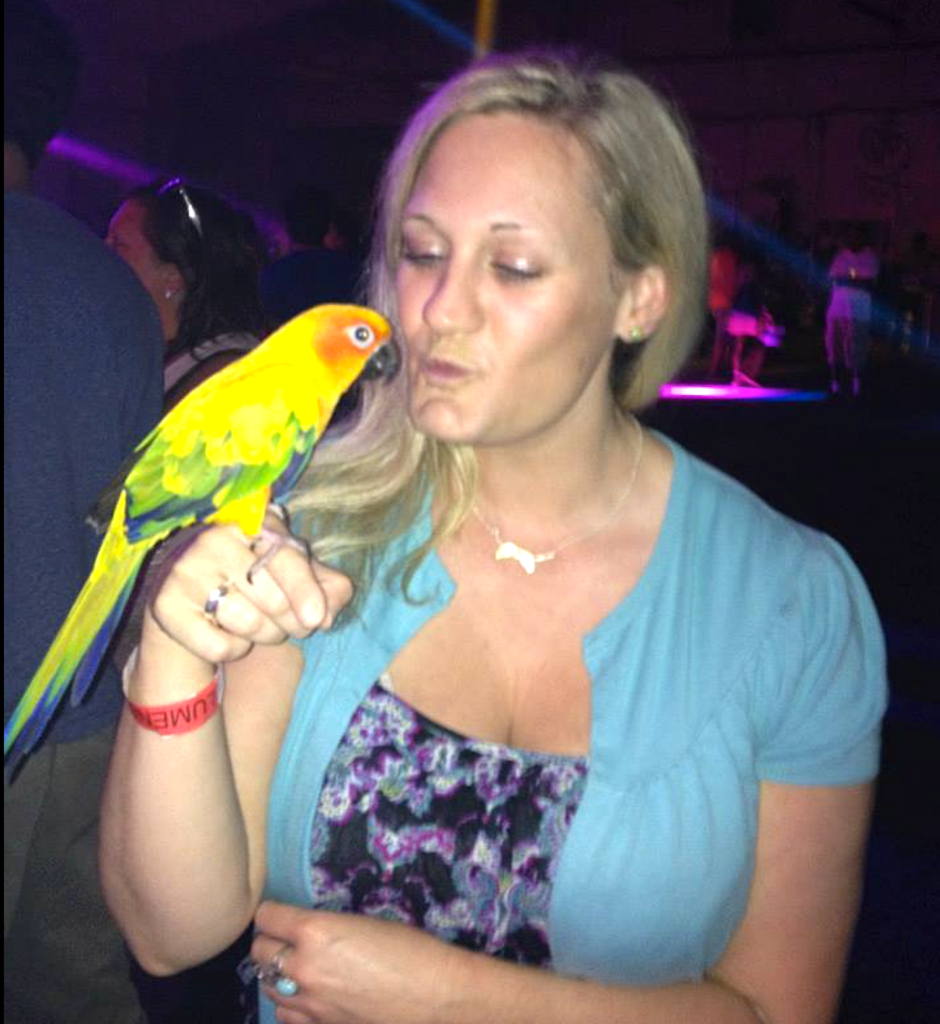
“My apologies, Apollo only picks the prettiest girls. And no offense Sonia, I think he prefers blondes.”
When I returned with the drinks, Apollo had already started to cozy up with Warrie, who was in the midst of deep conversations with Sonia.
“I moved from Virginia Beach to D.C. on a whim four years ago, and it was one of the best decisions I’ve made in my life. I still remember wise words from a friend, when I said, ‘I never would’ve chosen it.’ And he said, ‘Well, it chose you.’”
Sonia took a swallow of her punch and winced “So happy you found your happy place.”
I nodded with a smile then took a big gulp — the pineapple juice and grenadine tasted so sweet and rewarding “Housing is exorbitant here, but there are great deals to be had east of the River.”
Warrie carefully nursed her drink keeping a distance from Apollo’s cunning beak. “Hopefully, Lumen8 can attract different people to cross the bridge and realize that Anacostia is not so scary after all.”
Two Blondes enjoying each other’s company
I wholeheartedly nodded in agreement. “So what do you do for a living?”
Despite her best attempts to hold him back, Apollo had managed to steal a quick kiss from her. “I’m a dental hygenist.”
“Be careful he loves to peck between your teeth for food — he works better than dental floss. And what do you like to do for fun?”
“I love attending concerts and dancing my heart out. I never feel so full of life as when I’m spinning on a dance floor.”
“Well, tonight is your lucky night. Apollo loves to bust a move. How ’bout you Sonia. What type of art do you participate in?”
“I teach yoga. I play the violin, and I enjoy belly dancing.”
“Geez. Belly dancing? What’s the appeal?”
“It’s an ancient art form that crosses many boundaries. Come to my gig next month, and you’ll see it first hand.”
Tel’ Veh, a Turkish restaurant on the cutting edge of the Mount Vernon Triangle, was popular with guests due to its exotic, Mediterranean cuisine and generous happy hour specials. The taverna was contemporary but not overdone. Unlike other restaurants closer to the Verizon Center hub, it was graced with colossal, beautifully curved windows and tall ceilings adorned by a centerpiece chandelier. Tonight the venue was filled with revelers swaying to the harmony from a Turkish guitar and a lively street drummer. Together they formed a melodic duet deriving their rich tunes from the romantic Balkan peninsular. But the acoustics and drums were not what the packed crowds came to exuberate.
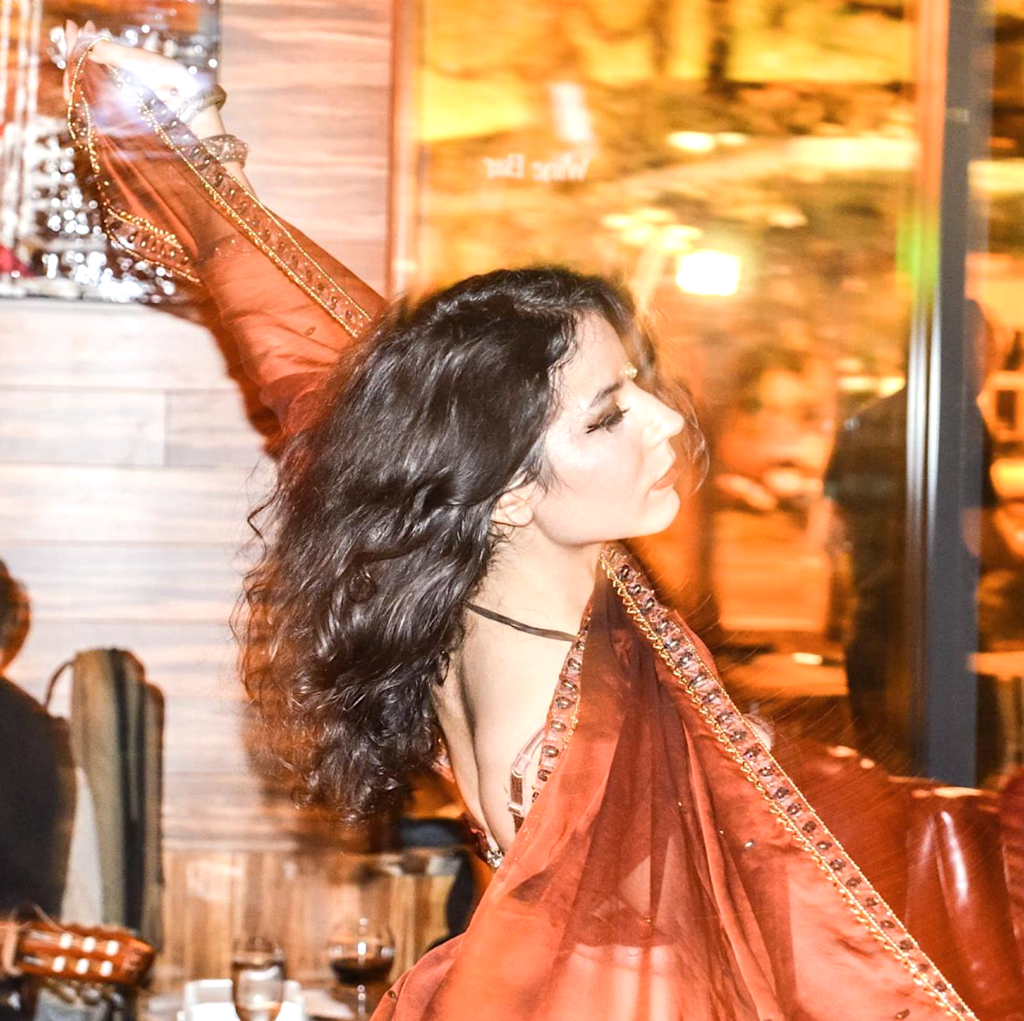
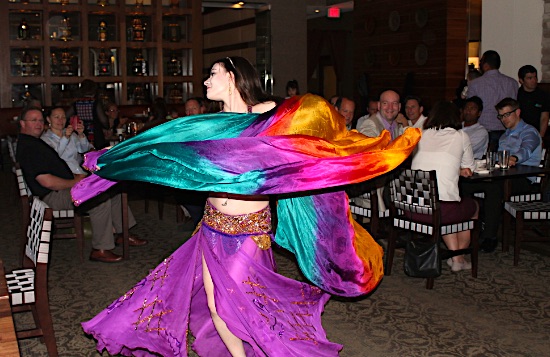
Sonia belly dancing — Courtesy of Chai Dynasty
The graceful Sonia was gyrating in the center of the spacious dining room, skillfully spinning while tossing her shiny veil over her voluptuous shoulders. Through her dramatic hip movements and sensuous shimmies, her sinuous flow evoked mystery and artistry.
The guests cheered enthusiastically, adoring every detail of her choreography, chanting and clapping with each hypnotic movement. After a tireless hour-long performance to the high-tempo music, Sonia could walk on water, and the crowds responded enthusiastically. Sonia graciously thanked everyone in the audience, then gestured for me to come over.
“Emir, this is Chito. He does photography and websites. He manages this cool, jazzy site that will feature your kebabs and mimosas. You guys should talk.”
Needless to say, the owner was very thankful for Sonia’s performance. She had agreed to waive her fee and only work for a large tab. And he was inclined to pay back the favor by hiring me to redesign their site. I was now starting to move beyond Chinatown and was grateful to Sonia and Suzannah for providing me with solid leads and Apollo for introducing me to new friends. I hoped there would be many more belly dancing performances in the future. I hoped there would be many more belly dancing shows in the future.
The political pulse of Washington, D.C. beat strong and steady, with politics woven into the fabric of daily life. It was against this backdrop that I received a call from Jim McBride, president and founder of the grassroots organization, Network for Progress, Jim, a hope monger and change-maker deeply involved in Generation Obama, shared his enthusiasm for my events and how well our groups complemented each other.
“We have a special event in mind,” Jim began. “A Super PAC is in town and wants to host a happy hour in D.C. Someplace centrally located, good food with a breezy deck.”
Our conversation naturally turned to politics, as it often did in this town. The Super PAC aimed to encourage Joe Biden to run for the presidency, just in case Hillary’s email server controversy jeopardized her chances. The idea was not only to support Biden but also to honor his late son, Beau Biden, through a fundraiser for the Fisher House Foundation . The Bidens’ commitment to serving military families made it a fitting tribute.
June 4, 2015
Will Pierce, a tall 26-year-old with a beaming smile is also a veteran of the wars in Afghanistan and Iraq and has worked for Hillary Clinton’s campaign in 2008 and volunteered for Obama’s that same year. Recently, he took on a new role, becoming a dedicated advocate for Joe Biden’s potential presidential run. Will’s passion for seeing Biden enter the race and his belief in the positive change Biden could bring to the country drove him to form the Super PAC “Draft Biden.”
“We don’t want to see another Bush or Clinton in the White House,” said Will. “We’re trying to show Biden that the majority of Americans would welcome seeing him run.”
Will, reflecting on Biden’s life and challenges, commented on how difficult it was to decipher the Vice President’s thoughts at that moment. Despite the unimaginable tragedy of losing his wife and one-year-old daughter in a car accident back in 1972, Biden didn’t step back or resign. Instead, he transformed that heart-wrenching experience into a source of strength, propelling him forward into a career dedicated to public service.
Jim expressed his satisfaction with the amazing turnout and the overwhelming support that poured in following Beau’s tragic passing. He believed that this groundswell of affection and encouragement might persuade the Vice President to enter the race for the presidency.
Surprisingly, even amidst the weight of Beau’s untimely death, the atmosphere was far from somber. The event managed to draw the presence of many attendees, including familiar faces like Mike Araman, Kobe Owens, Sue Schwartzberg, and Leonard Tyson, creating a sense of camaraderie and shared purpose during this pivotal moment in American politic
“I would support either Biden or Clinton in the White House,” said Mike, a seasoned political enthusiast, his confidence in his choice evident. “Whoever wins the GOP nomination won’t stand a chance against any of them.”
“There are too many seats in the Supreme Court that is up for nomination next term. We definitely need a Democrat in the White House,” said Leonard.
By the end of the night. A sizable amount of money was raised to provide free or low cost lodging to veterans and families receiving medical treatment. Supporters gathered to honor the Biden family’s contribution to the nation and support a great cause in memory of a great man, and everyone seemed to have a good time mingling and catching up with old friends.
A couple of months later, another call from Jim.
“August 6 is the first Republican Primary Debate,” Jim announced. “It’ll be a GOP Clown show for sure.”
“Yes, it’s hard to believe that Donald Trump is leading in the polls and lapping Cruz by double digits.”
“Can we host a rooftop event where we’re offered a panoramic view of the Capitol?”
Armin Armin of Chaplin’s recommended I visit Cambria hotel down the road. “It’s where I stay when I’ve knocked back a drink or two, and I’ve gotta get up early in the morning. They have an indoor rooftop pool and a nice lounge with a stellar view of the city.”
“Great suggestion, the Cambria near the D.C. Convention Center is the perfect location,” Jim responded.
“I’ll talk to Evan Walton, the Director of Food and Beverage to see if he can offer specials on select apps and bar drinks.”
“We also would like to televise Jon Stewart’s last ‘Daily Show’ after the Debate. He’s bidding farewell that night.”
“He’s a legendary pundit and BS caller. We’ll definitely miss him.”
“Yup after watching ten candidates for four hours play musical chairs, we”ll be bored to tears.”
“Well, music always goes well with politics and allegiances are expressed well in song. Lemme tap into my Rolodex and contact a few musicians who can add joviality to the evening.”
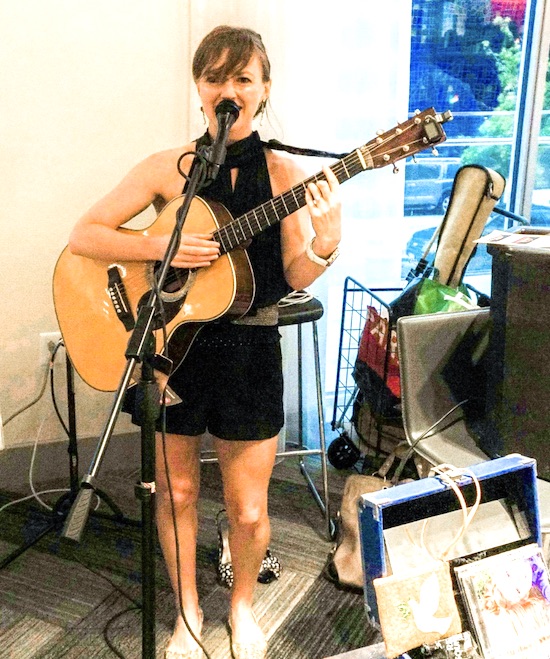
I remembered watching Flo Anito perform at the H Street Festival and enjoyed listening to her Jazz Pop on keys and guitar. Her raspy voice was addictive, and she has a large vocal range (3.5 octaves) reminding me of the highly expressive voice of Fiona Apple.
Flo Anito singing ‘No Dust Bunnies’.
Classically trained in voice, piano, and ‘cello, Flo began her singer/songwriter career at age 16 when she got her hands on her first guitar. She graduated from Wesleyan University in Connecticut with a B.A. in Music, and has lived and performed in the D.C. area ever since.
Flo has graced some of DC’s biggest stages: Strathmore, Wolf Trap, Merriweather Post Pavilion, the Birchmere, Blues Alley, the Fillmore, Hamilton Live, and Bethesda Blues & Jazz as well as dozens of annual festivals in the DMV.
“We’d love to be a part of this great event. I’ll make sure we have some exciting specials on apps and drinks for the evening. It’s going to be a fantastic night,” said Evan the food and beverage director.
A week before the event, we were pleased to see that over 100 had RSVP’d and the numbers just kept rising.
Jim exuded a big smile. “We’ve never gotten this kind of response for any of our events, not even the State of the Union or our annual Charity Date Auction.”
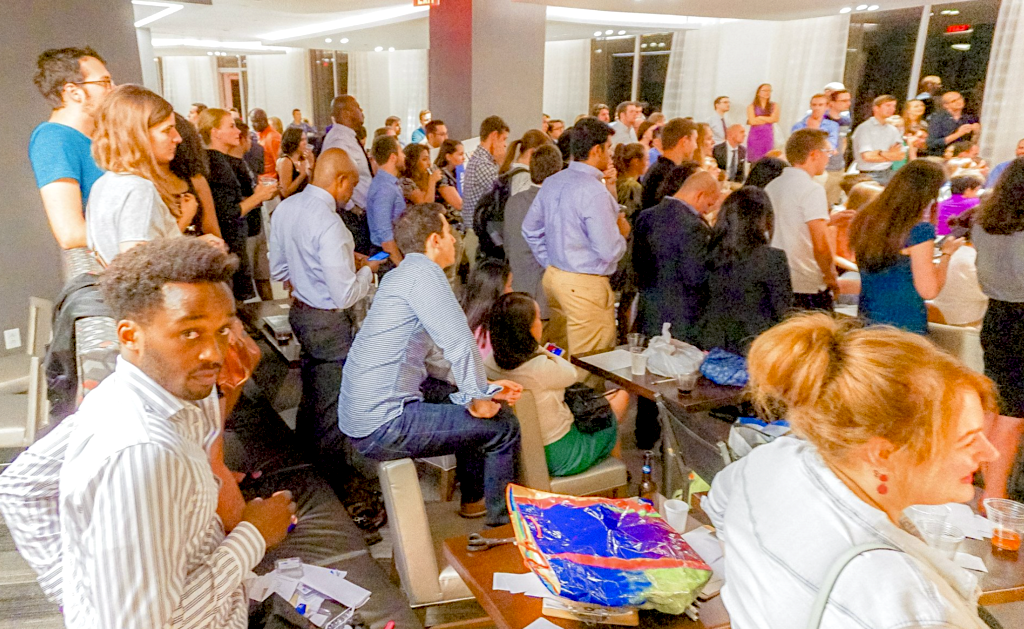
By the end of the night over 500 people had congregated at the Cambria some socializing and networking, some fully absorbed in the Debate, many enjoying the jazzy tunes from local favorite, Flo Anito belting out originals such as “Uh Oh!” and “Man of the Year” from her amazing album “No Dustbunnies”
We’ll have a big romance, straight off the silver screen
We’ll have a picket fence and the lawn of Kelly Green.
And I’ll sing my happy tune as I push my vacuum
And I’ll dust every room, you won’t find no dust bunnies.
“Thank you all so much for being here,” Flo expressed her gratitude as she took a moment to address the crowd. “Your energy is infectious, and it’s an honor to be part of such an exciting event. Let’s keep the spirit high and the music flowing!” With a beaming smile, she launched into another soulful melody, enchanting the audience with her captivating voice. When Flo sang, there were shades of Adele and Regina Spektor, and she created something new that captivated the audience.
Jim clapped exuberantly. “You were superb Flo. You should do more political functions. You’ve brought excitement to a boring debate.”
The turnout was extraordinary. It helped greatly that our event got a lot of play in the Wall Street Journal, D.C.ist, and other local media. For many Millennials, they were still in high school when Obama won the election and their vote would be critical in deciding the dynamics of the election.
When it was Trump’s turn to talk, he was greeted with a cacophony of boos.
“No way, will Donald Trump win the GOP nomination,” Mike Araman remarked.
A random intern chimed in, expressing their disapproval. “He’s a racist, sexist, ignorant, and divisive,” they remarked, mirroring the sentiments of many at the gathering.
Mike leaned forward, his eyes reflecting a mixture of excitement and concern. “You know, guys, this election season is turning out to be quite a show. Trump’s surge in the GOP has certainly made this race far more interesting. But whether he goes up against Hillary or if Joe Biden decides to enter the race, we’re in for a fascinating political showdown.”
The room fell into contemplative silence for a moment as everyone absorbed Mike’s words, knowing that the future held many uncertainties and potential twists in the political journey they were all embarking upon.
Jim chimed in, “These debates and events are essential in shaping the public’s perception of the candidates. It’s not just about the candidates themselves; it’s also about the voters and what they want to see in their leaders. That’s why events like this one are crucial in the lead-up to the election. They provide a platform for discussing the issues that matter to the people.”
Jim had a remarkable knack for always offering witty and pertinent comments at precisely the right moments. He had an inherent ability to infuse both humor and insight into his discussions, creating an engaging atmosphere for everyone present. Jim’s passion for politics shone through in his clever remarks, leaving no doubt about his deep appreciation for the political process.
“We kept the roof open for folks to enjoy the breathtaking views and then return downstairs for the food, fun, and mingling,”
Evan noted. “We managed to set a record for the number of attendees in our first year here in Shaw, and it was truly heartening to see people from all corners of the city choosing Cambria for such a historic event.”
As the debate unfolded, it became evident who the true winners were that night – our dedicated events team, the exceptional talent, the fantastic hotel (of course), and the passionate D.C. politicos, everyone but Trump.
Jim and I left that evening with a shared determination to continue hosting engaging political events in the run-up to the elections. While the dynamics of the race were uncertain, one thing was crystal clear: the political landscape was undergoing significant changes, and the upcoming election season promised to be historic and full of surprises. The question remained: would Trump secure the GOP nomination, and would he face off against Hillary, or perhaps Joe Biden would enter the race, making it even more unpredictable?
After the summer doldrums and fall foliage blanketed the National Mall, things began to pick up at the old neighborhood pub that flew Irish colors over by the Chinatown arch.
The Oregon Ducks were ranked in the Top 10 in the AP Poll and District Karaoke debuted with weekly sing-a-longs every Monday night (that was until guests at the adjoining Fairfield Inn complained about the racket). All of this hubbub plus the viewing of each NFL game every Sunday resulted in a lot of commotion at the Irish Channel.
In Sept, we organized a food tasting event where we invited friends to meet up and sample delicious Irish cuisine.
Top foodspotter, Dan Rosenstein, photographed the dishes for RUNINOut and was happy to shoot for some grub and a pint. “I love Irish food, and I love photographing people enjoying a pint of Guinness.
The event was arranged by General Manager, Colin Laverty who has lived in D.C. for 13 years. He grew up in West Belfast during the 80s and remembers distinctly the car bombings and revenge killings.
“I’ve enjoyed my time in D.C. tremendously. Belfast was also a great life experience and my memories of my time with my family and friends are always close to my heart.”
“How is Belfast similar or different from the Beltway?”
“Some people tell me parts of D.C. is tough. They don’t realize that for 30 years, Northern Ireland was scarred by sectarian violence — a period of time we sadly refer to as ‘the Troubles.’”
“Yes, that was a very troubling time. I had the pleasure to visit Northern Ireland in 2011 to see two musician friends who I met at the Folklife Fest in D.C. I also met an inspirational tour guide named Arthur McGee.”
“Really, why was he so great?”
“Because he told me that Belfast isn’t a byword for intolerance, but a beacon for hope. The Irish are no different from any other place on earth. They’re the products of circumstances and history, and the same problems that existed in Belfast apply everywhere.”
“You’re right about that. Police brutality, such as the RUC (Royal Ulster Constabulary) supported by British troops, happens today in the US and around the world. There’s still a lot of hatred and racism that we need to get rid of.”
“Glad to hear that the future looks rosy for Northern Ireland.”
“The violence has gone away, but the rates of youth suicides in Belfast are high and rising every year.”
Dan Rosestein (right)
“The best bangers and mash, I’ve ever had,” said Dan Rosenstein. “I’m not a big sausage person, but the black pudding made my mouth water.”
Behind the bar was Cormac McGrady, a tall, gregarious man from County Down. He had a great sense of humor and always had time for a joke, even at his own expense. He was a big Boston Red Sox fan and never missed a game if they were playing the Nats in D.C. or the Orioles in Baltimore.
Tom and Colin were delighted with the large turnout, and they were inclined to dole out free food and specials for future events. I wasn’t paid in dollars, euros or pounds, but compensated with a generous bar tab which even made me feel more part of the family.
“You guys did a great job,” said Tom. “Would like for you to visit our other Irish Channel location in Crofton, Maryland.”
Colin Laverty (right)
“You should support our next fundraiser,” said Colin.
“Another food tasting or karaoke?”
“No the Belfast-Beltway Boxing Project — it’s an annual, amateur boxing competition for at-risk youth in D.C. and Belfast. The youth train at area boxing facilities under the direction of the local coaching staff, tour the region, and spend time with the host families.”
One sunny weekend during the fall of 2013. The restaurant scene in G-Town was abuzz with tourist activity. I passed Georgetown Piano Bar and then Jinx Tattoo parlor, soothing sounds of reggae music emanated from the brown brick establishment. Bandolero was next and this is where I hoped I would cut my first big deal.
I was taken aback by the “Day of the Dead” atmosphere complete with metal cemetery gates and faux animal skulls hanging eerily on the walls. The interior was dark, the music deafening, the entire ambience spooky and western-chic.
I sat at the bar and ordered suckling pig tacos and grilled corn on the cob. The bartender poured me “El Bandolero”, their house Margarita on tap. He garnished it with lime and it was delectably rimmed with citrus salt.
After my meal, I waited anxiously, wondering whether I should order another cocktail.
Luckily, when I turned around, I came face to face with the Top Chef, himself, Mike Isabella. He wore his usual gray short sleeve chef coat, his right arm adorning a brass-knuckled pizza cuter tattoo, and on his left a brand new Mexican Cowboy. He was clean-shaven and wore a big smile. But his voice was gruff and he seemed dismissive.
“Thank you for showing me your website, but we’re not interested in your service. We have our own publicist and graphic designer. Our business is doing just fine.”
“How ’bout hosting an event here, say 20-30 people, select appetizers, social media coverage, you name it?”
“You’re welcome to speak to our manager to arrange an event. But we’re quite busy as it is, and we won’t be comping any meals.”
Shortly, after Isabella went back to the open kitchen, I returned to my pedicab and quietly rode to my next stop. As I steered down L St towards the GWU campus, I passed Bar McFadden’s to my left and 51st State Bar to my right, both great establishments to catch a game after work. But for now, I had seen my share of D.C. eateries. Tomorrow, I would venture into the Commonwealth to engage with other Top Chefs.
Crystal City, VA. has for many years been the home of military contractors and govies. During lunch and happy hour, they frequently congregate on restaurant row or at José Andrés’ Jaleo enjoying traditional as well as cutting-edge flavors.
Adjacent to Jaleo on Crystal Drive was Chef Morou’s Kora, a trattoria-style Italian restaurant that opened a couple of years ago.
As I approached the street-side glass doors, fondant blue jays chirped from olive trees that billowed over the sidewalk.
When I entered, I was greeted with dangling tree branches. Glowing tree canopies created a sense of intimacy. On the wall behind the kiln-fired pizza oven, decal tree branch silhouettes conferred a feeling of calm and relaxation.
I sat at the bar and ordered a Dark & Stormy. Then devoured a slice of the chicken pesto pizza.
Minutes later, Chef Morou entered with his crisp, white chef coat and toque.
I immediately recognized him. Slim and handsome with a pencil-thin mustache and goatee. The winner of an Iron Chef America competition in D.C., Chef Morou once challenged the invincible Bobby Flay in Season 3.
“Love the ambience Morou. It’s so sophisticated and chic.”
“Thank you, I got your email and looked over your site.”
Chef Morou who grew up on the Ivory Coast, cooks like he talks “American with an accent.”
“So would love to build a new website for you to go with your contemporary design.”
“Well, I know a thing or two about tech, I studied computer science in college. But lately, I’ve been quite busy scouting a location for another restaurant in D.C. and launching my African spice lines.”
“I understand that you’re very busy. That’s why you should hire us to promote your restaurant and feature your dishes.”
“Ok, but I have a big event tonight in Farrah Olivia that I have to plan.”
“Super, Bien, et toi.”
Although Morou was still contemplating, his response was more favorable and warm. I returned to my batmobile and rode through restaurant row keeping vigilant for new clients.
The following week, I got a text message from Morou.
“Thanks for visiting. My wife, Heather, says your service is nice but unnecessary. It’s like adding oil to pasta water.”
“I know that marketing and social media is considered the low-hanging fruit, but it’s extremely valuable to boost your bottom line.”
“Just look around you. We have a lot of overhead. Our restaurant is gigantic and our ceilings are 24 feet high – you can fit a church in here. Our utility bill alone is sky high.”
“I totally understand Chef, but what if we hosted an event. We would invite 20-30 people, you comp the meals and we in return will feature your cuisine all over social media.”
The next day, I contacted Michael Galang, founder of the Thursday Connect meetup group to see if he would help promote the event. Each person would pay $20 and we would split the proceeds.
Morou was born and raised on the Ivory Coast in West Africa and learned how to cook by watching his mother prepare feasts for their large family of 33 children. When he immigrated to America in 1988, he was hired as a dishwasher at Ristorante I Ricchi and was eventually promoted when a co-worker quit an hour before opening. Eventually, Morou was hired as the executive chef for Signature. Lobbyist Abramoff, who owned the restaurant, frequently provided free meals to sway lawmakers. Tom DeLay, Bob Ney, and John Doolittle were his favorite guests
But after the scandal hit the news, politicos no longer wanted to be seen at the restaurant, and the restaurant was doomed to join D.C. Eater’s list of Closures.
On the morning of the event, there were only 10 RSVPs and a few more that indicated interest. But we had room at our table for 20, and we needed butts in every seat.
It was then, that I gave my good friend Jackie a call.
“Hey Hon, we need a big favor. How quickly can you contact your friends to come to an Italian dinner at 7?”
“I’ll go through our listserv with BookaLokal (marketplace for group dining experiences) and see what I can arrange.”
“You helped me tremendously with the Chinese feast at Ming’s, if you could pull a monkey out of the hat, I would be indebted to you for life.”
Two hours prior to the event, Michael and I waited anxiously hoping for a decent turnout. We nibbled on calamari and sipped on Heavy Sea Lager. Little by little people started to trickle in. By dinner time, over 25 guests had shown up. We had met and exceeded all expectations.
Jackie was enjoying the squid ink tagliatelle with clams and calamari. “Compliments to the Iron Chef. So why did you name your restaurant Kora?”
“Our first restaurant was Farrah Olivia, named after our first two daughters. You can see a portrait of our three-year-old daughter Farrah on the wall.”
We turned our heads and admired the Andy Warhol-like portrait of Farrah.
“Our third daughter’s name is Kora, and the only thing she eats is pasta.”
Samantha Elizabeth took a sip of her Arnold Palmer “The salmon penne pasta and chicken marsala were out of this world. Cooked perfectly with large portions and reasonably priced. The sauteed mushrooms in marsala sauce over a pan-roasted chicken breast was incredible.”
“So glad you came Sam, and thanks for bringing your friends.”
“Absolutely, I told them about the citrus burst dessert and they all had to try it.” (a slice of lemon cake topped with white chocolate buttercream and shavings served with a scoop of lime sorbet and Grand Mariner infused mandarin oranges.)
We were able to photograph all the dishes and we were able to garner all the content necessary to feature them on RUNINOut.
Unfortunately, Suzannah couldn’t make it. She planted the idea of visiting celebrity chefs but she was now working on her own startup idea. I didn’t expect to keep someone that talented for very long.
And Jackie, who came through in the clutch, did not have to pay a dime. All her food and beverages were comped by me. She had become my go-to miracle worker, and someone I would rely on whenever I got in a jam. There would be many more jams and like a 9th inning relief pitcher, we hoped to escape them all without allowing a run.
“What a smashing event. What’s next on your plate?” Michael asked.
“Haven’t given it much thought. It’s football season, so perhaps a Florida Gators watch party?”
“Yeah, sports is nice, but you can’t always rely on me to help out,” Jackie commented.
“I could use ten of you, frankly.”
“Then you should interact with the D.C. food bloggers. Chef Morou and other restauranteurs like him need lots of coverage and publicity.”
Michael took a sip of his Blue Moon. “Have you thought about hosting a comedy night or feature live entertainment?”
That was an interesting suggestion, one that I would have to ponder.
After dinner, there wasn’t much nightlife activity on Crystal Drive, so Jackie and I and a few others crossed Route 1 to 23rd St where there is a small, bustling enclave with a bundle of hookah shops and international eateries
Right in the center stands Freddie’s Beach Bar, Northern Virginia’s longest-running gay bar. The beach-themed, purple-lavish bar is adorned with rainbow flags and pink flamingos. Freddie Lutz, who grew up down the hill, has owned the business for over 12 years. He is an affable man, a respected community leader and has been working in the industry for over 35 years.
He opened Café Italia 20 years ago and then decided to open up a Gay bar up the road.
Before the repeal of “Don’t Ask, Don’t Tell” many gay service members were in the closet. All it took was someone to even think you were gay to snitch, and you would be facing a bad conduct discharge. That’s why Freddie’s served as a safe refuge because it was advertised as a “straight-friendly” bar. This gave everyone protection – they won’t have to worry about being caught because straight people went there too.
When we walked in, we knew right away we were going to have a blast. The bar was filled with patrons knocking back pints of Devil’s Backbone. A Ballard from Doris Day was belting in the background.
We found Freddie himself going table to table, mingling with customers like he was running for mayor of Crystal City.
“Freddie’s is the most diverse bar in the DMV. It bridges the gap between the straight and gay communities – that’s one of the most magical things about us.”
After chatting with Freddie and ordering our beach-inspired cocktails, I came upon two of my friends who had actually been my tenants for the last eight years.
Dywayne and Ty were enjoying the music, ambience and cuisine.
“We just came from dinner at Kora just across Route 1. You guys need to come to one of our events,” I suggested. “How’s Wade Road?”
“Everything in the apartment is fine. I will pencil that in on our calendar. By the way, you can come by Home Depot sometime and pick up your rent,” Ty said. “Unless you just want me to mail it to you.”
“Home Depot is fine. I gotta buy some supplies anyway. Can I find you at the Customer Service Desk?”
“Absolutely. You know which days I’m off. I can’t hide from you.”
“Freddie’s is such a great place to get together. We need one of these in every city,” Dywayne said.
“Couldn’t agree with you more. It’s such a great atmosphere.”
Despite Freddie’s popularity, gay bars today are dwindling since many bars have accepted the LGBTQ culture and have adopted drag shows to their regular performances. Freddie’s has been a huge building block for the community and fortunately will be here to stay.
“Next time, you have a craving for pasta, visit Café Italia down the road. They’ve been a fixture here since 1976.”
“Will do. And thanks for bridging the gap in our community.”
“Thanks for coming over,” Freddie said. “See you at Freddie’s Follies on Saturdays.”
Back then Freddie’s and the D.C. sports bar Nellie’s were one of the few venues that featured drag brunch. Now it’s so popular, that mainstream venues are serving up drag with their eggs benedict and mimosas.
On November 11, 2013, Super Typhoon Haiyan slammed into the Philippines causing massive loss of life and a trail of destruction in its wake. Battering the archipelago with wind gusts of up to 168 mph, it was the deadliest cyclone on record. I, along with my expanding network of Fil-Am friends watched in horror as the island nation struggled to bury the dead and deliver food, water, and medicine to the suffering.
So I was encouraged with hope when I got a call from my veteran friend, Kim “Dancing Queen,” a self-proclaimed musical arts fanatic, foodie and lover of anything Asian, particularly Cantonese.
“Have you ever visited Medaterra in Woodley Park?”
“Afraid not. I normally stay close to downtown. I don’t venture that far north on Connecticut Ave.”
“Well can you please reach out to the owner, Angela? She wants to host a fundraiser for the Philippines typhoon relief, and I thought you would be the perfect choice to spearhead it.”
“I’m deeply honored that you would help out. I will contact her first thing.”
Angela was happy that I agreed to spearhead a fundraiser. “Post an ad on Facebook. Let them know that 50% of proceeds of food and drink will be donated to AMCROSS.”
Angela and I also reached out to all the Filipino-American groups as well to a vast variety of meetups in the area, and we were delighted that over 100 people came to dine and donate money. By the end of the night, we had raised $1,200 for the American Red Cross, and Angela Aly was thrilled. “The event was enormous, and you executed like a champ.”
“My heartfelt thanks to you for offering your space and amazing specials. I appreciate Kim for reaching out to me and my gratitude for everyone who showed up and provided unconditional support.”
“Yes, the donations will help tremendously and we’ll keep praying for the victims for basic supplies, comfort, and healing.”
“Without a doubt. Say, so how’s your cafe doing? Do you get a lot of foot traffic at lunch and after work?”
“Some, but the young folks prefer to hang out on U St, H St, and 14th St nowadays.”
“Well, lemme see how I can help you. We’re pretty skilled at leveraging social media so we can place butts in seats for those strolling casually down Connecticut Ave.”
The following week, I pitched camp at the Mediterranean bistro taking pictures of dishes and featuring them on the website. In my free time, I would ride my pedicab through Woodley Park, picking up riders who didn’t want to walk the half-mile uphill from the Metro to the Smithsonian Zoo. Connecticut Ave is lined with restaurants and sidewalk cafes and there was plenty of foot traffic after work and on weekends.
I also took the opportunity to visit neighboring restaurants in the rustic enclave including the Lebanese Taverna, Open City, and the Afghan Grill. Woodley Park was a small village bounded by Rock Creek Park and the zoo. But it was an international hamlet with ethnic cuisines from all corners of the world.
The Lebanese Taverna serves classic, Mediterranean cuisine in a modern, contemporary setting. In 1976, Tanios and Marie Abi-Najm boarded a cargo ship in the dead of night with their five children to escape the civil war in Lebanon. After working at local restaurants for three years, they saved enough money to purchase the Athenian Taverna in the Westover neighborhood in Arlington, VA. They made a modification in the sign to read Lebanese Taverna and the rest is history. Today, the business has bloomed to six restaurants, four cafes, and a market and deli.
The chicken shawarma was roasting on the pit with onions and cherry tomatoes embedded in between slices to give it a juicy flavor. As the inverted cone of meat turned slowly on the rotisserie, the chef deftly sliced thin shavings from the outer layer to make the crowd favorite, doner kebab.
At the bar, a stylishly chic couple started off with the bread – a football-shaped pita of hot, chewy goodness which they dipped in hummus with the right amount of tahini and olive oil.
Then as an appetizer, they ordered shawarma sliders with hot slices of lamb stuffed inside a soft pillow of bread.
The entree was braised lamb shank with white wine, the tender chunks were falling off the bone. They made room for dessert — baklava, phyllo dough stacked with honey, and pistachios to cap off a perfect meal.
I sat at the bar and ordered an Almaza, a mild and smooth Pilsner brewed and bottled in Lebanon.
[ Image: Screen Shot 2022-02-05 at 1.33.17 AM.png ]
Lebanese Taverna bar
I visited the manager, Charlie Ayoub. “What’s RUNINOut, and how do I know you’re some fly-by-night operation.”
“Well, we have hundreds of thousands of users in the D.C. area and we were just selected ‘Best of D.C.’ in the Readers’ poll.”
“How good are you with managing events?”
“Well, we just organized a fundraiser at Medaterra across the street and raised $1,200.”
“Alrighty, hot shot. Let’s see if you can arrange an Arabian nights themed party for us.”
I looked at Charlie wide-eyed and baffled. Did he want fire dancers, sword jugglers, snake handlers? Perhaps I could ask some of the folks from the drum circle in Meridian Hill Park to participate. We can set up henna art and have tarot card readings. Maybe I’ll bring Apollo and have him fly to different customers and eat their pita bread dipped in olive oil.
“Oh certainly, Charlie, there’s no event no matter how wild or exotic that I can’t handle.”
“Super, traditional Arab folk music with Raqs Baladi please.”
I immediately called Sonia Herrero.
“Raqs Baladi—that’s Egyptian belly dancing,” she informed me with a chuckle.
“Well can you help out a hopeless fellow? I’ll let you take Georgia out for a hike.”
“Would love to, but I just started a new job at the Department of Education, so I can’t commit right now.” However, I would love to see Apollo.”
“Cool, let’s make a date to go biking, and he’ll tag along.”
“Nope, busy.”
“Well, we got the EU Embassy Run in May, and all the Embassies love to see Apollo.”
Next, I called Angela and briefed her on my meeting with Charlie.
“Don’t stress out. I’ve got the perfect solution for you.”
She wrote down a name and number on the back of the menu. “Asala, call her, see if she’s available.”
I dialed the number with trepidation.
“Hello, who’s this?”
“Umm, this is Angela’s friend from the Medeterra. Do you know anything about an Arabian Nights performance at the Lebanese Taverna?”
“Wait, are you the fella riding the pedicab up and down H St during the summer Fest?
“Yes, the one with the squawking parrot that matches the color of your veil.”
“Certainly, I would be happy to dance at your event. As long as you’re able to make the arrangements behind the scenes.”
Raqs Baladi is an Egyptian dance that originated several hundred years ago performed by ordinary countrymen and women during gatherings and celebrations. Women moved core body parts like the spine, abdomen, pelvis, and legs helping them to develop core strength and a healthy reproductive system. People were enthralled by seeing the women move their hips, so the dance took off, spreading all across the middle-east and into India.
Jennie “Asala El Masri” discovered belly dancing in 2003 after enduring a knee injury from high school sports. Belly dancing served as an excellent therapy as she developed her core. Today she still loves sports but has found that dancing feeds her passion for movement and music. Her performances remain in high demand, and she has performed for a wide range of venues including festivals and embassies.
It was definitely my responsibility to market the event to bring a decent turnout. Asala didn’t dance for free, and it was my job to bring in enough revenue to ensure her happiness. I, on the other hand, worked for a pat on the back and an open tab. The golden Almaza pilsners were refreshing and crisp and they always paired nicely with shawarmas and doner kebobs — I ate like a sultan and drank like a commodore.
And when the lights dimmed, and the majestic mejance chimed, Asala emerged from behind the red curtains, moving deftly like an eloquent diva. Her giant wings made for a truly dramatic entrance eliciting accolades from the enthralled guests. Each instrumental note hummed in unison with the elegant strides of her toned core and her undulating belly.
We continued every Thursday night in April, hoping the word would spread quickly and her magical allure would entire millenials in droves. Her costume was consistently glamorous and her choreography flawless. And with the succulent Lebanese cuisine and Charlie’s hospitality — I felt sure we had all the right components for a huge hit.
True to form, she readily got diners to rise on their feet and celebrate this ancient art form from Mesopotamia. And Asala interacted remarkably well, displaying her elegant smile and keeping the audience entertained and captivated with a sensation of enigma and glamour.
Perhaps there was no other night where her prowess was on display than on April 13. If no courageous soul rose to the floor, Asala would pick an innocent victim. From the corner of her eye, she saw a nice gentleman smiling and seemingly enjoying himself. So she went over to tie her veil around his head, only to notice that he was wearing a priest uniform. Charlie gasped. Asala glanced over and caught his expression and dreaded catching his wrath after the show. Surprisingly, everyone else seemed to get a kick out the entrapment and many thought that she had planned it out from the beginning.
All the online reviews for the food, service and performance were glowing, but sadly, the attendance continued to be sparse. Very few mainstream Washingtonians were fans of this exotic art or were willing to drive up to sleepy hollow to participate. Instead, they congregated at the more popular hub: H Street, 14th Street, Adams Morgan, and Dupont Circle at the hip hop lounges swaying to the familiar beat of go-go, funk and R&B.
My immediate reaction was to call Jackie Woodbury for another lifeline. Maybe Wayne Manigo could infuse the show with light-hearted laughter. We even discussed having Asala dance to classic rock — an idea that was immediately shot down by Charlie. But if we didn’t draw a large enough crowd, he would be scrap the rest of the shows.
Nicole Foster was the wet behind the ears Marketing Manager trying to drum up new clientele for the President’s Sports Bar at the Renaissance Hotel in the Penn Quarter.
So when I got a call from the Marriott, requesting our services, I wasn’t about to turn it down.
As I walked around the expansive lobby, I noticed how drab, gray, and uninviting it was. The only customers I saw in the President’s Sports Bar were mindless tourists in tees and lobbyists in suits sealing deals over after-work cocktails. There were pictures of Kennedy swinging a golf club in Hyannis Port and Reagan in Camp David with Prime Minister Thatcher. There were no pictures of Nixon, but there sure was plenty inside Room 214 at the Watergate building where G. Gordon Liddy directed the infamous break-in of the DNC headquarters, erupting into a major political scandal.
The President’s Sports Bar
At the mahogany wooden bar, a power broker ordered a Watergate: Maker’s Mark, Grand Marnier, Myer’s Dark rum, sugar, bitters, pineapple, and ginger. He’s trying his best to avoid the pitfalls that ensnarled Casino Jack Abramoff, owner of the infamous Signatures Restaurant down the road. The diplomatic presence was so strong that at any moment I could imagine Kevin Spacey playing Congressman Frank Underwood emerging from the VIP dining room uttering his most fallacious quote “The road to power is paved with hypocrisy and casualties.”
“So what did you have in mind Nicole?”
“Well, we’re an old bureaucratic town rooted deep in tradition, so maybe target Young Gov Leaders or D.C. Young Republicans.”
“You’re kidding me. The Renaissance already has its unwavering patronage. Let’s shoot for something totally radical and out of the blue”
I called my friend, Wayne Manigo, to see if he could arrange a standup show with the area’s best comedians.
“Why comedy?” Nicole asked puzzled and perturbed.
“Cuz people here are so uptight, they need to take the edge off. And comedy relating to the vibrant restaurant industry and addressing the political environment is the perfect panacea for healing.”
Wayne Manigo
WayneManigo
“You know, living in D.C. is like being in a never-ending game of political chess, where every move is a debate and ‘compromise’ is that one piece you lost under the sofa. That’s why we’ve brought in comedy tonight – it’s like finding that lost chess piece, but instead of putting it back on the board, we throw it out the window and laugh about it!”
The audience chuckled, and Wayne continued, “And don’t worry, the only thing we’ll be staining at the Marriott tonight is your memory with good jokes. We’re keeping it clean – so clean, you could serve dinner on our punchlines and still pass a health inspection.”
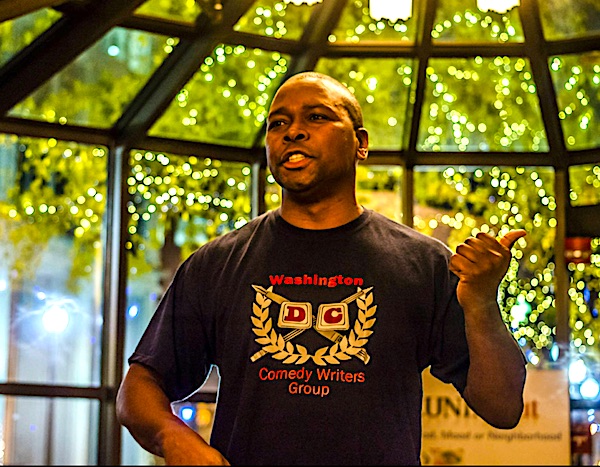
“I kicked off the Comedy Writers Group in 2011, because let’s face it, a joke unshared is like a politician who doesn’t tweet – it just doesn’t make an impact. Comedy’s a team sport; without someone to laugh, a joke’s just a sentence with too much attitude.”
“The Fabulous Fat Doctor Blagmon held his comedy classes with us at Judy’s Bar & Restaurant. Fat Doctor Blagmon always said, ‘Write in your journal every day. Even if all you’ve got is ‘I’ve got nothing,’ scribble that down. It’s like a placeholder for your future genius – or your future grocery list. Either way, you’re winning.’”
“My idol, Richard Pryor, was a master at mixing comedy with tragedy. Kind of like a chef who mixes sweet and sour, except instead of a dish, you get a life story. And in my case, let’s just say my life’s recipe is one part comedy, two parts ‘Oops!’, and a sprinkle of ‘Did that really happen?’.”
“Back in the day, I was the go-to IT wizard at the SEC. You know, Securities and Exchange Commission, where the only securities I was exchanging were sleep for stress. My life was a series of night calls, like a superhero, except my superpower was rebooting routers at 3 AM. I got so good at navigating the dark, I thought about moonlighting as a burglar.
But, like any sensible person who finds themselves whispering sweet nothings to a modem at 2 in the morning, I had an epiphany. So, I quit, embracing freedom… a little too enthusiastically, it seems. Before I knew it, my new office had four wheels, and my home address was ‘various locations in Northern Virginia’.
Living out of my car, I became a nomad with a library card. Reston, Rockville, Falls Church – I was the only guy doing a library tour without a book signing. And let me tell you, nothing says ‘I’ve made it’ like waking up to a view of the Reston Public Library.
Visiting friends in D.C. became a special operation. My car tags expired, making my vehicle as welcome in the city as a skateboard in Congress. So, I’d park in another state and take the Metro in, like an international commuter.
And here’s a pro tip for you: the key to seamless urban camping is to never look like you’ve just rolled out of a tent. I mastered the art of looking casually homeless – it’s all about the ‘business casual’ homeless chic.
Falling down became my weekly exercise. It’s amazing how a public stumble turns you into a stand-up comedian. You learn to laugh it off, mostly to assure bystanders you haven’t broken anything expensive, like your pride.
Through it all, I found the secret to a stress-free life: inner peace, zen, and the unshakable belief that if I can handle a conference call while parked outside a Starbucks for free Wi-Fi, I can handle anything.
So, here’s to the journey from IT help desk to helping myself. Turns out, the biggest reboot I needed was for my own life. And maybe, just maybe, the real securities were the friends we made along the way. No? Just me? Alright then.”
Comedy:
“In my latest adventure, I’ve taken on the role of Comedy Entrepreneur, which is like being a regular entrepreneur but with better jokes and slightly worse financial planning. My mission? To turn D.C. into the comedy capital of the world. Move over, politics; it’s time for punchlines.
Our approach is simple but revolutionary. We target bars on their quietest nights, you know, when they’re just one sad song away from becoming a country music cliché. We walk in and say, ‘Hey, how would you like us to pack this place with laughter and customers? No, this isn’t a joke, but we do have plenty of those.’
We kicked things off at Recessions Bar, because what better place to start a comedy revolution than a spot named after economic downturns? Our concept is ‘Comedy x 10’ – featuring ten different comedians each week. By the end of the month, that’s 40 comedians, each with their unique brand of humor. That’s not just a comedy show; it’s a comedy marathon with a sprinter’s pace.
Think about it: where else can you hear 40 different takes on life, politics, and why pizza is the perfect breakfast food? Our shows offer a smorgasbord of perspectives, ensuring that if one joke doesn’t land for you, the next one might just be your new favorite.
This model doesn’t just breathe life into slow nights; it creates a vibrant, dynamic community hub. We’re not just filling seats; we’re creating an ecosystem where comedians thrive, bars flourish, and audiences get their weekly dose of serotonin. It’s a win-win-win, the trifecta of entrepreneurial success.
Our vision is to make D.C. not just the capital of the country, but the comedy capital as well. A place where laughter drowns out the noise of politics, if only for a night. So, if you’re looking for a revolution, join us. After all, in D.C., we’re used to uprisings – but this time, we’re rising up in laughter.”
Chef:
So did you know that I’m a part-time chef? Chefs Jared Thomas and his mentor Marianne from D.C. Central Kitchens trained me. They had a powerful way to inspire me and made me fall in love with cooking. Chef Jared has also spoken to the Comedy Writers Group at Judy’s a few times, and he’s not only inspirational but funny.
In fact, he moved me to create a character called ‘Bottom Chef’ for a comedy contest at Hightopps Restaurant in Timonium, MD. My outfit is a chef’s jacket with a logo similar to the ‘Top Chef’ design. Here are some of my jokes:
I start my food prep each day with a ritual — raise my shot glass and yell “Bottoms Up!”
“My culinary education took place behind bars, in the unforgiving confines of a vegan prison. Ever been trapped in a relationship with a vegan? That’s freedom compared to vegan jail.”
“You don’t truly earn the title of ‘Bottom Chef’ until you’ve experienced the culinary depths of ‘Rock Bottom.’ My mentor? Chef Boy-R-Dee. His philosophy? A man, a plan, a can.”
“The city of Buffalo sued me for defamation of their wings.”
“In the heated world of culinary arts, Chef Gordon Ramsay isn’t the pioneer of kitchen meltdowns. I’ve been perfecting the art of the scream long before it was televised. ‘Threaten me with prison again, and it’s not the food that’ll get chopped.’”
“I once ascended to dubious fame as the face of Spam. Remember, Spam isn’t just for dinner; it’s a last resort. If the dog turns its nose up, you know it’s yours.”
“As ‘Bottom Chef,’ I’ve innovated the cooking process by pre-ruining your meal. Why wait? I’ll splatter the food directly into your toilet.”
“These days, my signature dishes are anything that can be drowned in hot sauce and red wine. It’s a delicate culinary balance—some for the pan, more for the chef.”
Amidst the trials of trying every new restaurant in town, I’ve realized perhaps my most needed culinary tool isn’t a spatula—it’s a personal trainer. As Orlando Darden playfully noted, “It might be time to cut back on the beer.” His comment, met with roaring laughter, reminded us all that the essence of good comedy, like good cooking, lies in its relatability and the joy it brings to those who partake in it.
The room was filled with laughter, and Nicole couldn’t help but enjoy the comic relief that Wayne was providing. She leaned back in her chair, more relaxed than before. Next was Leon Scott, a Comedian, Writer and Journalist for WUSA-9 CBS.
Leon Scott
Next was Leon Scott, a Comedian, Writer, and Journalist for WUSA-9 CBS.
“What’s going on? How’s everyone doing? Feel good, Well I feel great and lemme tell you why. I got the best back-handed compliment I ever got in my life. I was out and this tall woman walked up to me and said ‘You concentrated sexy.’ That’s like saying just add water and you become 6’5″. I’ve never felt that tall in my life.
My best friend Rome is 6’5″, and he always says things that takes being tall for granted. He would say ‘Man, being tall doesn’t help me meet women.’ And his voice is tall.
That’s a lie cuz I’ve never had a woman come up to me and say. ‘So I saw the top of your head from across the room.”
But being short hasn’t stopped me from going on TV. I just gotta sound tall. Speaking about news media, would like to introduce the next segment — Real Time with Bill Maher.
Dan Verkman
Hi, I’m Dan Verkman, but everyone tells me I look like Bill and they say it in a way like I’ve never heard it before.
“Do you know who you look like?” or “Anyone ever tell you who you look like?” Yeah only for the umpteenth time today. Now buzz off.
I do get a lot of people checking me out like I’m so kind of a weirdo. Unless they yell ‘Bill’, I’m never sure why they’re staring. Do I have a big booger in my nose, is my hair sticking up, is my fly down?
Doctor’s Office:
One time I was checking if for a doctor’s visit and I overheard an older married couple talking. “Hey, that guy looks like that comedian guy from TV,” the husband says. Then, a couple of minutes later you hear him say, “even acts like him too. A real jerk”
Then after filling out my paperwork and I sit down, he leans over to ask me. “Ever hear of a TV personality named Bill Maher?”
I looked at him like he was from outer space. “Who the hell is he?” Sometimes it’s smart to play dumb.
Supermarket:
Then there’s the moment I was going through the checkout counter at the supermarket, and the cashier says, “You know who you look like..?”
“Yes!” I responded hoping she won’t press me further.
“I’ve seen you in line before, you have a home in the DMV, don’t you..?”
“Ah, yeah.”
“Well, who’s doing the cooking?”
“The writers,” I responded hoping she would realize that I was just pulling her leg.
“You’re gonna mention me on your show aren’t you?
“Only if you don’t charge me the county bag fee.”
“You kidding with the millions you have, you could buy the entire store.”
I can’t even walk down main street any city, without someone yelling from their car.
“Hey Bill, saw you on TV last night. Love your show.”
Speed Dating:
But I’m not complaining. Looking like Bill has gotten me a lot of perks. Went on a speed dating event the other night where I was told by 10 different girls “Did anyone ever tell you who you look like?”
One girl asked, “What do you do?”
“I make people laugh.”
“Are you a comedian?”
“No, I write code.”
Tattoo Bar:
Afterward, I went to the Tattoo Bar up the street and was approached by 3 hot chics who asked for a pic. The bar manager then said, “Name it, you got it.” Then a tough-looking dude approached and said “You really him? You look different on TV.”
Metro:
On the metro ride to a show one night, two Black guys approached and said “Anyone ever tell you, you look like Freddy Krueger?” I know Bill can be evil, but that’s pretty extreme.
After the show, two Black girls called out from an Audi.
“Bill Maher!”
“Yes, better than Freddy.”
“You wanna smoke a bowl with us?”
The audience clapped hands. Someone yelled “Bill has jungle fever you know. Play the role.”
Karaoke:
I sing karaoke, and sometimes I put my name in as Bill M. One girl thought I was Bill Murray and had me autograph her forearm.
One hot blonde came over and nearly sat on my lap and whispered “I know who you are.”
“How was she in bed?” someone chuckled.
Let’s just say, I played the role that night.
Art Show:
One time I was at an art show in Bethesda when I met Anne Currie from the Today show. And she asked what I was doing here.
In a somewhat inebriated state from all the free wine they were serving, I told her I was in town for the White House Correspondents Dinner. — I had just overheard it was the next day just a few minutes earlier.
I think she actually believed me cuz I can play the role of a journalist pretty convincingly.
House of Cards:
Did you know I auditioned for the journalist role on House of Cards? They had me read three roles, all political pundits. The first role was as a Glen Beck guy. Everybody auditioning was a real reporter. The guy who auditioned before me was Jamie McIntyre from CNN. He said to me while we were in the waiting room “You know, you look quite familiar.”
So now you can add a new title to my resume — Bill M. the actor.
The audience gave Dan a standing ovation. “You should write a book about this!” Wayne suggested. “It’ll be an N.Y. Times Bestseller”
At the end of the night, Nicole came over and gave me a pat on the shoulder.
I turned around and said, “So comedy night was a smashing success. We were able to reach out to the young millennials who love to meet, laugh and drink. We should do a sequel.”
“Are you kidding me, some of these jokes were downright raunchy. Wayne was inspiring, but some of the standups really bombed it. And Dan may be Bill’s doppelganger, but I’m not interested in hearing about his sexcapades. Tonight, you’ve embarrassed the Marriott name. JW himself would turn over in his grave.”
Wayne shook his head and grimaced. “So I guess there won’t be a part deux.”
“Yup back to the ole drawing board,” I lamented.
9 Comics & a Monkey at the Renaissance Hotel Standup
There were two milestones I needed to achieve in order to complete my MBA — a new venture capstone project and a study abroad trip to compare and contrast cultures, business practices, and management styles.
In the spring semester of 2012, I enrolled in a six-week course entitled Engaging Diaspora Communities for International Business and Development. It was taught by Dr. Liesl Riddle, the associate dean of GW’s School of Business who has written extensively about diasporas and international entrepreneurship.
The course studied the diaspora communities in the US and abroad and their motivations for sending remittances to their home countries to spur growth and prosperity. A vast majority of the diaspora who return to Ethiopia are starting businesses and creating jobs. The class culminated with a week-long trip to Ethiopia to take what we learned and apply it firsthand.
There are an estimated 2.5 million Ethiopians living outside of Ethiopia. Many of them live in Washington, DC, so this particular diaspora was the perfect one to focus on.
“I want you all to contemplate what you expect Ethiopia to be like, compared to what we observed once we are actually in the country,” said Dean Riddle.
The GWU MBA class departed from Dulles excited about the adventures ahead. When they arrived at Addis Ababa 14 hours later, they were sleep-deprived and jet-lagged but enlivened nonetheless. Situated in the Horn of Africa, Ethiopia is a rugged, landlocked country and the cradle of humanity where Homo Sapiens first walked on two legs. It is the “Land of Origins”…of humanity, language, and of course one of life’s greatest pleasures – coffee arabica.
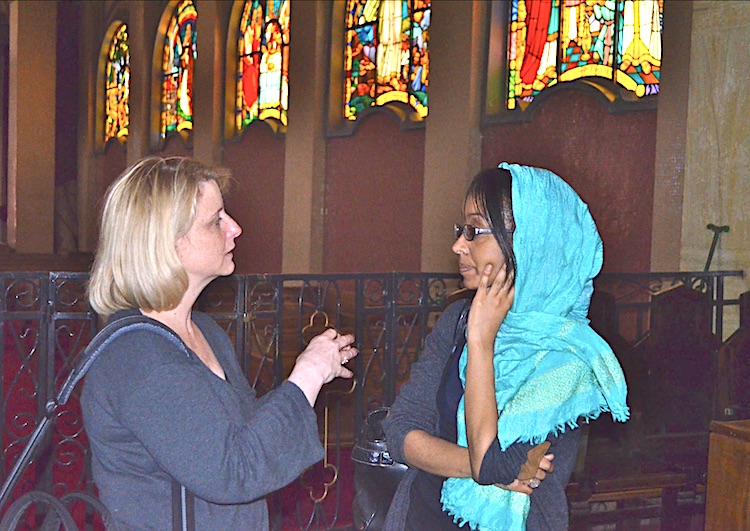
Since it was too early to check into our suites, Dean Riddle arranged for us to do some sightseeing. Our first stop was the Holy Trinity Cathedral, a product of the colonial period imbued with rich history and majestic architecture.
Many tourists who visit Washington, DC yearn to visit the Smithsonian Natural History Museum to ogle at the Hope Diamond. Likewise, an obligatory stop in Addis Ababa is the National Museum of Ethiopia to admire the Lucy fossil. She is 3.2 million years old, and the most famous early human ancestor because she walked upright. Unfortunately, the bones we saw were not the real Lucy, but plaster replicas. The original skeleton is displayed at the Cleveland Museum of Natural History. Ironically, it was offered to the Smithsonian in D.C., but turned down due to a resolution that early human fossils should be stored in the country of origin and to make displays in other countries with fossil replicas. It’s like traveling 7,000 miles to meet a fairy tale luminary, only to find out she’s half the world away on a sabbatical. But real Lucy or not, we were ready to do some slumbering as we finally headed to the hotel.
On the way to the Ramada we were greeted by the impressive stone monument of the Lion of Judah roaring over the city, a crown jewel of the infamous Haile Selassie.
Finally, at the lodge, I took a long shower and squeezed in a power nap, but by nightfall, we had to gather up for our first guest speaker – Addis Alemayehou, a serial entrepreneur who returned to his roots and has become a household name in Addis. He founded 251 Communications which has grown into one of the leading PR and communication firms in the country.
“I started my entrepreneurship endeavor here when the war between Ethiopia and Eritrea was just coming to an end and the economy at the time was in shambles,” Addis said. “I lost my iPod and missed having my playlist with all my favorite songs, and realized that there were many people who also enjoyed Western music. So I started the first English Speaking FM Radio station in Addis. A good business is always one that finds a need in society and fills that void.”
“Are there lots of opportunities here for startups?” my classmate, Marilu Ortega asked.
“Business in Ethiopia flourishes out of sheer need. If you were to spend a week in this country, carrying a notepad and writing down everything you wished you had but didn’t, you would finish the week with at least 35 promising ideas.
“How is the labor market here?” Erin Dahan asked.
“Steadily improving every year. Wages are low and there’s lots of talent here. Foreigners are investing and diasporans are returning and creating millions of jobs every year.”
The next day, we met one of those diasporans who had contributed enormously to the job market. Daniel Gad immigrated to the US after school in search of better career opportunities. After serving as an executive for AT&T for 20 years and building a nest egg, he decided to return home. When he met with the Chamber of Commerce to see where he should invest, they steered him to the field of agriculture. Daniel deep-dived in the industry and discovered that flowers are a multi-billion dollar export business. He then created a 28-hectare rose farm called Metrolux Flowers which he successfully exited. He now manages and operates Omega Farms, a leading vegetable production farm that produces and sells high-value vegetables to the EU. He is currently collaborating with PepsiCo on a partnership called EthioPEA aimed at chickpea production which would hire over 10,000 farmers. Daniel Gad is undoubted “mining gold from the dirt.”
* * *
One industry that is facing a difficult time getting diasporans to return is the medical field.
“There are more Ethiopian doctors working in Washington, DC than in Ethiopia,” said Dr. Asfaw Atnafu, a professor of radiology at Addis Ababa University and the Head of Telemedicine at the Black Lion Hospital
One issue that Dean Riddle taught us in class is the concept of “brain drain”. In Ethiopia, many students leave the country to study medicine, but the vast majority do not return. Dr. Atnafu who studied medicine abroad was given a very lucrative offer to practice medicine in the UK. It seemed obvious for him to accept it. But one day, his mentor saved a very well-known British official who was suffering from a severe brain injury. The surgery was such a success that he was interviewed by the BBC. They asked him why he was returning to his homeland. The doctor said that Ethiopia would be safer now because they would now have one neurosurgeon. That one sentence changed Dr. Atnafu’s perspective, so he decided also to return.
Ethiopia is one of the fastest-growing countries in Africa with more than 104 million people. The country has made significant health care gains lately, such as lowering infant mortality, but more work needs to be done — particularly in rural areas. Healthcare, something that many Americans take for granted is a precious resource in many Third World countries and needs to be drastically improved and will be key to boosting economic growth.
Black Lion Hospital
Dr. Atnafu was not focused as much on remittances as he was on the social and educational aspects that diasporans can have on Ethiopia. That was why he’s big on telemedicine. Much of the engagement he facilitated was through knowledge sharing and training conducted virtually. In addition to receiving input from diasporans abroad, the medical community in Ethiopia can contribute to the medical dialogue by sharing their own experiences.
I wish my former boss, Admiral Robinson had an opportunity to meet with Dr. Atnafu. As the Surgeon General, responsible for seeing healthcare for the Navy and Marine Corps throughout the world, he was a big proponent of telemedicine and would have loved sharing information with Ethiopia on how to make healthcare available to everyone.
* * *
We also met with Dan Rosenthal, the Commercial Officer at the U.S. Embassy. Ethiopia is a state-run economy and with the government overseeing the development, there is a lot of red tape. Thankfully, the country is starting to privatize and is looking for foreign investors to improve the quality of life for Ethiopians.
“The five sectors that are the most important for the future are Telecommunication, Agriculture, Manufacturing, and Power. These industries will create the maximum number of jobs leading the country to a dynamic future.”
“What are some of the major draws for international investors?” I asked.
“Duty-free imports of capital equipment, tax exemptions, cheap electricity, a thriving local airline with a large international footprint, and duty-free access to the US market through the African Growth and Opportunity Act. But probably the most attractive is low wages — the country wants to keep its wages low to attract investment for its manufacturing industry.”
“But low wages will barely lift workers out of poverty, and once workers gain skills, they will leave their jobs to seek higher-paying jobs, resulting in high attrition and higher training costs.”
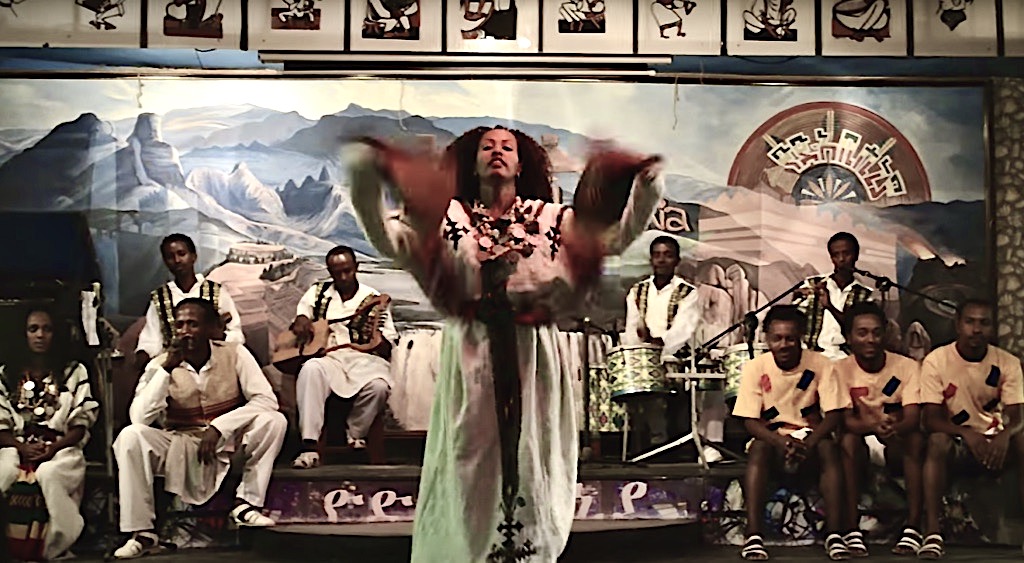
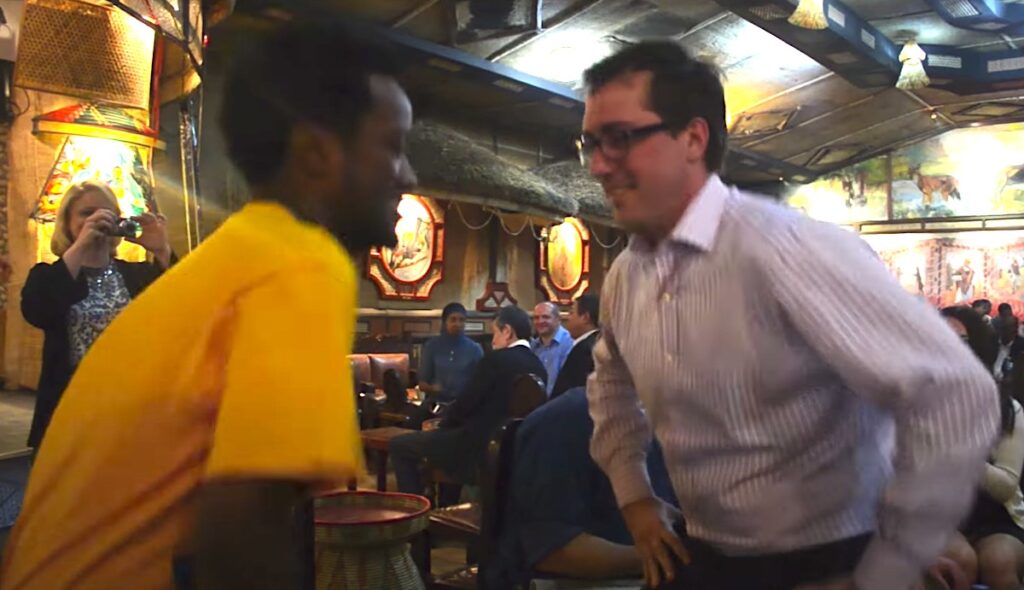
The field trip wasn’t all meetings and business attire. We also went to enjoy the food and culture. And Dean Riddle recommended we visit the 2000 Habesha Cultural Restaurant. At first glance, the restaurant offering a buffet of traditional food and a stage show of dancing and singing looked like another tourist trap. But you cannot judge a venue by its clientele.
2000 Habesha Cultural Restaurant
We loaded up with large platters of injera and wot and sat up front to enjoy the festive performances. The veggie-friendly dishes were anything but boring. The healthy portions included ruby beets, lentils, salad, carrots, green beans, and chickpeas and were flavored with garlic, paprika, and rosemary. After a few glasses of honey wine and bottles of St George beer, a couple of brave souls sauntered on stage and performed the Eskita (traditional dance moving the shoulders).
The next day, Dean Riddle and several of my classmates visited the Boston Day Spa nearby. They had a relaxing time to refresh and detox until one or two of them accidentally imbibed on the tap water that was served to them and immediately realized they weren’t in Boston USA. Ethiopia has made impressive progress over the past 10 years on improving water quality, but the water supply is still very contaminated and should not be drunk. Needless to say, a couple of them caught gastroenteritis and had to rest at the hotel to recuperate.
At this trailblazing spa, we got to meet with Tadiwos Belete, a diasporan who trained as a hairstylist and attended cosmetology school in Boston. When the Derg regime overthrew the Ethiopian monarchy in 1974 and established a brutal dictatorship, Tadiwos, at the age of 15 decided to flee on his own to Sudan. There he was even paid by farmers to scare off birds feeding on crops. After a few years of roaming about, he applied for refugee status in the U.S. and moved to Boston where he worked odd jobs until he decided to become a hairstylist.
Boston Day Spa
After saving money, Tadiwos wanted to open up a salon in the city’s poshest neighborhood, but nobody wanted to rent to an unestablished immigrant. He decided to reach out to the owner of a building on Newbury St by inviting him for dinner at a nearby Ethiopian restaurant to get acquainted. The owner was sold by his negotiating skills, and in 1998, Tadiwos opened up his first hair salon called Konjo (beautiful in Amharic).
It wasn’t long before Tadiwos started to feel a longing to return to his homeland. He developed the idea of starting a luxury spa, hair salon, and hairdresser training school in Addis Ababa. But he didn’t have the funding. He asked nearly every customer who got a haircut from him to partner with him and invest in his country. After asking nearly a thousand people, one Taiwanese woman reluctantly agreed to come in as a silent investor. Tadiwos built an office block on crumbling, dilapidated Africa St, where many had not dared to set foot. His relatives thought he was crazy, but he wouldn’t be deterred.
Nine years later, business is through the roof, and his brilliant idea has spurred dozens of other spas to sprout all over the city. Tadiwos has also embarked on a development boom, opening up a restaurant and a wine bar downtown along with two luxury resorts a couple of hours from the hub. In all, he employs over 1,500 people spurring the economy. We had the opportunity to visit Tadiowos’ Kuriftu Resort, a 28-room tourist retreat in Bahir Dar, at the source of the Blue Nile river. It’s an amazing place with great food, hookah, and a splendid lake where you can go on a relaxing boat ride. And like Boston Spa, they have a massage, steam, and sauna to top off a very relaxing retreat from the city. Just remember not to drink the water.
On the way back to the city, we stopped at the legendary Tiya Stelae, an archaeological site containing 36 enigmatic monuments. Each obelisk-shaped stone is engraved with primitive, clear images of swords, shapes, and figurines. To date, no one has been able to determine the age or the purpose of these carvings. One reason why they call Ethiopia a “Land of Mystery.”
legendary Tiya Stelae
Finally, we got to visit the Commodities Exchange, established just four years prior. The country’s two major goods exports are not surprisingly coffee (29%) and cut flowers (14%).
Ethiopia is also a land of rich opportunities for investors, from all over the world. That is why it is projected to be Africa’s fastest-growing economy, and perhaps one of the fastest globally. Labor is fairly inexpensive and highly skilled and the country has made huge investments in infrastructure and manufacturing. The government is making reforms to unleash the private sector and has wholeheartedly embraced the diaspora for impactful development projects. Returning diaspora also share invaluable skills, education, and experiences they acquired from the West. In order for the motherland to optimize development and job growth, she must continue to forge lasting, meaningful ties with this salient community, translating into sustained, measured growth in the years ahead.
But the road to investment is a rocky one. Diasporans are facing a huge information gap in the current market and steep odds that they will reach their lofty goals. That’s why it’s highly imperative that they conduct proper research and fully understand the industry and the market in which they are operating in. They need to be savvy innovators and shrewd negotiators in a volatile and intransigent market. What I found noteworthy was the resourcefulness and resilience of the diaspora community. Through grit and resilience, many persevered and ultimately made a significant difference for their country and citizens.
On the final day of our journey, I sat down with my friends to discuss what we learned.
Rasheida Knight was really smitten with Addis Alemayehou. Addis has been able to achieve massive success because he was innovative. Most people who lose an item of value like an iPod would regard it as a setback. Addis viewed it as an opportunity to fill a void. He reflected on how important his playlist of Western music was to him and realized that there were many Ethiopians that felt the same way. He conducted a target market analysis to understand the size and scope of the audience and researched what was needed to launch the first private English-speaking radio station, Afro-FM. He not only tried to understand how people work, but he also wanted to understand how things work. And in so doing, he documented everything.
“If you were to spend a week in Ethiopia and write down everything you wished you had but didn’t, you would come up with tons of innovative ideas.”
Marilu Ortega enjoyed her time at the spa and was thus impressed with the innovativeness of Tadiwos Belete who thoroughly researched the local market and felt that a day spa business could thrive there. People thought he was crazy, but he understood the potential customer base and was confident that the salon would be a huge success.
But Tadiwos didn’t have the funds or resources to make all this happen. He was an effective negotiator beginning in his Boston, MA. days when he skillfully convinced a building owner to lease him space to open his first hair salon to when he convinced one of his customers to invest in his business venture abroad. Without his ability to listen, communicate and persuade, Boston Day Spa would never have been built.
Tadiwos Belete
Erin Dahan was impressed with Tadiwos’ resourcefulness. At the age of 15 and living in a Sudanese refugee camp, he was able to survive and find a way to show his usefulness to farmers and work with the Catholic Church to immigrate to the U.S. He lived in Boston for 20 years and through resourcefulness and grit, managed to save money and learn an important skill that led him to build his luxury spa business franchise.
Brady Shannon also enjoyed hearing about the resourcefulness of Daniel Gad. After living in the U.S. for 20 years, he was shocked when the Chamber of Commerce recommended that he invest in flowers. To be successful in agriculture one has to be highly resourceful. For one, the country did not have access to modern farming equipment. They still used pitchforks and plowed with donkeys. Daniel eventually sold MetroLux Flowers and started a new business in horticulture called Omega Farms. He did a lot of research and observed how his farmers harvested chickpeas. He then realized that by being more resourceful and making small improvements in their handling processes, his farmers would be able to increase production by 30%.
“I like to use the analogy of gold in the dirt,” said Daniel Gad. Ethiopia has a lot of dirt. The key is to find out how to get gold out of it.”
Rashida, Marilu, Erin & Brady
Marilu sympathized with the huge healthcare challenges the country faces. “Their resourcefulness in utilizing telemedicine is both novel and remarkable,” she said. “Dr. Atnafu has made huge sacrifices and has done a remarkable job.”
All the entrepreneurs we met, made bold decisions and took huge steps to start their businesses in a very risky and volatile environment. There was a huge information gap, and they faced steep odds against reaching their lofty goals. When faced with challenges, some of them had to take a step back or make a drastic course change, but they always kept their eyes focused on their goal and navigated towards it.
Even 10 years later, I remain inspired by the group’s resourcefulness, their deep understanding of the current market, their ability to broker and negotiate, their willingness to adopt innovation, and their courage to take the next step.
The following weekend, Zach and I were in my Subaru Baja, driving at full speed on the N.J. Turnpike to NYC.
“Why are we driving up to the Big Apple just to pick up a damn rickshaw?” Zach asked incredulously. “Segways are all the rage on the Mall.”
“So we can hang signage promoting our brand and ride it all over town like a taxi cab.”
“Can’t you just buy one in D.C.?”
“There’s a premium for these three-wheeled wonders in the metro area. But in NYC, where their popularity was spurred, there’s a superabundance.”
Many tourists choose to ride the pedicabs instead of taking a bus or taxi because it allows them to observe the surroundings better and because the bikes can squeeze through heavy traffic. And sure enough, as soon as we crossed the Lincoln Tunnel, the busy streets of Manhattan were congested with taxis, bikes, scooters, and pedestrians. One pedicab driver just purchased a medallion to own a taxi and was selling his weaning out of the travel destination business. He was happy to let it go for $1800, and I was delighted to take it off his hands. We deftly squeezed the pedaled contraption on the bed of my Baja and with the handlebars hanging over carried it home to greener pastures. When we landed at the Mall and took her on a spin-down Constitution, she looked like a Lamborghini basked in sunshine.
“I will dub her Lil Yellow.”
“Yes, she looks sleek and shiny and will definitely turn some heads.”
“She’s not just for advertising. She’s to make a few bucks, and you’re welcome to ride Lil so you can earn extra beer money. How else is a scavenging Colonial supposed to survive? I know it sucks to be a non-paid intern.”
“Yes getting paid with cheeseburgers and subs gets old after a while. Yes, I’ll love to take her on a spin after class and see if I can coerce some stray tourists to pile on.”
“Sounds like a plan. And don’t forget we’re not licensed to charge a fare but can easily take donations.”
“Super, I’ll bring along my school work which I can tackle when there’s a lull.”
“Yes, please use your time wisely, and take the opportunity to learn more about the history and landmarks so you can better inform and entertain your guests.”
When Zach was parked at the green zone in front of the American History Museum, he spotted a pretty Persian girl with long brown hair and knee-high socks. Tall and tanned, she looked like a supermodel on wheels, and it was evident that she was passionate about her mission.
Her name is Shaadi, and she was a former elementary school teacher turned into an enterprising rockstar.
“How did you get into this business dominated by jocks, vets, and hippies?”
“Well, I got into an accident, and doctors found a tumor in my left leg. They removed it, and the tumor returned. When I was rehabbing on a stationary bike, it was challenging to have my right leg get my other leg to go around. So I made a pact with myself. ‘The day I can ride my bike again, I’m gonna ride for 50 miles, and I’m not gonna stop.’”
Shaady took Zach under her wings and got him up to speed on the history and background of this fledgling business.
Last summer, the Park Police started cracking down on pedicabbers on the Mall. They claimed we were cutting into the Tourmobile monopoly that the National Park Service had a long-term contract with. An operator was attempting to pick up customers in front of the Smithsonian Air and Space Museum when he was tased, tackled, and arrested.
“Damn, that’s harsh. So the Park Police Gestapo felt threatened, so they started suppressing our Eco-Friendly business model.”
“Yes, we’ve come to a truce now. I love your silly monkey logo, by the way. I’ve got six pedicabs and would love to advertise your brand on our backs.”
“Love how environmentally friendly this is,” stated a tourist from Maine. “Summer days are just roasting, and we’re too exhausted to walk up and down the Mall. Take your time and tell us all you know about the spots.”
When Zach wasn’t using the cab to shuttle tourists, Lil Yellow was employed during multiple events such as Taste of D.C., where we interacted with various vendors such as the Cupcakes Lounge. The multi-day culinary event along Pennsylvania Ave attracted some of the region’s best restaurants and lively entertainment.
People loved the thrill of the ride and they loved posing and shooting selfies. Even met a young, newlywed couple who deemed it quite romantic and were found smooching in the back.
“Are we allowed to drink inside the cab?” a passenger asked meekly.
“I don’t see why not. The only stipulation is that the driver can’t drink. But please buckle up.”
During our reconnaissance and cold calls with Suzannah, I would drive the pedicab and she would sit in the back waving at dumbfounded passersby. From time to time, we would pick up a sightseer or a tipsy passenger bar crawling along H Street. Lil Yellow was our lucky charm. We were able to negotiate business with Biergarten Haus on H St., Ulah on U St., and Jake’s American Grille in Chevy Chase.
Our pedicab and signage got a lot of attention, and we were invited to provide complimentary rides during the H Street Festival, the quintessential 10-block street party featuring live music, karaoke stages, live music, and yes, even belly dancing.
It was a sweltering, hot day, and many people were tired of having to walk from 3rd to 14th street. My illustrious intern agreed to provide rides as long as I provided refreshments and he kept all the tips.
When we weren’t providing rides, guests enjoyed using our cab as a photo op, and we were happy to oblige.
Every year, the British-themed double-decker bus would be parked in front of The Queen Vic where Newcastle Brown Ale flowed like the River Thames.
There was a half-pipe for local skateboarders. Dangerously Delicious Pies sponsored a hands-free pie-eating contest and the grungy ex-funeral parlor turned lounge, Rock and Roll Hotel, pumped music all day.
Zach and I got to meet so many people — tourists, locals, business owners, and artists. One gifted performer specialized in Egyptian belly dance, and she was quite a ravishing entertainer. Dressed in a red chiffon hip scarf, the Arabian beauty swayed her hips and shimmied her body rhythmically to the cheering audience’s delight. I didn’t catch her name, but I promised to introduce myself the next time I see on stage.
There were also tons of local artists such as Pete Baker, and Flo Anito was strumming her guitar, singing her tongue-in-cheek ballad to the vacuum “No Dustbunnies.”
Flo is a classically trained vocalist and pianist and sang like a blue jay on a hot summer day.
The H St Fest was the best block party in town. There were tons of people and lots of random conversations. It was the best marketing event we could dream of and the word was definitely getting out that RUNINOut was about rides.
In the Fall, we provided support at the Marine Corps Marathon cheering runners and even offering free rides to spectators or exhausted runners who wanted to beat the (14th street) bridge. Runners had to maintain a 14 min/mile pace until mile 22 or else they would be taken off the course and bussed back.
The ending was great with Marines in their BDUs shouting “Oorah” and handing out the coveted Eagle, Globe and Anchor finisher medals. There were tons of photo-op moments, and we all had a blast, especially Kanita, who lost her voice screaming and cheering.
“The pedicab is great for marketing. You should take her on a spin on Halloween night and get more people to come aboard,” she suggested.
One thing about the intelligent mind of a great attorney — she was always a source of great ideas. And so was my reliable sidekick, Suzannah.
“I have an idea for an event.” Suzannah said. “Hold a reelection night party for Obama at the Rocket Bar in Chinatown.”
And November 6, 2012, President Obama and his running mate Joe Biden had easily gotten reelected and the GOP, it seemed, had become the grand old party of the past.
The views at the Georgetown waterfront were busy with paddle boarders launching from the Key Bridge Boathouse and lunchers enjoying the open patio seating at Sequoia and Tony & Joe’s Seafood Place. Bikers were crisscrossing the Capital Crescent trail on their way to Bethesda or Cabin John. Runners and strollers were enjoying the historic C&O Canal stopping at the numerous bakeries and coffee shops to grab a bite or to enjoy the rich, sweet aroma.
While kids were splish-splashing in the fountain and grown-ups were getting their feet wet, Sunita Amatya was sitting on the side of the river, praying for the thousands of lives lost thousands of miles away.
On April 25, 2015, a 7.6 magnitude earthquake struck the city of Kathmandu in central Nepal killing 9,000 people, affecting millions of lives, and causing $10 billion in damage.
“May the tragic and devastating situation get better with Divine grace. May all five elements of the creation (earth, water, fire, space, and air) be balanced forever and will there be no more natural disasters,” she chanted towards her Supreme Deity.
The common belief is that to experience enlightenment one must be quiet and sit motionlessly. But that couldn’t be further from the truth. Then as her prayers to Dharma were received, her devotion transformed to dance as hundreds of sightseers and gawkers were entranced by her majestic movements. But this was not a performance. Sunita was touching her dimension beyond her limited mind and body. It was an inner engineering language to express life energy while using the body as an instrument.
Suddenly out of the corner of her eye, she saw a spirited straggle of runners. Not just any runners that you would see spurting all over the pristine paths of D.C. But these exuberant runners were adorned in bright red Embassy Run shirts, matching their crimson red Nepali flags they were waving. The color symbolizes the brave spirits of the Nepalese people and the two triangular pennants represent the Himalaya Mountains and the two major religions: Hinduism and Buddhism.
The astounding sight was too coincidental to be a coincidence. She quickly rose and with the enlightened spirit of Buddha followed the throng to a neighborhood saloon on Water Street called Mr. Smith’s.
For a second, she wondered whether she belonged here. The pub was unassuming and low-key, and there she saw what seemed like a hundred road-weary warriors all dressed in crimson red, nursing a cold Dos Equis.
“Saw you guys running by the waterfront. Are you running for Nepal?” she asked gingerly.
“Absolutely, we’ve been running 13 miles and raising awareness for survivors of the earthquake,” I answered. “Are you from Nepal?”
“Why yes, I was just at the park praying and dancing for the plight of our people. And Prince Shiva led me down this path to join your gathering.”
“That’s quite poignant. We were devastated when we heard about the earthquake, and we wanted to use our run as a vehicle to raise awareness and funds.”
“Then Prince Siddhartha answered my prayers. My son, Sudin, and I are also raising money for recovery and relief, but our efforts to date have fallen short.”
“I think there are ways that we can collaborate. But first, tell me why dancing is so transformative.”
“Dancing helps us purify our thoughts and heart and heals us from physical and mental pain. It’s to let God in and to let go of any negativity — to attain bliss.”
“Wonderful, Audrey Pichmimi said. “Can you show us outside how you perform your dance?”
Sunita showed us how to dance for enlightenment on the Georgetown Waterfront
The following Thursday evening, a couple of dozen revelers, runners, and members of the Newah Organization of America (NOA) amassed at Courthaus Social in Arlington to honor the people of Nepal, discuss earthquake relief opportunities, and enjoy music and dance.
Sudin plays Sax @ Courthaus Social
Sunita brought her talented son 16-year-old, Sudin who played the sax and sang traditional folk music. The music carried powerfully through the outdoor patio on a warm spring night, and many onlookers inquired about the cause — NOA was able to also receive generous donations from those who were deeply touched and wanted to show their support.
We charged $20 for entry which included a wide selection of appetizers. Jackie was instrumental again, spreading the word and getting people to book the event through her site, Bookalokal
Audrey, who was enamored with Sunita’s faith, returned to help raise money and to enjoy Nepali music.
By the end of the night, we were able to present NOA with a check for $1,000
Members of NOA receiving a donation from the Nepal Relief Fundraiser
“We are extremely grateful for your spirit of generosity,” said Ram Shrestha, president of NOA. “We will be able to provide medical supplies and build temporary shelters with these funds.”
“Thank you very much,” Sunita said. “This divine circumstance proves that praying and dancing is indeed transformative.”
“It’s our great pleasure, to serve a small part in this. I’m now a true believer in the power of spiritual dancing. My thoughts and prayers to the courageous people of Nepal.”