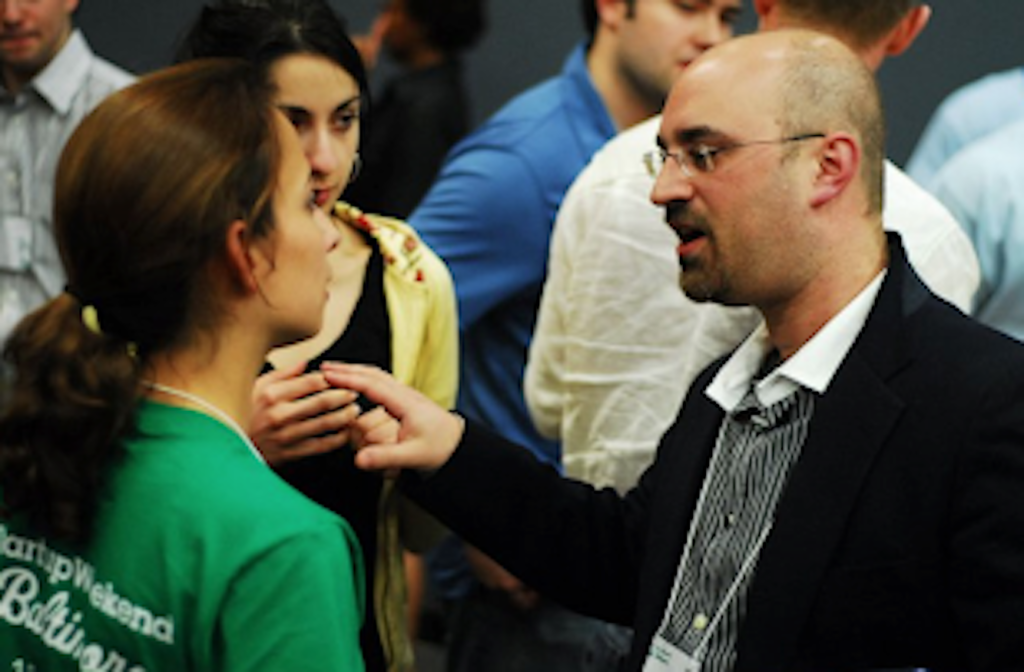
Jason Morenz was working in the kitchen in Piola located on the northern border of U St by Florida Ave NW. The restaurant was popular on Sunday for their bottomless brunch (not mimosas) but 10 different types of pizzas (personal size) as much as you can binge.
During the weekday, all draft beer (including the Peroni) was only $3 and occasionally, they would offer involtini puffs, bite-sized roll-ups with bacon, mozzarella, and eggs. On the 29th of each month, Piola would offer AYCE handmade Gnocchis with a handful of decadent sauces.
Although 14th Street has a fair share of pizzerias, Piola was popular with pizza aficionados for their thin-crust and savory cheese and hearty toppings. Couples and groups also came for the chilled atmosphere and friendly servers.
Piola’s, on most nights, was buzzing and the demand for take-out was through the roof. The biggest problem was apps like DoorDash and Grubhub took a huge slice of their paper-thin margins, as much as 30%.
“Why not cut out the middleman?” Jason thought to himself. “We could build a slick website and channel all call-in orders through it.”
Under his direction, I purchased the domain Piola D.C. and replicated their menu on an eCommerce platform. Then I updated Google maps with the new website name.
Within days, the website traffic started to pick up and if anyone called to order, they were redirected to the new site. But Piola’s did not have its own fleet of delivery drivers. So Jason came up with another ingenious idea.
For every delivery order that came in, Jason would duplicate the order on the Postmates app.
For the sake of example, Charlene is at home with a big craving for traditional Italian pizzas and Peter is working a swing shift as a bike messenger.
Charlene ordered the Quattro Formaggi on the Piola D.C. website. The instruction would then be automatically printed out and sent to the kitchen. Jason would then make the same order on the Postmates app. In little time Peter would show up at Piola’s to pick up Jason’s pizza.
Jason would immediately greet Peter. “This order is for Charlene and it’s going to this address down the road,” Jason instructed. “And I’m going to tip you ahead of time, so don’t screw this up.”
15 minutes later, Peter called Charlene at the Union Row Flats on 14th and she happily buzzed him in. He checked in at the front desk then took the elevator to the 5th floor and tapped on her door.
Charlene opened the door in her skimpy, pink terrycloth bathrobe “Come on in,” as she motioned for him to follow her.
“Please set the pizza on the table.”
Peter bewilderedly followed her to the dining room. Then he opened his bright red pizza warmer bag and gently took out the large pizza box with the slogan “FAMOSI PER LA PIZZA” embossed on the side.
Charlene thanked him with a slight twinkle in her eye.
Peter returned the smile and maintained a steady gaze. Then a prolonged uneasy silence, while Peter noticed a partial view of the Capitol rotunda from the master bedroom vaulted windows. He wanted to say something, but luckily she beat him to it.
“Well, I guess I better dig in while it’s still hot,” she mutters under her breath.
“Umm, yeah. It looks good. I betta be going now,” he mumbles.
Peter almost tripped on himself as he stumbled out. He thought he heard her say something about the savory gorgonzola, but by then he had safely extricated himself into the hallway.
“Whoa, wait, don’t leave just yet…”
Peter’s heart was jumping by the time he got to the elevator.
“You forgot your tip.”
But Peter already got his tip, from Jason at Piola’s, and he noticed on the app that there was another order to pick up.
As soon as he descended down to the lobby, he wished he could retrace his steps back to the apartment with the shapely blonde and the panoramic view.
“Man, I had my one chance, and I totally blew it,” he muttered. “How could I be such a coward,”
He thought about calling Charlene and inquired how she was enjoying her slice, and whether she wanted him to bring up some chardonnay to complement, but he clearly didn’t have the guts to see it through.
The autumn night was dreamy and delightful when Peter raced back to the store.
“You’re a dumbass,” Jason admonished. “Such a pathetic loser.”
“Well I delivered on time,” Peter quipped. “And the pizza was still hot and steamy when she ate it.”
“Yeah, but you left the tip on the table, you idiot, not to mention some other things.”
“Well, I definitely didn’t expect her to be so revealing. Perhaps she was seducing me to make a move, then report me to Postmates.”
In the weeks ahead, Piola was humming, and the orders kept flooding in. The upper echelon and franchisees were delighted with the ton of sales and the favorable reviews.
But then the number of orders made by Jason on Postmates aroused suspicion. The corporate office in Miami Beach caught on to the website and the Piola D.C. domain.
One morning, I was aghast when an email from the company’s attorneys showed up in my inbox. They wanted to know why I purchased the domain without their permission and why I created the site without their oversight.
For the next several days, I kept mum, but after they hit the resend button, I decided I would finally disclose my motives.
I opened the books to everything we did and mentioned to them how the new site was making them a killing.
Needless to say, they were grateful, but still piqued that I owned the domain name of the local franchisee.
“We would like you to transfer the domain to the corporate office ASAP.”
“Well, there were expenses incurred for both labor and costs.”
“We’re willing to pay, as long as you’re willing to cooperate.”
The following Tuesday, a check for $500 arrived in the mail. Then later that day, Jason and I drove to Piola and picked up 20 boxes of pies with all the flavors they offered on their menu.
We drove them down Connecticut Ave until we reached Dupont Circle. Then we entered the ornate building on 1800 Massachusetts Ave and rode the elevator to the 2nd floor.
Guests were beyond pleased when they saw Jason and I laid out 20 boxes of mouth-watering pies on a folding banquet table.
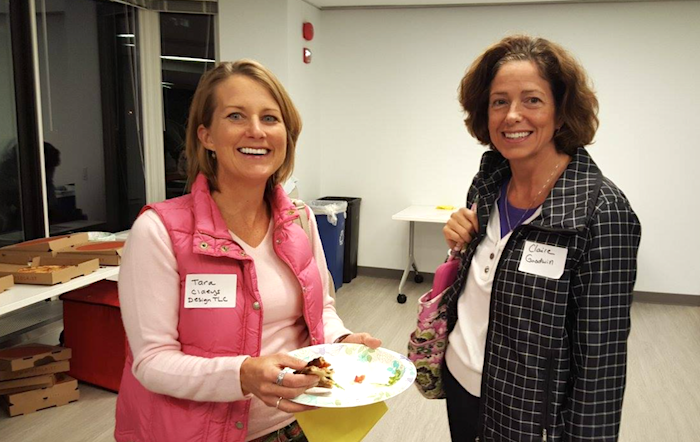
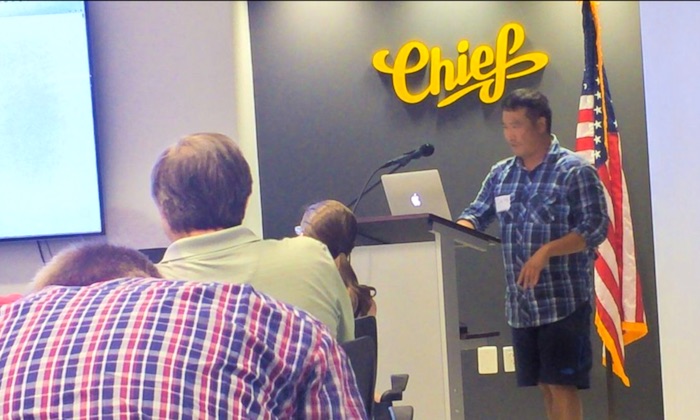
“Thank you so much for your donation to our monthly meetup,” said Scott Johnson, CEO of Agency Chief. “Hope this didn’t set you back much.”
“It didn’t cost us a dime, but getting these pies wasn’t easy.”
“Hope you didn’t have to do anything under the table. Either way would love for you to share your experiences at our next WordPress meetup.”
“Can I share my portfolio with the audience?”
“Absolutely, just don’t talk about your work for Mpire or the Showcase Theater.”
In October 1984, I enlisted in the Navy straight out of high school in a small town in Southeast Georgia. After serving aboard the USS Francis Hammond (FF-1067) in Yokosuka, Japan (the land of my mother), I applied for a commissioning program and the Navy awarded me a scholarship to the University of Florida where I earned my degree in Material Science and Engineering. Upon my commissioning, I served as a Fire Control Officer and Navigator aboard USS O’Ban non (DD-987) in Charleston, South Carolina. and Mayport, Florida, and as Cruise Missile Training Officer in San Diego, California. After back-to-back sea tours, I wanted to broaden my horizons beyond Surface Warfare so I lateral transferred to the Public Affairs Community. I served as the P.A.O. for the USS John C. Stennis (CVN-74), which deployed for Operation Enduring Freedom after 9/11, and as the Public Affairs Officer for Bethesda Naval Hospital (now Walter Reed) where a generation of warfighters healed and moved on. After Bethesda, I was assigned to The Office of the Secretary of Defense where I served as a spokesman for detainee affairs in Guantánamo Bay, Cuba. There wasn’t a single day that I wasn’t answering a media query about the health and well-being of our Gitmo detainees, and after two years of shuffling back and forth from D.C. to Camp Delta, I was ready to return to military medicine. I served as the P.A.O. for the Surgeon General of the Navy, an assignment that required a lot of traveling to visit our medical forces in the U.S. and abroad. My final duty was as a P.A.O. for the U.S. European Command and NATO’s Supreme Allied Commander where I got to do a lot of traveling in Europe as well as visit our troops in Afghanistan. By then, I was both burned out and washed out and my marriage fell apart due to the stressors of the military, and in Nov. 2009, I retired with 20 years of combined service.
I was ready to reboot and start a brand new career in the private sector. Thankfully, the Veterans Affairs offered generous G.I. Bill education benefits, so I applied to the George Washington University School of Business hoping to incorporate my experience and appreciation with social media in my career. I enrolled in the Executive MBA program, a degree where I fit in because it was targeted to senior managers who were already in the workforce. The school was in high demand due to the great recession as many unemployed decided to return to school. Before the semester started, our cohort of 20 eager students embarked on a five-day retreat at the Homestead Resort in Hot Springs, VA.
We were attending sessions that didn’t require powerpoint or pointers, but still had everything to do with leadership development. Because the truth is, you can’t learn management from just inside a classroom.
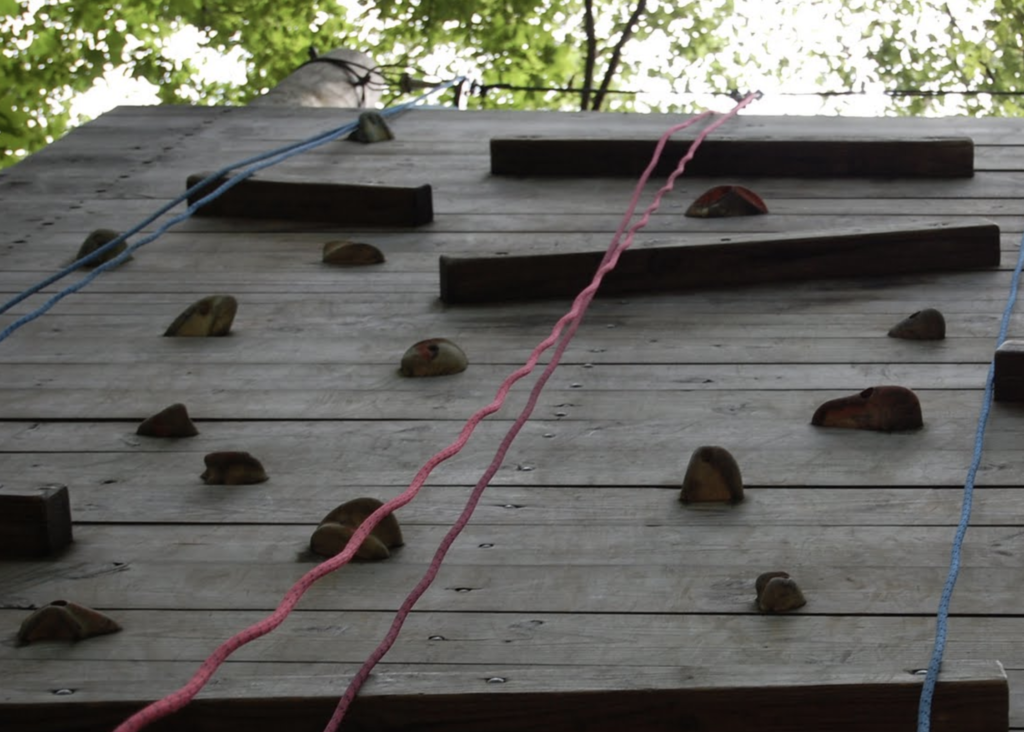
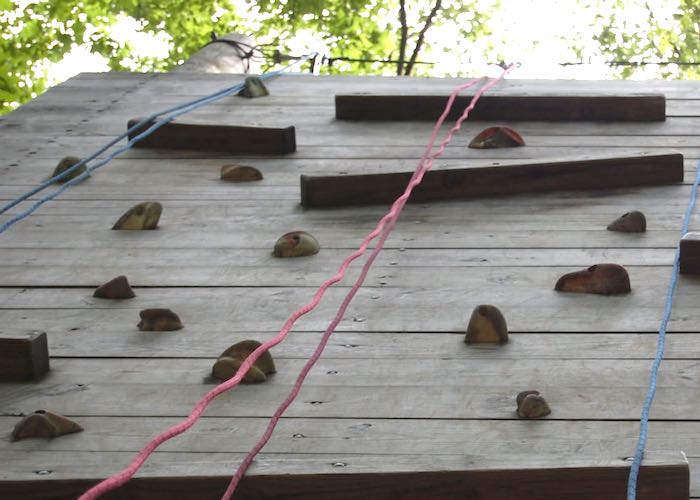
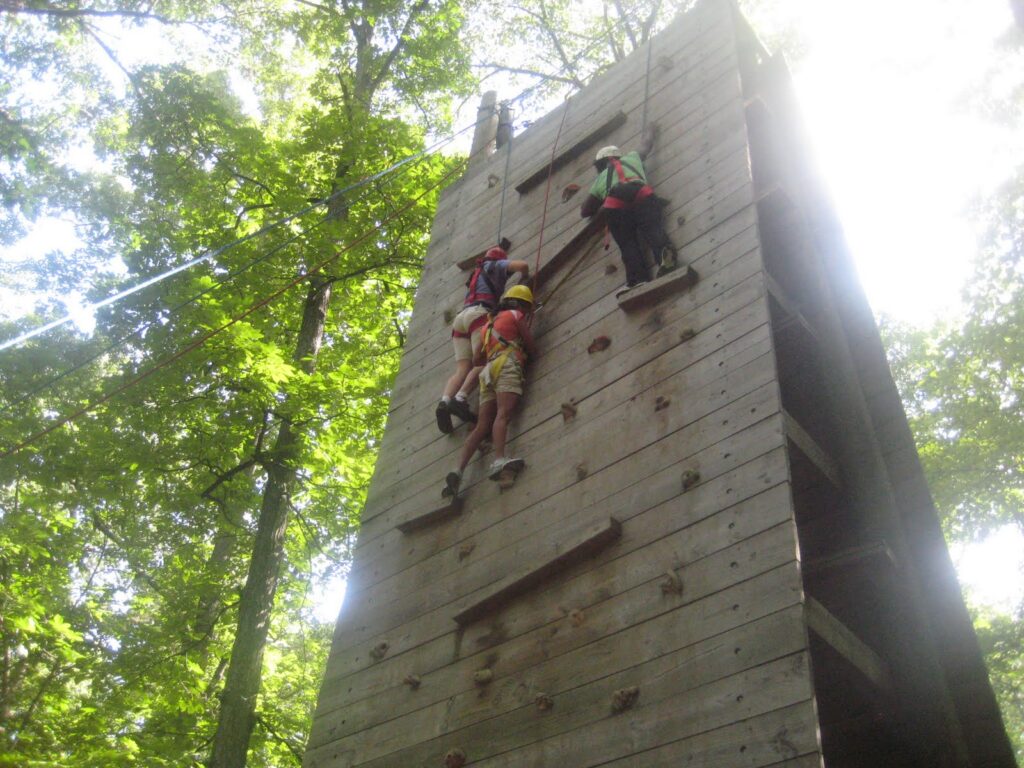
After spending two days engaged in team-building exercises and thought-provoking discussions, we were ready to get some fresh air. The next morning, we hiked down the Allegheny Mountain gorge trail, through the thick forest, past the lovely cascade falls until we arrived in the middle of a grassy field with a gigantic wall affectionately known as the Tower. At first glance, the 40-foot Tower seemed daunting and insurmountable.
Throughout life, we face many obstacles both personal and professional. The key to responding to these roadblocks is to face them head-on and to rely on the support from others around you. This is teamwork — being supported and supporting each other. To work as a team, it’s imperative to understand each other’s strengths and weaknesses, both physically and mentally. The better we know one another, the better we’re able to assist each other.
The Ropes Course is a metaphor for problem-solving — it challenges us to face our fears and climb on. The higher you climb, the more you rely on your team for support.
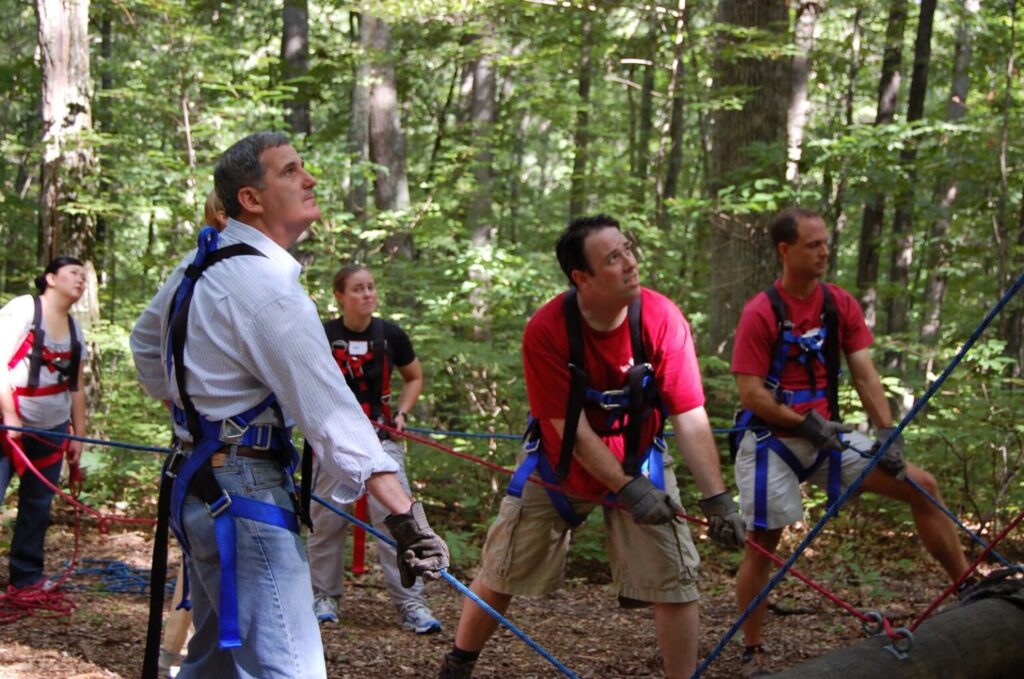
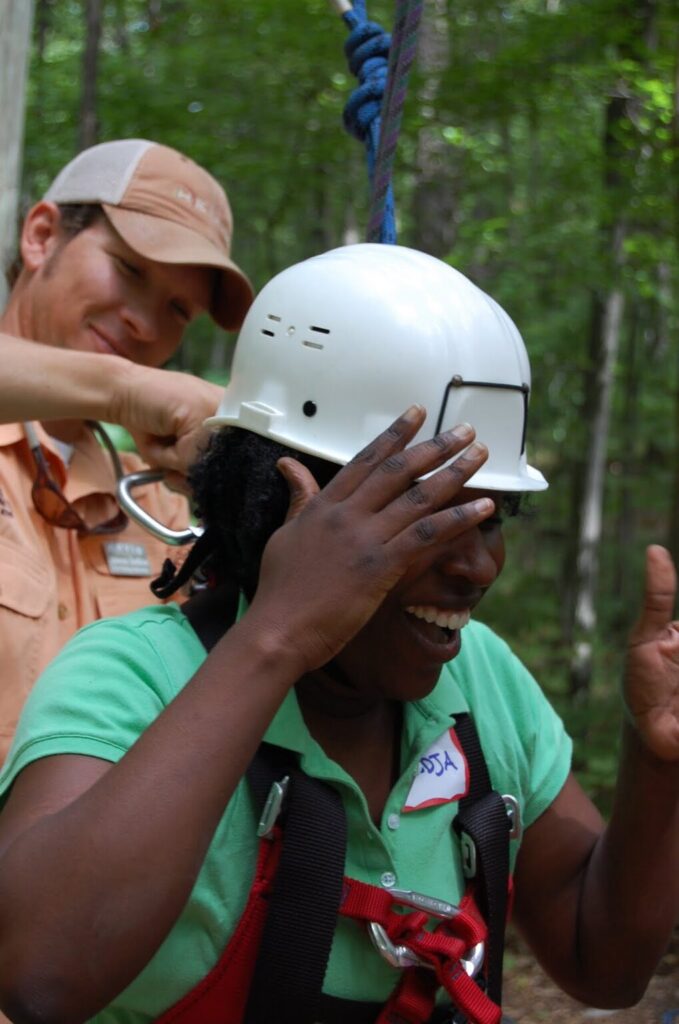
The first task was to have each person assist their team members in donning their harnesses — the one crucial piece of equipment that would ensure our safety and protection.
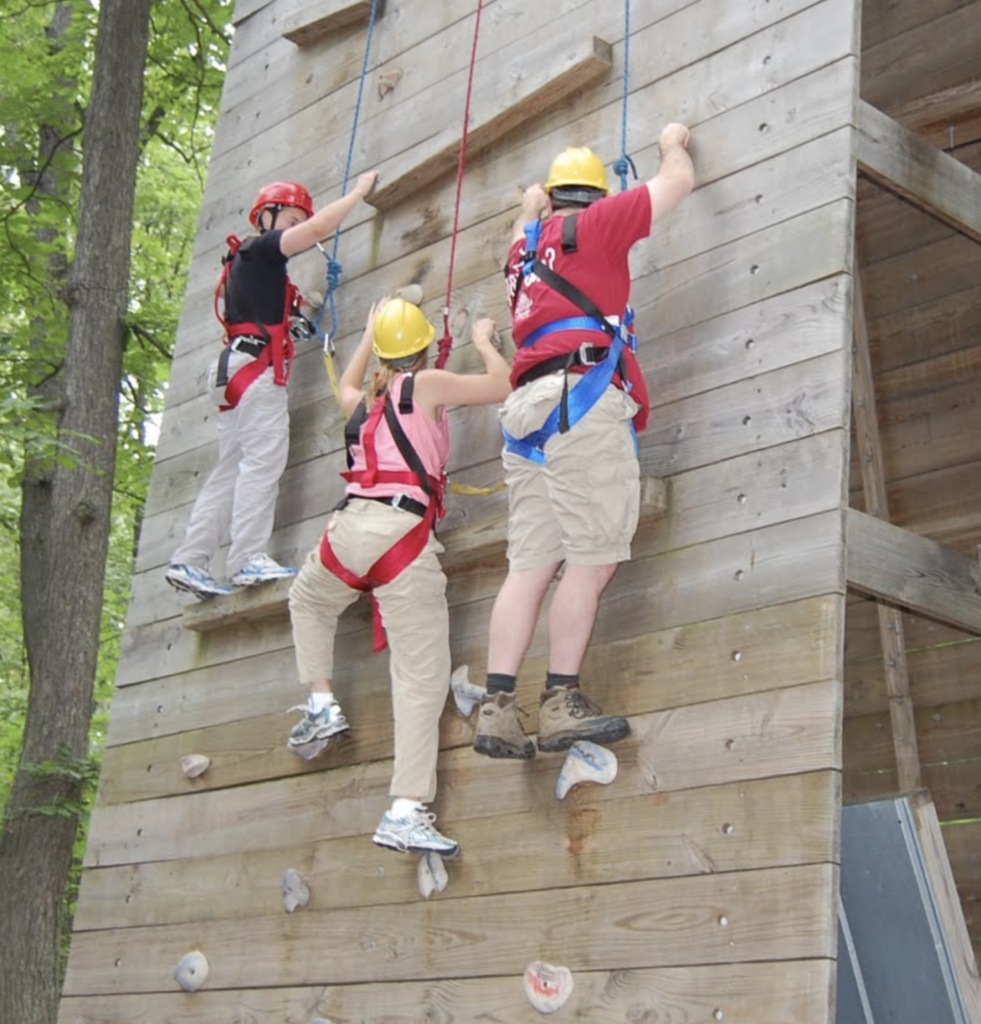
Then each three-member team ascended in tandem facing the challenge of not having enough steps for all three to ascend at the same time. Sometimes a climber would have to take a step down in order for another climber to proceed. That was ok, as long as they all reached their final goal together.
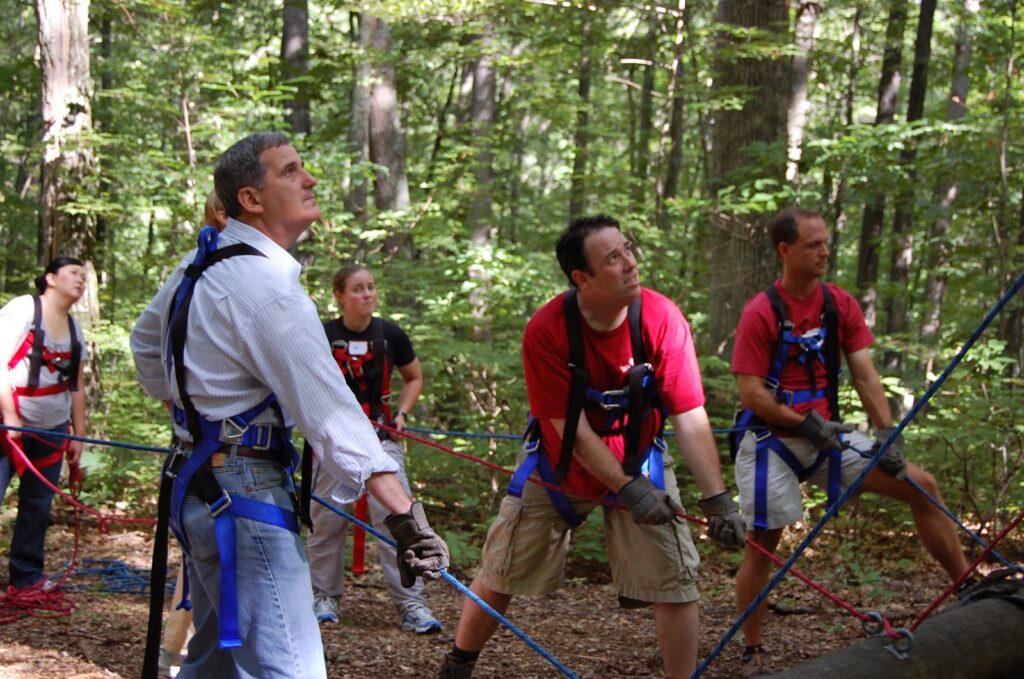
Meanwhile, the rope handlers kept a close eye on the climbers, coaching them on where to place their hands and feet and providing support and encouragement so that the 3-member team could ascend up to the top together and then back down.
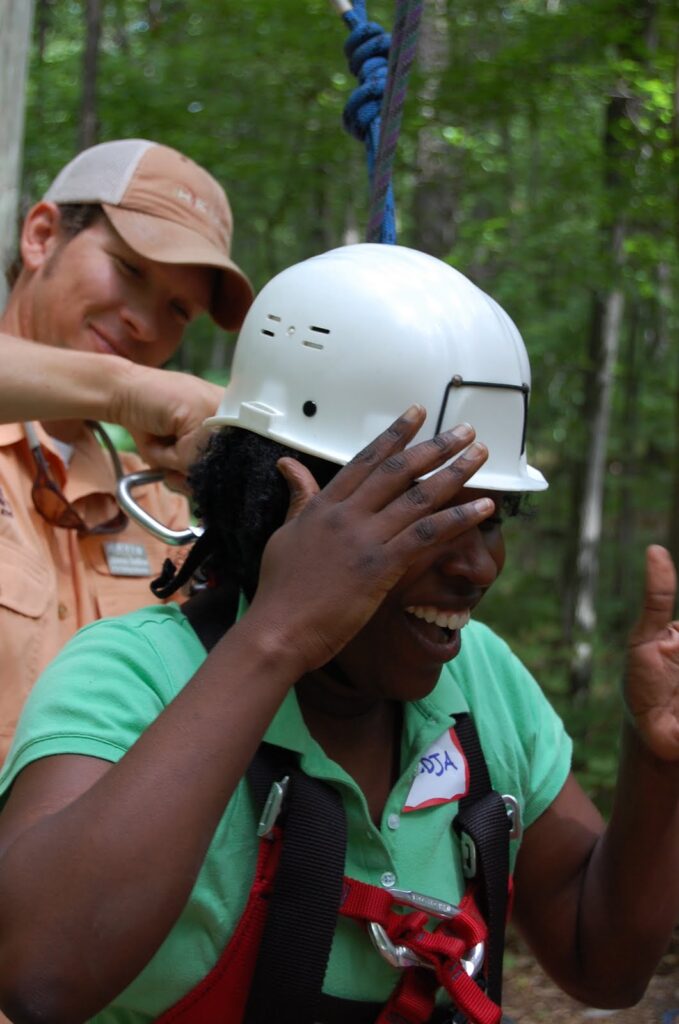
When it was my turn to go, I knew I could rely on my teammates Senodja Walker and Amir Moore.
Rope team:
“Senodja, place the right hand on the block and your left foot on the step.”
“Amir, move your right foot off the step and place it on the block so that Senodja can place her foot on it.”
As the climbers moved up the wall and then back down, the Belay teams were tasked to remove the slack by paying out or pulling in the excess line. They kept a close eye and a taut line, but they were not allowed to pull the crew up the wall — the climbers had to figure this out on their own.
Climbers: “Slack!” (pay out a little rope.)
Belayers: pays out the rope and pauses to see if climbers ask again.
Eventually, all of us made it over the wall and back down, taking one step at a time. The journey in life is rarely simplistic and straightforward. If we keep striving, we will eventually reach our goals, even if we have to climb over life’s challenges, obstacles, and setbacks.
Senodja completes her climb
The EMBA class was broken down into five groups of four and we would remain in our group for the entire two years. One of the first projects that we worked on was the Airline Pilots Association. ALPA, with 53,000 members and 40 airlines in the U.S. and Canada, is the largest airline labor union in the world.
We were having a conference call on Skype when I touted the fact that airlines such as Jet Blue and Delta have successfully used Twitter and Facebook to promote their services and to provide updates on weather and flight cancellations.
“I’ve had it with you. Your solution to everything is always social media!” Eli my classmates exclaimed.
This wasn’t the first time he had said that and we always seemed to butt heads over the value of social media for building brand awareness and winning new customers.
I immediately slammed the phone down in disgust, ending the conference call.
The next thing I did was call Senodja on the phone. “I can’t work with Eli any longer — he’s so unaccepting of social media. I’m here to learn and broaden my horizon, not to clash heads with idiots who are operating in the stone age.”
“Wish you could join my team, but we’re already maxed out.”
“Then maybe I should try to understand his point of view better and discuss our differences.”
“Or perhaps you could transfer out of the EMBA and enroll in the Professional MBA program — it may take a little longer to complete but you’re offered a choice of a wide selection of classes and will be collaborating with a diverse myriad of people, many I’m sure value the virtues of social media.”
October 1984
I enlisted in the Navy, straight out of high school in a small town in Southeast Georgia., named Darien. After serving aboard the USS Francis Hammond (FF-1067) in Yokosuka, Japan (the land of my mother), I applied for a commissioning program and the Navy awarded me a scholarship to the University of Florida where I earned my degree in Material Science and Engineering. Upon my commissioning, I served as a Fire Control Officer and Navigator aboard USS O’Ban non (DD-987) in Charleston, South Carolina. and Mayport, Florida., and as Cruise Missile Training Officer in San Diego, California. After back-to-back sea tours, I wanted to broaden my horizons beyond Surface Warfare so I lateral transferred to the Public Affairs Community.
I served as the Public Affairs Officer for the USS John C. Stennis (CVN-74), which deployed for Operation Enduring Freedom after 9/11, and as the P.A.O. for Bethesda Naval Hospital (now Walter Reed) where a generation of warfighters healed and moved on. After Bethesda, I was assigned to The Office of the Secretary of Defense where I served as a spokesman for detainee affairs in Guantánamo Bay, Cuba. There wasn’t a single day that I wasn’t answering a media query about the health and well-being of our Gitmo detainees, and after two years of shuffling back and forth from D.C. to Camp Delta, I was ready to return to military medicine. I served as the Public Affairs Officer for the Surgeon General of the Navy, an assignment that required a lot of traveling to visit our medical forces in the U.S. and abroad. My final duty was as a P.A.O. for the U.S. European Command and NATO’s Supreme Allied Commander where I got to do a lot of traveling in Europe as well as visit our troops in Afghanistan. By then, I was both burned out and washed out and my marriage fell apart due to the stressors of the military, and in Nov. 2009, I retired with 20 years of combined service.
I was ready to reboot and start a brand new career in the private sector. Thankfully, the Veterans Affairs offered generous GI Bill education benefits, so I applied to the George Washington University School of Business hoping to incorporate my experience and appreciation with social media in my career. I enrolled in the Executive MBA program, a degree where I fit in because it was targeted to senior managers who were already in the workforce. The school was in high demand due to the great recession as many unemployed decided to return to school. Before the semester started, our cohort of 20 eager students embarked on a five-day retreat at the Homestead Resort in Hot Springs, VA.
We were attending sessions that didn’t require powerpoint or pointers, but still had everything to do with leadership development. Because the truth is, you can’t learn management from just inside a classroom.
After spending two days engaged in team-building exercises and thought-provoking discussions, we were ready to get some fresh air. The next morning, we hiked down the Allegheny Mountain gorge trail, through the thick forest, past the lovely cascade falls until we arrived in the middle of a grassy field with a gigantic wall affectionately known as the Tower. At first glance, the 40-foot Tower seemed daunting and insurmountable.
Throughout life, we face many obstacles both personal and professional. The key to responding to these roadblocks is to face them head-on and to rely on the support from others around you. This is teamwork — being supported and supporting each other. To work as a team, it’s imperative to understand each other’s strengths and weaknesses, both physically and mentally. The better we know one another, the better we’re able to assist each other.
The Ropes Course is a metaphor for problem-solving — it challenges us to face our fears and climb on. The higher you climb, the more you rely on your team for support.
The first task was to have each person assist their team members in donning their harnesses — the one crucial piece of equipment that would ensure our safety and protection.
Then each three-member team ascended in tandem facing the challenge of not having enough steps for all three to ascend at the same time. Sometimes a climber would have to take a step down in order for another climber to proceed. That was ok, as long as they all reached their final goal together.
Meanwhile, the rope handlers kept a close eye on the climbers, coaching them on where to place their hands and feet and providing support and encouragement so that the 3-member team could ascend up to the top together and then back down.
When it was my turn to go, I knew I could rely on my teammates Senodja Walker and Amir Moore.
Rope team:
“Senodja, place the right hand on the block and your left foot on the step.”
“Amir, move your right foot off the step and place it on the block so that Senodja can place her foot on it.”
As the climbers moved up the wall and then back down, the Belay teams were tasked to remove the slack by paying out or pulling in the excess line. They kept a close eye and a taut line, but they were not allowed to pull the crew up the wall — the climbers had to figure this out on their own.
Climbers: “Slack!” (pay out a little rope.)
Belayers: pays out the rope and pauses to see if climbers ask again.
Eventually, all of us made it over the wall and back down, taking one step at a time. The journey in life is rarely simplistic and straightforward. If we keep striving, we will eventually reach our goals, even if we have to climb over life’s challenges, obstacles, and setbacks.
The EMBA class was broken down into five groups of four and we would remain in our group for the entire two years. One of the first projects that we worked on was the Airline Pilots Association. ALPA, with 53,000 members and 40 airlines in the U.S. and Canada, is the largest airline labor union in the world.
We were having a conference call on Skype when I touted the fact that airlines such as Jet Blue and Delta have successfully used Twitter and Facebook to promote their services and to provide updates on weather and flight cancellations.
“I’ve had it with you. Your solution to everything is always social media!” Eli my classmates exclaimed.
This wasn’t the first time he had said that and we always seemed to butt heads over the value of social media for building brand awareness and winning new customers.
I immediately slammed the phone down in disgust, ending the conference call.
The next thing I did was call Senodja on the phone. “I can’t work with Eli any longer — he’s so unaccepting of social media. I’m here to learn and broaden my horizon, not to clash heads with idiots who are operating in the stone age.”
“Wish you could join my team, but we’re already maxed out.”
“Then maybe I should try to understand his point of view better and discuss our differences.”
“Or perhaps you could transfer out of the EMBA and enroll in the Professional MBA program — it may take a little longer to complete but you’re offered a choice of a wide selection of classes and will be collaborating with a diverse myriad of people, many I’m sure value the virtues of social media.”
Nicole Foster was the wet behind the ears Marketing Manager trying to drum up new clientele for the President’s Sports Bar at the Renaissance Hotel in the Penn Quarter.
So when I got a call from the Marriott, requesting our services, I wasn’t about to turn it down.
As I walked around the expansive lobby, I noticed how drab, gray, and uninviting it was. The only customers I saw in the President’s Sports Bar were mindless tourists in tees and lobbyists in suits sealing deals over after-work cocktails. There were pictures of Kennedy swinging a golf club in Hyannis Port and Reagan in Camp David with Prime Minister Thatcher. There were no pictures of Nixon, but there sure was plenty inside Room 214 at the Watergate building where G. Gordon Liddy directed the infamous break-in of the DNC headquarters, erupting into a major political scandal.
The President’s Sports Bar
At the mahogany wooden bar, a power broker ordered a Watergate: Maker’s Mark, Grand Marnier, Myer’s Dark rum, sugar, bitters, pineapple, and ginger. He’s trying his best to avoid the pitfalls that ensnarled Casino Jack Abramoff, owner of the infamous Signatures Restaurant down the road. The diplomatic presence was so strong that at any moment I could imagine Kevin Spacey playing Congressman Frank Underwood emerging from the VIP dining room uttering his most fallacious quote “The road to power is paved with hypocrisy and casualties.”
“So what did you have in mind Nicole?”
“Well, we’re an old bureaucratic town rooted deep in tradition, so maybe target Young Gov Leaders or D.C. Young Republicans.”
“You’re kidding me. The Renaissance already has its unwavering patronage. Let’s shoot for something totally radical and out of the blue”
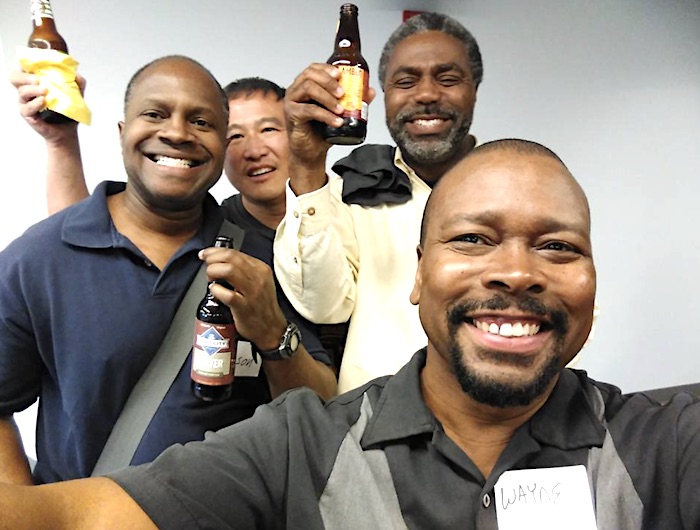
I called my friend, Wayne Manigo, to see if he could arrange a standup show with the area’s best comedians.
“Why comedy?” Nicole asked puzzled and perturbed.
“Cuz people here are so uptight, they need to take the edge off. And comedy relating to the vibrant restaurant industry and addressing the political environment is the perfect panacea for healing.”
Wayne Manigo
WayneManigo
“You know, living in D.C. is like being in a never-ending game of political chess, where every move is a debate and ‘compromise’ is that one piece you lost under the sofa. That’s why we’ve brought in comedy tonight – it’s like finding that lost chess piece, but instead of putting it back on the board, we throw it out the window and laugh about it!”
The audience chuckled, and Wayne continued, “And don’t worry, the only thing we’ll be staining at the Marriott tonight is your memory with good jokes. We’re keeping it clean – so clean, you could serve dinner on our punchlines and still pass a health inspection.”
“I kicked off the Comedy Writers Group in 2011, because let’s face it, a joke unshared is like a politician who doesn’t tweet – it just doesn’t make an impact. Comedy’s a team sport; without someone to laugh, a joke’s just a sentence with too much attitude.”
“The Fabulous Fat Doctor Blagmon held his comedy classes with us at Judy’s Bar & Restaurant. Fat Doctor Blagmon always said, ‘Write in your journal every day. Even if all you’ve got is ‘I’ve got nothing,’ scribble that down. It’s like a placeholder for your future genius – or your future grocery list. Either way, you’re winning.’”
“My idol, Richard Pryor, was a master at mixing comedy with tragedy. Kind of like a chef who mixes sweet and sour, except instead of a dish, you get a life story. And in my case, let’s just say my life’s recipe is one part comedy, two parts ‘Oops!’, and a sprinkle of ‘Did that really happen?’.”
“Back in the day, I was the go-to IT wizard at the SEC. You know, Securities and Exchange Commission, where the only securities I was exchanging were sleep for stress. My life was a series of night calls, like a superhero, except my superpower was rebooting routers at 3 AM. I got so good at navigating the dark, I thought about moonlighting as a burglar.
But, like any sensible person who finds themselves whispering sweet nothings to a modem at 2 in the morning, I had an epiphany. So, I quit, embracing freedom… a little too enthusiastically, it seems. Before I knew it, my new office had four wheels, and my home address was ‘various locations in Northern Virginia’.
Living out of my car, I became a nomad with a library card. Reston, Rockville, Falls Church – I was the only guy doing a library tour without a book signing. And let me tell you, nothing says ‘I’ve made it’ like waking up to a view of the Reston Public Library.
Visiting friends in D.C. became a special operation. My car tags expired, making my vehicle as welcome in the city as a skateboard in Congress. So, I’d park in another state and take the Metro in, like an international commuter.
And here’s a pro tip for you: the key to seamless urban camping is to never look like you’ve just rolled out of a tent. I mastered the art of looking casually homeless – it’s all about the ‘business casual’ homeless chic.
Falling down became my weekly exercise. It’s amazing how a public stumble turns you into a stand-up comedian. You learn to laugh it off, mostly to assure bystanders you haven’t broken anything expensive, like your pride.
Through it all, I found the secret to a stress-free life: inner peace, zen, and the unshakable belief that if I can handle a conference call while parked outside a Starbucks for free Wi-Fi, I can handle anything.
So, here’s to the journey from IT help desk to helping myself. Turns out, the biggest reboot I needed was for my own life. And maybe, just maybe, the real securities were the friends we made along the way. No? Just me? Alright then.”
Comedy:
“In my latest adventure, I’ve taken on the role of Comedy Entrepreneur, which is like being a regular entrepreneur but with better jokes and slightly worse financial planning. My mission? To turn D.C. into the comedy capital of the world. Move over, politics; it’s time for punchlines.
Our approach is simple but revolutionary. We target bars on their quietest nights, you know, when they’re just one sad song away from becoming a country music cliché. We walk in and say, ‘Hey, how would you like us to pack this place with laughter and customers? No, this isn’t a joke, but we do have plenty of those.’
We kicked things off at Recessions Bar, because what better place to start a comedy revolution than a spot named after economic downturns? Our concept is ‘Comedy x 10’ – featuring ten different comedians each week. By the end of the month, that’s 40 comedians, each with their unique brand of humor. That’s not just a comedy show; it’s a comedy marathon with a sprinter’s pace.
Think about it: where else can you hear 40 different takes on life, politics, and why pizza is the perfect breakfast food? Our shows offer a smorgasbord of perspectives, ensuring that if one joke doesn’t land for you, the next one might just be your new favorite.
This model doesn’t just breathe life into slow nights; it creates a vibrant, dynamic community hub. We’re not just filling seats; we’re creating an ecosystem where comedians thrive, bars flourish, and audiences get their weekly dose of serotonin. It’s a win-win-win, the trifecta of entrepreneurial success.
Our vision is to make D.C. not just the capital of the country, but the comedy capital as well. A place where laughter drowns out the noise of politics, if only for a night. So, if you’re looking for a revolution, join us. After all, in D.C., we’re used to uprisings – but this time, we’re rising up in laughter.”
Chef:
So did you know that I’m a part-time chef? Chefs Jared Thomas and his mentor Marianne from D.C. Central Kitchens trained me. They had a powerful way to inspire me and made me fall in love with cooking. Chef Jared has also spoken to the Comedy Writers Group at Judy’s a few times, and he’s not only inspirational but funny.
In fact, he moved me to create a character called ‘Bottom Chef’ for a comedy contest at Hightopps Restaurant in Timonium, MD. My outfit is a chef’s jacket with a logo similar to the ‘Top Chef’ design. Here are some of my jokes:
I start my food prep each day with a ritual — raise my shot glass and yell “Bottoms Up!”
“My culinary education took place behind bars, in the unforgiving confines of a vegan prison. Ever been trapped in a relationship with a vegan? That’s freedom compared to vegan jail.”
“You don’t truly earn the title of ‘Bottom Chef’ until you’ve experienced the culinary depths of ‘Rock Bottom.’ My mentor? Chef Boy-R-Dee. His philosophy? A man, a plan, a can.”
“The city of Buffalo sued me for defamation of their wings.”
“In the heated world of culinary arts, Chef Gordon Ramsay isn’t the pioneer of kitchen meltdowns. I’ve been perfecting the art of the scream long before it was televised. ‘Threaten me with prison again, and it’s not the food that’ll get chopped.’”
“I once ascended to dubious fame as the face of Spam. Remember, Spam isn’t just for dinner; it’s a last resort. If the dog turns its nose up, you know it’s yours.”
“As ‘Bottom Chef,’ I’ve innovated the cooking process by pre-ruining your meal. Why wait? I’ll splatter the food directly into your toilet.”
“These days, my signature dishes are anything that can be drowned in hot sauce and red wine. It’s a delicate culinary balance—some for the pan, more for the chef.”
Amidst the trials of trying every new restaurant in town, I’ve realized perhaps my most needed culinary tool isn’t a spatula—it’s a personal trainer. As Orlando Darden playfully noted, “It might be time to cut back on the beer.” His comment, met with roaring laughter, reminded us all that the essence of good comedy, like good cooking, lies in its relatability and the joy it brings to those who partake in it.
The room was filled with laughter, and Nicole couldn’t help but enjoy the comic relief that Wayne was providing. She leaned back in her chair, more relaxed than before. Next was Leon Scott, a Comedian, Writer and Journalist for WUSA-9 CBS.
Leon Scott
Next was Leon Scott, a Comedian, Writer, and Journalist for WUSA-9 CBS.
“What’s going on? How’s everyone doing? Feel good, Well I feel great and lemme tell you why. I got the best back-handed compliment I ever got in my life. I was out and this tall woman walked up to me and said ‘You concentrated sexy.’ That’s like saying just add water and you become 6’5″. I’ve never felt that tall in my life.
My best friend Rome is 6’5″, and he always says things that takes being tall for granted. He would say ‘Man, being tall doesn’t help me meet women.’ And his voice is tall.
That’s a lie cuz I’ve never had a woman come up to me and say. ‘So I saw the top of your head from across the room.”
But being short hasn’t stopped me from going on TV. I just gotta sound tall. Speaking about news media, would like to introduce the next segment — Real Time with Bill Maher.
Dan Verkman
Hi, I’m Dan Verkman, but everyone tells me I look like Bill and they say it in a way like I’ve never heard it before.
“Do you know who you look like?” or “Anyone ever tell you who you look like?” Yeah only for the umpteenth time today. Now buzz off.
I do get a lot of people checking me out like I’m so kind of a weirdo. Unless they yell ‘Bill’, I’m never sure why they’re staring. Do I have a big booger in my nose, is my hair sticking up, is my fly down?
Doctor’s Office:
One time I was checking if for a doctor’s visit and I overheard an older married couple talking. “Hey, that guy looks like that comedian guy from TV,” the husband says. Then, a couple of minutes later you hear him say, “even acts like him too. A real jerk”
Then after filling out my paperwork and I sit down, he leans over to ask me. “Ever hear of a TV personality named Bill Maher?”
I looked at him like he was from outer space. “Who the hell is he?” Sometimes it’s smart to play dumb.
Supermarket:
Then there’s the moment I was going through the checkout counter at the supermarket, and the cashier says, “You know who you look like..?”
“Yes!” I responded hoping she won’t press me further.
“I’ve seen you in line before, you have a home in the DMV, don’t you..?”
“Ah, yeah.”
“Well, who’s doing the cooking?”
“The writers,” I responded hoping she would realize that I was just pulling her leg.
“You’re gonna mention me on your show aren’t you?
“Only if you don’t charge me the county bag fee.”
“You kidding with the millions you have, you could buy the entire store.”
I can’t even walk down main street any city, without someone yelling from their car.
“Hey Bill, saw you on TV last night. Love your show.”
Speed Dating:
But I’m not complaining. Looking like Bill has gotten me a lot of perks. Went on a speed dating event the other night where I was told by 10 different girls “Did anyone ever tell you who you look like?”
One girl asked, “What do you do?”
“I make people laugh.”
“Are you a comedian?”
“No, I write code.”
Tattoo Bar:
Afterward, I went to the Tattoo Bar up the street and was approached by 3 hot chics who asked for a pic. The bar manager then said, “Name it, you got it.” Then a tough-looking dude approached and said “You really him? You look different on TV.”
Metro:
On the metro ride to a show one night, two Black guys approached and said “Anyone ever tell you, you look like Freddy Krueger?” I know Bill can be evil, but that’s pretty extreme.
After the show, two Black girls called out from an Audi.
“Bill Maher!”
“Yes, better than Freddy.”
“You wanna smoke a bowl with us?”
The audience clapped hands. Someone yelled “Bill has jungle fever you know. Play the role.”
Karaoke:
I sing karaoke, and sometimes I put my name in as Bill M. One girl thought I was Bill Murray and had me autograph her forearm.
One hot blonde came over and nearly sat on my lap and whispered “I know who you are.”
“How was she in bed?” someone chuckled.
Let’s just say, I played the role that night.
Art Show:
One time I was at an art show in Bethesda when I met Anne Currie from the Today show. And she asked what I was doing here.
In a somewhat inebriated state from all the free wine they were serving, I told her I was in town for the White House Correspondents Dinner. — I had just overheard it was the next day just a few minutes earlier.
I think she actually believed me cuz I can play the role of a journalist pretty convincingly.
House of Cards:
Did you know I auditioned for the journalist role on House of Cards? They had me read three roles, all political pundits. The first role was as a Glen Beck guy. Everybody auditioning was a real reporter. The guy who auditioned before me was Jamie McIntyre from CNN. He said to me while we were in the waiting room “You know, you look quite familiar.”
So now you can add a new title to my resume — Bill M. the actor.
The audience gave Dan a standing ovation. “You should write a book about this!” Wayne suggested. “It’ll be an N.Y. Times Bestseller”
At the end of the night, Nicole came over and gave me a pat on the shoulder.
I turned around and said, “So comedy night was a smashing success. We were able to reach out to the young millennials who love to meet, laugh and drink. We should do a sequel.”
“Are you kidding me, some of these jokes were downright raunchy. Wayne was inspiring, but some of the standups really bombed it. And Dan may be Bill’s doppelganger, but I’m not interested in hearing about his sexcapades. Tonight, you’ve embarrassed the Marriott name. JW himself would turn over in his grave.”
Wayne shook his head and grimaced. “So I guess there won’t be a part deux.”
“Yup back to the ole drawing board,” I lamented.
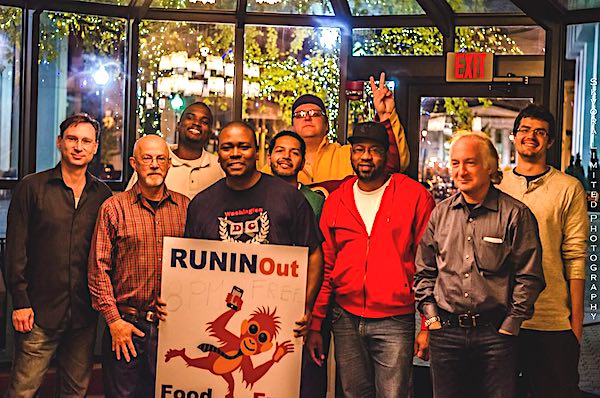
9 Comics & a Monkey at the Renaissance Hotel Standup
The views at the Georgetown waterfront were busy with paddle boarders launching from the Key Bridge Boathouse and lunchers enjoying the open patio seating at Sequoia and Tony & Joe’s Seafood Place. Bikers were crisscrossing the Capital Crescent trail on their way to Bethesda or Cabin John. Runners and strollers were enjoying the historic C&O Canal stopping at the numerous bakeries and coffee shops to grab a bite or to enjoy the rich, sweet aroma.
While kids were splish-splashing in the fountain and grown-ups were getting their feet wet, Sunita Amatya was sitting on the side of the river, praying for the thousands of lives lost thousands of miles away.
On April 25, 2015, a 7.6 magnitude earthquake struck the city of Kathmandu in central Nepal killing 9,000 people, affecting millions of lives, and causing $10 billion in damage.
“May the tragic and devastating situation get better with Divine grace. May all five elements of the creation (earth, water, fire, space, and air) be balanced forever and will there be no more natural disasters,” she chanted towards her Supreme Deity.
The common belief is that to experience enlightenment one must be quiet and sit motionlessly. But that couldn’t be further from the truth. Then as her prayers to Dharma were received, her devotion transformed to dance as hundreds of sightseers and gawkers were entranced by her majestic movements. But this was not a performance. Sunita was touching her dimension beyond her limited mind and body. It was an inner engineering language to express life energy while using the body as an instrument.
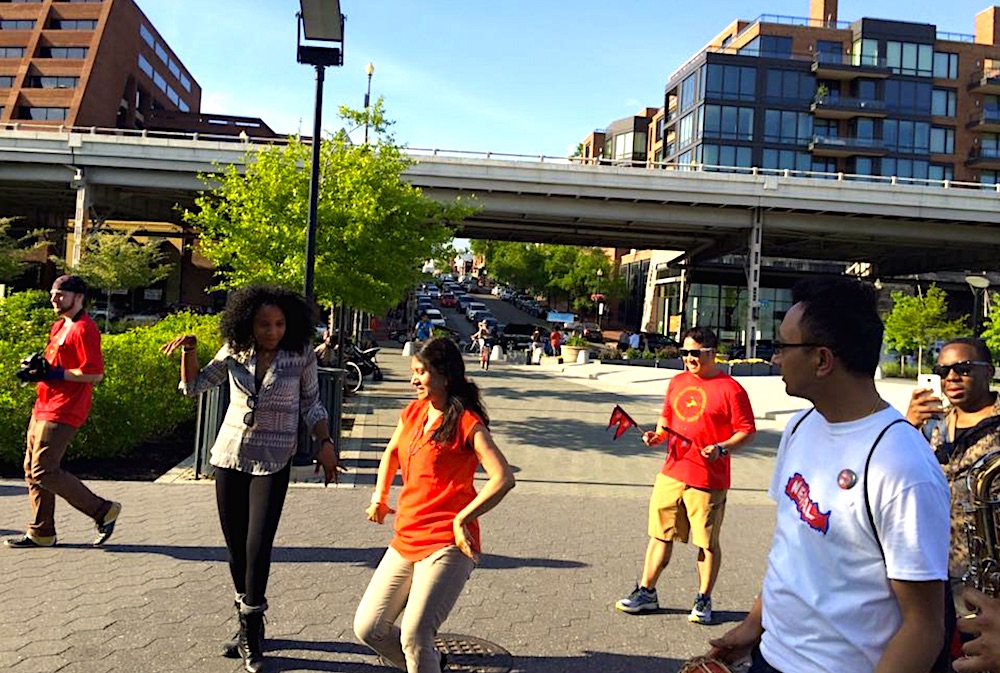
Suddenly out of the corner of her eye, she saw a spirited straggle of runners. Not just any runners that you would see spurting all over the pristine paths of D.C. But these exuberant runners were adorned in bright red Embassy Run shirts, matching their crimson red Nepali flags they were waving. The color symbolizes the brave spirits of the Nepalese people and the two triangular pennants represent the Himalaya Mountains and the two major religions: Hinduism and Buddhism.
The astounding sight was too coincidental to be a coincidence. She quickly rose and with the enlightened spirit of Buddha followed the throng to a neighborhood saloon on Water Street called Mr. Smith’s.
For a second, she wondered whether she belonged here. The pub was unassuming and low-key, and there she saw what seemed like a hundred road-weary warriors all dressed in crimson red, nursing a cold Dos Equis.
“Saw you guys running by the waterfront. Are you running for Nepal?” she asked gingerly.
“Absolutely, we’ve been running 13 miles and raising awareness for survivors of the earthquake,” I answered. “Are you from Nepal?”
“Why yes, I was just at the park praying and dancing for the plight of our people. And Prince Shiva led me down this path to join your gathering.”
“That’s quite poignant. We were devastated when we heard about the earthquake, and we wanted to use our run as a vehicle to raise awareness and funds.”
“Then Prince Siddhartha answered my prayers. My son, Sudin, and I are also raising money for recovery and relief, but our efforts to date have fallen short.”
“I think there are ways that we can collaborate. But first, tell me why dancing is so transformative.”
“Dancing helps us purify our thoughts and heart and heals us from physical and mental pain. It’s to let God in and to let go of any negativity — to attain bliss.”
“Wonderful, Audrey Pichmimi said. “Can you show us outside how you perform your dance?”
Sunita showed us how to dance for enlightenment on the Georgetown Waterfront
The following Thursday evening, a couple of dozen revelers, runners, and members of the Newah Organization of America (NOA) amassed at Courthaus Social in Arlington to honor the people of Nepal, discuss earthquake relief opportunities, and enjoy music and dance.
Sudin plays Sax @ Courthaus Social
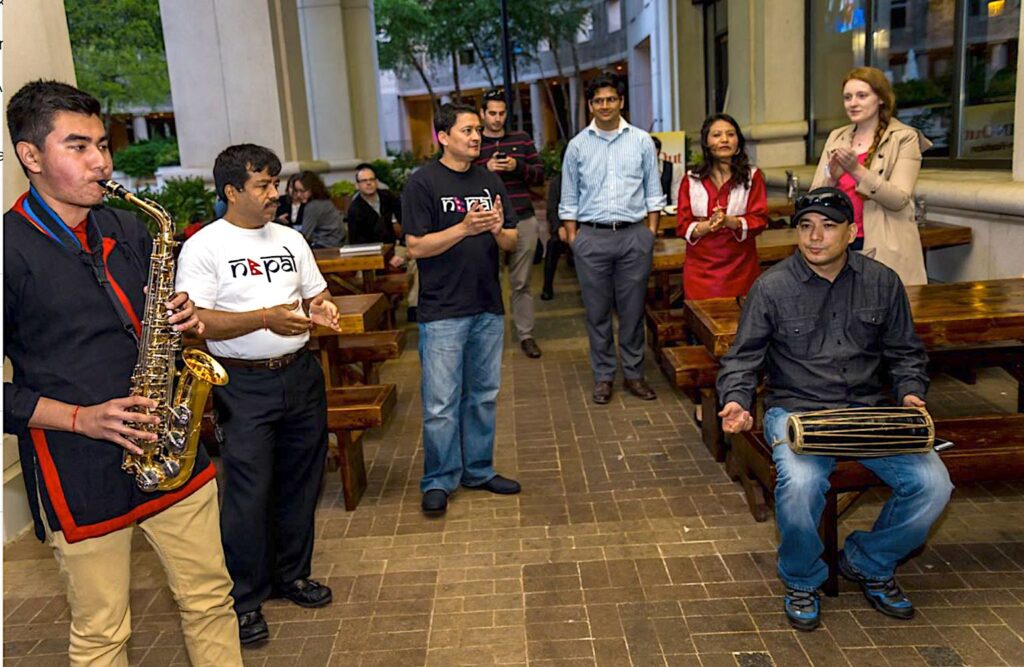
Sunita brought her talented son 16-year-old, Sudin who played the sax and sang traditional folk music. The music carried powerfully through the outdoor patio on a warm spring night, and many onlookers inquired about the cause — NOA was able to also receive generous donations from those who were deeply touched and wanted to show their support.
We charged $20 for entry which included a wide selection of appetizers. Jackie was instrumental again, spreading the word and getting people to book the event through her site, Bookalokal
Audrey, who was enamored with Sunita’s faith, returned to help raise money and to enjoy Nepali music.
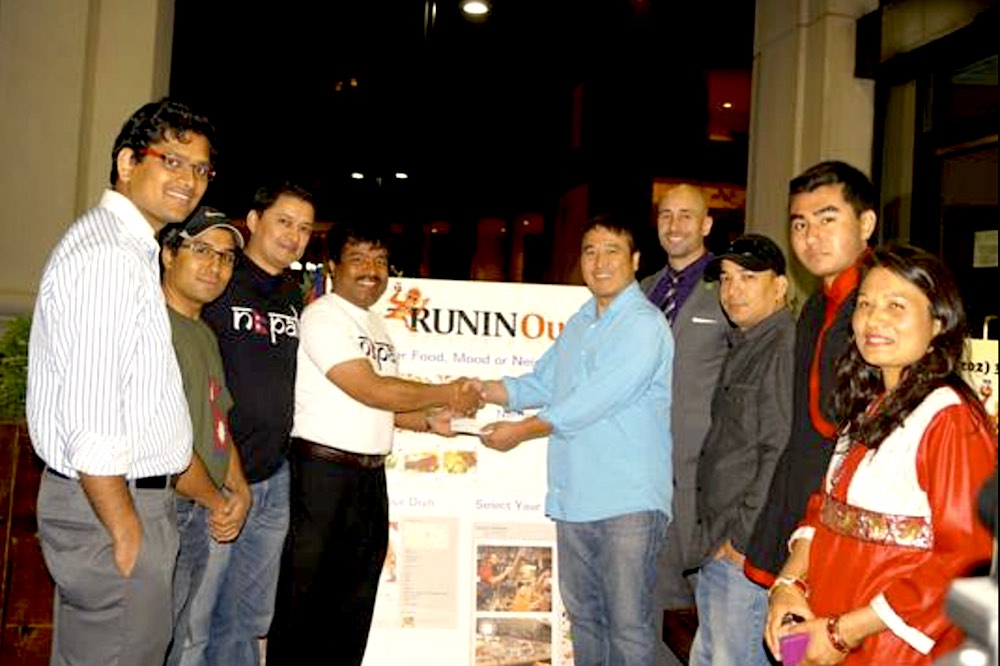
By the end of the night, we were able to present NOA with a check for $1,000
Members of NOA receiving a donation from the Nepal Relief Fundraiser
“We are extremely grateful for your spirit of generosity,” said Ram Shrestha, president of NOA. “We will be able to provide medical supplies and build temporary shelters with these funds.”
“Thank you very much,” Sunita said. “This divine circumstance proves that praying and dancing is indeed transformative.”
“It’s our great pleasure, to serve a small part in this. I’m now a true believer in the power of spiritual dancing. My thoughts and prayers to the courageous people of Nepal.”
RUNIN is not exactly about the joys (or pain) of running. It’s not about running out of food either. Did you realize that RUNIN is actually a back acronym? Huh? Let’s take a look at the qualities of the Ethiopian Diaspora.
They were all Resourceful in surviving tough living conditions and eventually found success in their business ventures. They Understood the local environment well and identified the target market audience before starting their businesses in Ethiopia. They had to Negotiate with business owners, investors and the local governments who at first had little faith in them. They had to be Innovative to find the right business that would fill a void. And they all made bold decisions but remained open-minded and nimble when they Navigated toward their goals.
Resourcefulness:
Resourcefulness is about using the full resource of tools and other people to solve problems and reach goals. When the devastating EF-5 tornado ripped through downtown Joplin, Americans from near and far rushed to lend a helping hand. Thankfully, there was no shortage of compassion and generosity. The AmeriCorps displayed resourcefulness by allowing me to build an online database that tracked donations and matched them with survivors and their specific needs.
When our team didn’t place during Startup Weekend due to lacking a technical co-founder, I had to rely on resourcefulness to find a developer who was flexible enough to fulfill our requirements.
When we reached out to restaurants, many were willing to have us photograph their dishes, but didn’t want the food to go to waste. So we decided to photograph the food in conjunction with events and allow our guests to enjoy it. The events also served to promote the restaurants and we were able to capture amazing photography of attendees enjoying the ambiance and cuisine.
R also stands for Reflecting on what’s important in this journey and seeing how we can make improvements. Deb Santos taught me how to truly reflect — learning to invest in myself and showing self-compassion regardless of my mistakes.
R also stands for Researching. The secret sauce for RUNINOut was the behind-the-scenes research that we did for each restaurant to ensure that the user would get the best results possible.
Understanding:
The Irish Republican Army who sought a united Ireland clashed with the British forces resulting in massive death and destruction. When I visited Belfast, I met a tour guide named Arthur Magee who talked about building bridges. For peace to start and the troubles to end, both sides had to build bridges.
“If you come nigh you will see a city where on a micro level, people are building bridges. The most important bridge that is been built is in each and every single person here. That bridge is between who you actually are and how you see yourself. Whether you’re part of the problem, looking back and blaming other people, or whether you’re part of the solution and reaching out and seeing other human beings, as exactly that, human beings.”
From a business standpoint, one must fully understand the environment, the target market, and the competition in order to build a successful business. The diaspora community had done their research — that’s why they were able to build a leading PR firm, a luxury day spa chain, and a rose farm despite facing steep odds and many doubters that were skeptical that such business ideas could flourish in Ethiopia.
I applied these lessons when I worked with restaurants and bars. When I tried to sell our services to the Irish Channel, they were also receiving bids from other providers. In order to stand out from the competition, I studied the pub’s clientele and target market to determine which sports teams they could affiliate with and which social events we could host.
When the Lebanese Taverna requested to host a belly dancing event with Arabian folk music, I immediately did my research to familiarize myself with the art of belly dancing — I would then need to be resourceful to find the right talent and audience that would attract a strong turnout so we could host many more events and raise money for charity.
Over the years, we ended up working with several different groups and hosted a wide variety of events: running, comedy, political, food blogging — spanning a diverse group of bars and restaurants.
In the end, hosting tons of events took its toll, and I had to honestly look in the mirror and realize that the boozing had gone to extremes and I needed to start tapering off.
Negotiating:
Many restaurants were receptive to our services but did not have the resources or the inclination to pay for them. So we found a clever way to negotiate by having them host our events and provide free food and other amenities. We often got paid, but we were willing to barter web and social media assistance for food, eatups, and fundraisers.
Negotiating is something that I’ve always done my entire adult life. Throughout my entire Navy career, I never seemed to get what I wanted so I had to negotiate for just about everything of value. Successful negotiating requires understanding the other side’s priorities, open communication, and settling differences.
Innovating:
My search for a technical co-founder led me to take a Greyhound to Vancouver to find a web developer who could create our site in Drupal. And once the framework was built, I had to stay current in both Drupal and WordPress by regularly attending tech meetups.
Innovating meant building a menu prototype for Burma Restaurant and Vapiano’s so customers can decide on their orders while waiting in line.
When RUNINOut got rejected by the GW Business Plan Competition, I had to find ways to gain traction with users. It was imperative that we were able to expand our reach throughout the entire city with innovative methods. That meant deploying a used pedicab to market our brand and acquiring loyal followers who would vote for us for Best of D.C. We won the “Best Restaurant App” award in 2012 and 2013, and my alma mater agreed to let us present in the Business Plan Competition after all.
Navigating:
Some people struggle to make a decision. Some may be very simple like what to wear, others are very complex like finding a new job. Many times, we’ll end up regretting the decision that we make, but the worst decision is making no decision. No decision can be a decision, also, but the main thing is you need to take some action.
Navigating means making a decision to go one way and to stay on course despite experiencing choppy seas. It also means making course changes if the path is not the right one for you, even if it means making a drastic change.
I wouldn’t be where we are today if I never got into a scuffle with my GWU classmate causing me to transfer out of the Executive MBA program to the Professional MBA. With more freedom and flexibility, I was able to enroll in a New Ventures class where the idea of RUNINOut came to life.
After working tirelessly for over five years, It was clear that it was time to change course. Hosting events was time-consuming and tiring, and there was usually excessive drinking resulting in anxiety and depression.
It also became clear that we needed to branch out further from the DMV (D.C. – MD – VA).
How we would achieve that and what would the next step would be, was still undecided. But it was clear that it was time to take a radical, new direction.
Wherever we would be going, it would sure be a magical ride that the universe has specifically earmarked for us.
I was driving back from Front Royal, VA, the gateway to the Shenandoah National Park, when I got an unexpected call from a long-time restaurateur friend.
“Manuel, it’s great to hear from you. How’s the Iguina family?”
“Wife and kids are fine. We’re launching a new restaurant theme on H Street.”
“Really, Latin, Puerto Rican?”
“Neither one, I just got hired as the Director of Operations by Ben’s Chili Bowl.”
“Wow, chili and half-smokes – a local legacy. Congrats!”
“Yes, it’s a true iconic symbol, but we’ll be focusing on a totally different cuisine – Southern with a twist of Caribbean.”
“Sweet my friend, on U Street?”
“No, above the new location on 1001 H Street – we’ll be changing its name from Ten 01 to Ben’s Upstairs in “a few weeks.”
That makes a helluva lot of sense. The Ben’s name holds a massive amount of clout. What worked on U Street with Ben’s and Ben’s Next Door should work on H.”
“Yes, we’re thrilled beyond belief, and I would love for you to join our team.”
The following week, I met with Nizam Ali, owner and Vice Chair of the Ben’s Chili Bowl Foundation; Manuel and his Chef who hails from North Carolina, Quinton Mitchell. We formulated a plan to photograph their space and savory dishes, develop a website theme that captures their unique character and aggressively market the space to locals and tourists.
“H Street Fest is the biggest block party in D.C.,” Nizam asserted. “We want to launch Upstairs in conjunction with the Festival and hope that people from all over come in and sample our cuisine and experience our renowned, timeless brand.”
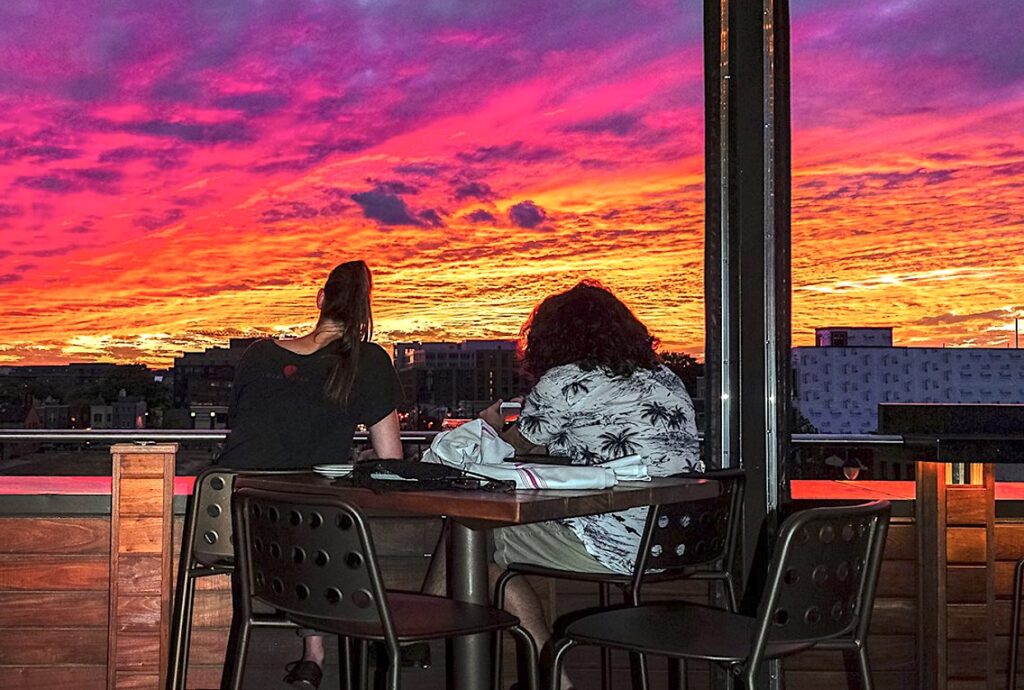
Similar to the iconic lunch counter on U Street with Ben’s Next Door, a historical American restaurant, Ben’s Upstairs featured a full service bar as well as a covered rooftop space offering stunning sunset views.
H Street was once a thriving economic corridor. But after the ’68 riots, the area was devastated. Similarly, U Street was ravaged to ruins after the riots. Businesses were damaged and smoldered, but Ben’s Chili Bowl stayed opened even through the many nights of curfew. Ben’s fed first responders and black activists, and served as a peaceful gathering place and safe haven for all.
Kay’s Jewelers and Morton’s Department Store burned down during April 1968 riots. Overall, more than 1,100 buildings in D.C. were damaged and the middle-class fled to the suburbs to seek safety and open space. People did not return for 20 years, and it wasn’t until the start of the 21st century that people began to invest in their community and redevelop the battered corridor.
That’s why Ben’s Chili Bowl is such a revered landmark. President Obama and national celebrities frequently dropped by to grab a bite, and for many world leaders, it’s a rite of passage after visiting the White House.
“Our slogan is Southern-influenced cuisine food with a hint of Caribbean flavors,” Nizam announced.
“Fried oysters Po-Boy with citrus aioli, fried green tomato BLT with ancho chile lime mayo, jerked salmon and lobster roll with arugula and roasted peppers, whole fried snapper served with coconut mojo are our featured dishes,” Quinton revealed. “And Manuel also assists since he’s from the enchanting island of PR.”
“Also love the stuffed yucca and green plantains as well as the mac ‘n’ cheese studded with crawfish,” Manuel shared.
“My father Ben was born in Trinidad and my mother Virginia is from Southern Virginia. We want our new menu to reflect the Ben’s family roots,” Nizam remarked.
“And the drinks are very much Latin/Caribbean featuring Bacardi mint Mojitos, Mezcal Margaritas, and Stoli Raspberry Sangrias,” Manuel informed. “Very comparable to my Little San Juan.”
“Thanks for all this timely information. I need to ask for a favor. “I have a friend who just arrived from Jamaica. Can you get her a job?”
“If she has a green card, she’ll fit right in,” Manuel replied. “And BTW, will you be inviting food bloggers like you did at Mio?”
“Super idea — food bloggers and social media influencers.”
Who me also a food model? Well when my good friend Chito invites me to join him as he samples a new restaurant’s menu, what else can I say but YES! At the two weeks old new #benschillibowl on H St. As I sample the variety of dishes, all I can think is that this restaurant has transcended it’s legendary staple of #chillihotdogs and fries! Very satisfied with the experience.
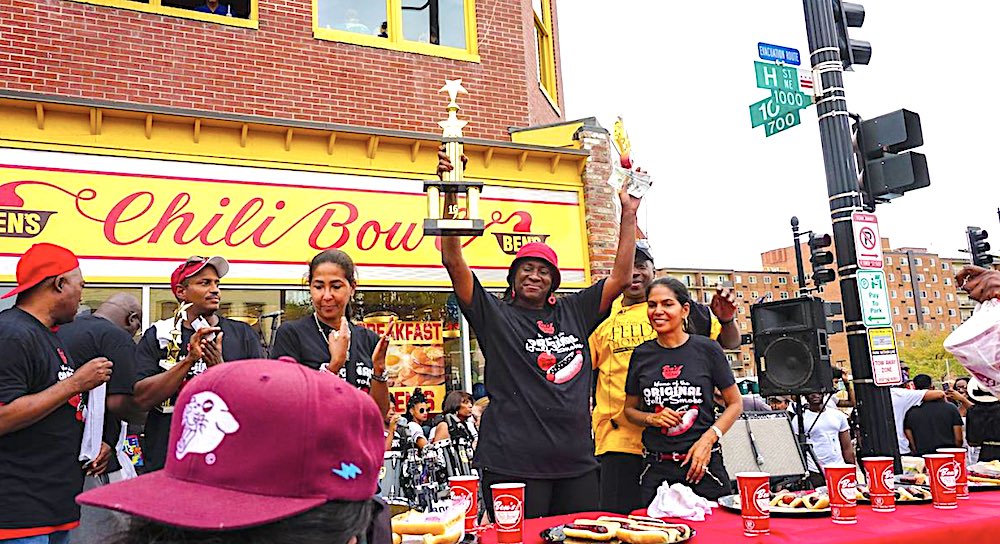
On Saturday, Sept 17, during the H Street Festival, Ben’s Chili Bowl welcomed eaters and spectators to the 4th Annual Half Smoke Eating Contest.
Tens of thousands streamed along the 11-block corridor looking to taste wholesome food and experience diverse culture and fun.
Half Smoke Eating Contest
What is unique about the D.C. half smoke? Is it because it’s half pork and half beef? Or is it Ben’s original spice mix that is a well-kept family secret. Or maybe because it’s grilled on both sides on a hot griddle until perfectly charred. Whatever the reason, the sausage placed on a lightly steamed bun, dowsed with yellow mustard, sprinkled with chopped white onions and smothered with the famous, generation-old chili sauce has become D.C.’s signature dish.
As usual, Virginia Ali, the Matriarch of the D.C. restaurant world, was busy running the restaurant, cooking half smokes and cleaning tables.
Eight lucky participants got to enjoy the sweet, smoky half smokes, grilled to perfection, to see who could consume them the fastest.
Mary Jones set a local record by devouring eight half-smokes in eight minutes — a feat that could put Joey Chestnut to shame.
Vida Ali congratulates Mary Jones for winning the Half Smoke Eating Contest.
Ben’s stage also showcased some of D.C.’s hottest local artists such as Rare Essence, Ozone, Renee and Wooty 95
After the contest and concert, fans filed into Ben’s to grab a chili dog with chili cheese fries or Upstairs to grab a Southern Caribbean sandwich paired with a Mojito.
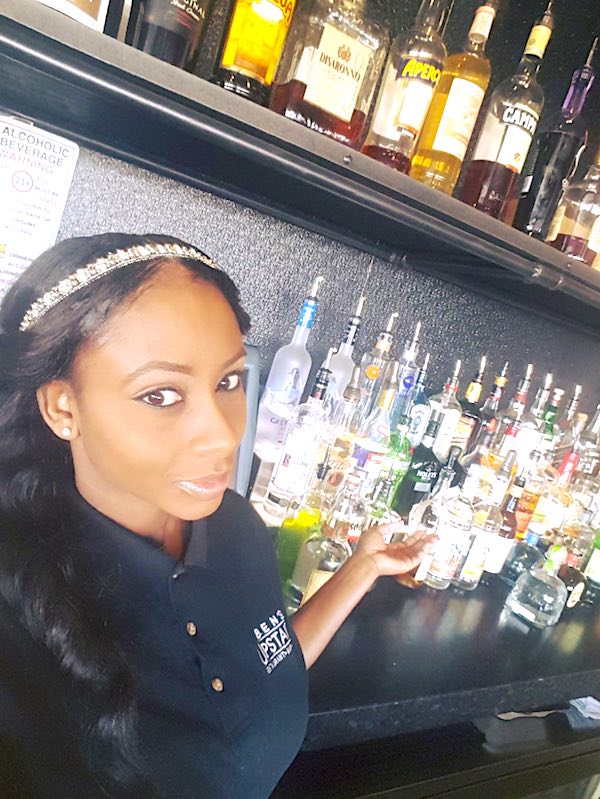
A beautiful, full-figured woman with long, black hair and a thick, rich accent served me a Caribe cupcake with a Red Stripe.
[ Image: Kiomey Ben’s Upstairs.png ]
Kamara @ Ben’s Upstairs
“Thank you kindly Kimara. What a great time for you to start working here.”
“I’ll swing by shortly to see if you want another one.”
“Thanks, but one beer is all I’m gonna have today.”
“What are you on a diet?”
“I’m trying to taper off, and attending these events and festivals ain’t making it any easier.”
The festival was amazing and the launch was a smashing success. Now it was time to stroll down the avenue to watch other local talents and dancers perform. Cheers to H Street! This community has become a veritable playground for foodies and art and music aficionados alike.
I wanted to remain in this vibrant city and enjoy all the perks she had to offer — her culture, the restaurant scenes, the melting pot — but part of me told me it was time to move on..to head west towards the mountains and valleys, where I would find respite and healing.
We applied for the GWU Business Plan competition three times, hoping that indeed the third and last time was the charm. Unfortunately, all the leprechauns in the world could not help us. Each time, we advanced to the semifinals, but the finals turned out to be our tough mudder.
The second time, was the most promising, where we came in 9th, so we served as a back-up just in case one of the top eight teams couldn’t present. Unfortunately, we weren’t asked to pinch-hit and we went back to the drawing board for the following year.
Then, on April 2, 2013, I got the dreaded news that once again we didn’t make the cut.
* * *
April 2, 2013
Chito,
I was shocked that RUNINOut did not advance to the finals, since you were ranked #9 last year! I didn’t read your 20-page business plan this time, but the feedback from the judges this year will give you more insights into why this happened, and you will receive it much sooner than before. That’s all because I put an emphasis on upgrading this year to an online scoring/commenting system which means no re-keying of the judges’ comments.
Please let me know if there’s anything I can do to help RUNINOut continue to grow and thrive.
John Rollins
* * *
Professor Rollins explained to me that the independent group of judges (mostly non-faculty business leaders) may not have had the insight to select the top teams. The business school was pulling for me, but since they had to keep the competition objective, they had no say in the matter.
Not only did the rejection sting, but the elimination kept us from securing funding. That’s because the university published the results online so venture capitalists (VC) were privy to this info.
My alma mater wasn’t the only one that rejected us. We were also spurned by D.C.’s VC firm and accelerator Fortify as well as Baltimore’s Emerging Technology Center. An accelerator takes an early-stage startup that has already developed a minimum viable product and helps them secure resources and capital funding. They also provide a nominal amount of funding in return for a small equity stake, normally 5-10%.
So was acceptance to an accelerator the right path for RUNINOut? Without mentorship and funding, our chances of reaching rapid growth were slim to none. It didn’t mean that our business model wasn’t sound or that we would never be profitable. But it likely meant our company would focus on lifestyle instead of growth, on income rather than revenue, on bootstrapping instead of venture capital, and instead of advertising, we would rely on face-to-face guerrilla marketing.
This new path was right up our alley. Since we hosted several events a month, we had developed a knack for gaining traction and creating a buzz. We provided value, engagement, and fun, and in return, our attendees spread the word virally and gave us raving reviews online.
A week after receiving the bad news from GWU, Suzannah woke me up with some glad tidings. We were selected as the “Best Restaurant App” in the Washington City Paper Readers’ Choice poll.
After dozens and dozens of events, miles, and miles of pedicab rides, and tons of food blogs, the hard work seemed to have paid off.
I called Gregg Coppen, the web developer from Vancouver, and he almost fell off his chair. “I’m so glad we decided to add the faceted search at the last minute — this feature must have been popular with restaurant-goers.”
He was so proud to add the new “Best App” tag to his portfolio and exuberant that he could make a tremendous impact thousands of miles away.
“When you approached us two years ago, we were hesitant to take on this project on a shoestring budget. But looking back, I’m damn glad we trusted our intuition.”
“Yes, it’s amazing what we can accomplish if we all work together, communicate and innovate.”
Soon, I shared the news with Professor Rollins.
“What, you beat Yelp, Foodspotting and Urban Table?”
“It’s hard to believe — it was really the matter of getting name recognition and we did that by gaining traction.”
“I tell you what. You guys didn’t advance, but your company has shown user-acceptance and income – that’s really what matters, not a trophy.”
On April 22, 2013, I got the chance to do just that. I was delighted to have the opportunity to present my business and demo my site to the University where the idea was born. And that was really the most important thing — acceptance and validation from an academic institution. The consumers, we already had them in the bag.
During the spring of 2010, I enrolled in Professor Richard Donnelly’s New Ventures Class at the George Washington University (GWU) School of Business. Students had to create ideas for a new venture, form groups of four and present the idea to the entire class at the end of the semester.
My teammates were Daniel Lonnerdal, Jing Xe, and Mustafa Onerci.
“What I learned from the Foodspotting eatup at Burma Restaurant was the need to provide faceted search where users can choose their cuisine, type of dish, ingredients, and taste preferences,” I said.
“Not only that, but you can choose your mood and ambiance,” Jing added. “Last weekend, I went on a date with my boyfriend. I tasked him to find something romantic with a pleasant view and no distractions, and thank goodness he didn’t disappoint.”
“Lucky for him, he came through. And if you’re a fan of sports like me, you can select the team that you like to watch, and the site will tell you which pubs to visit. A Falcons fan definitely doesn’t want to stumble blindly into a Saints bar. Unless you’re game for an ass whooping contest.”
“Perfect example — what shall we name it?” Daniel asked
We brainstormed for a few..”How ‘bout Food Runner?” Mustafa suggested.
“Nah, some people drive or catch a cab.”
“How ‘bout Run this Town?” Jing asked.
“Nah, not a big fan of Jay-Z.”
“How ‘bout Dining Out?” Daniel asked.
“Meh, how ‘bout RUNINOut?” I suggested.
“That’s a weird name. Like running out of food, groceries, things to do?” Mustafa asked.
“Umm, yeah that’s an accurate expression.” I began to write the name on the notepad.
“Strange…Looks too much like RUIN tho. And isn’t running spelled with two N’s and one G?” Jing asked.
“Yeah, but that’s just too long to fit in an address bar. I like the shortened version even if we’re ruining the spelling.”
“It’s kinda catchy, but I think people will get confused and misspell it. Then they won’t be able to find it on Google,” Jing replied.
“Well tell that to Larry Page and Sergey Brin when they came up with Google or Jerry Chang with Yahoo.”
“Too bad we’re not in Silicon Valley. So are you going to hire someone local to develop the site?” Daniel asked.
“Would love to, but the prices in this town are up in the stratosphere due to high demand from government contracts.”
“Then why don’t you outsource the work to India, the Philippines, or Africa?” Mustafa suggested.
“We can outsource the content management once the structure is in place. But to build the foundation, I want to find a team from North America who understands our culture, our cuisine, our history, our beliefs, and attitudes. Someone who I can physically reach out and touch if I need to and someone that won’t break our piggy bank.”
“Where can you find such gifted talent whose willing to work below market price?” Daniel asked.
“Dunno, but maybe we can find a technical co-founder at the next tech meetup.
“That’s possible. And I hope we get good feedback from Professor Donnelly and the class during our capstone presentation next month.”
Presenting RUNINOut at the New Ventures Class at The GWU University
I enrolled in the Executive MBA program, and before the semester started, our cohort of 20 eager students embarked on a five-day retreat at the Homestead Resort in Hot Springs, VA.
Our team coaching sessions led by Professor James Bailey didn’t require PowerPoint or pointers but still had everything to do with leadership development — You can’t create a leader in a classroom.
After spending two days engaged in team-building exercises and thought-provoking discussions, we were ready to get some fresh air. The next morning, we hiked down the Allegheny Mountain gorge trail, through the thick forest, past the lovely cascade falls until we arrived in the middle of a grassy field with a gigantic wall affectionately known as the Tower. At first glance, the 40-foot Tower seemed daunting and insurmountable.
Throughout life, we face many obstacles both personal and professional. The key to responding to these roadblocks is to face them head-on and to rely on the support from others around you. This is teamwork — being supported and supporting each other. To work as a team, it’s imperative to understand each other’s strengths and weaknesses, both physically and mentally. The better we know one another, the better we’re able to assist each other.
The Ropes Course is a metaphor for problem-solving — it challenges us to face our fears and climb on. The higher you climb, the more you rely on your team for support.
The first task was to have each person assist their team members in donning their harnesses — the one crucial piece of equipment for our safety and protection.
Then each team ascended in tandem facing the challenge of not having enough steps for all three to ascend at the same time. Sometimes a climber would have to take a step down in order for another climber to proceed. That was ok, as long as they all reached their final destination together.
Meanwhile, the rope handlers kept a close eye on the climbers, coaching them on where to place their hands and feet and providing support and encouragement so that the 3-member team could ascend up to the top together and then back down.
When it was my turn to go, I knew I could rely on my teammates Senodja Walker and Amir Moore.
Rope team:
“Senodja, place the right hand on the block and your left foot on the step.”
“Amir, move your right foot off the step and place it on the block so that Senodja can place her foot on it.”
As the climbers moved up the wall and then back down, the Belay teams were tasked to remove the slack by paying out or pulling in the excess line. They kept a close eye and a taut line, but they were not allowed to pull the crew up the wall — the climbers had to figure this out on their own.
Climbers: “Slack!” (pay out a little rope.)
Belayers: pays out the rope and pauses to see if climbers ask again.
Climbers: “Up rope.” (pull in rope slack.)
Belayers: pulls in rope and pause to see if climbers ask again.
Senodja Walker
Eventually, all of us made it over the wall and back down, taking one step at a time. The journey in life is rarely simplistic and straightforward. If we keep striving, we will eventually reach our goals, even if we have to climb over life’s challenges, obstacles, and setbacks.
The EMBA class was broken down into five groups of four and we would remain in our group for the entire two years. One of the first projects that we worked on was the Airline Pilots Association. ALPA, with 53,000 members and 40 airlines in the U.S. and Canada, is the largest airline labor union in the world.
We were having a conference call on skype when I touted the fact that airlines such as Jet Blue and Delta have successfully used Twitter and Facebook to promote their products and to provide updates on weather and flight cancellations.
“I’ve had it with you. Your solution to everything is always social media!” Eli my classmates exclaimed.
This wasn’t the first time he had said that and we always seemed to butt heads over the value of social media for building brand awareness and winning new customers.
I immediately slammed the phone down and ended the conference call.
The next thing I did was call Senodja on the phone. “I can’t work with Eli any longer — he’s so unaccepting of social media. I’m here to learn and broaden my horizon, not to clash heads.”
“Wish you could join my team, but we’re already maxed out.”
“Then maybe I should try to understand his point of view better and discuss our differences.”
“Or perhaps you could transfer out of the EMBA and enroll in the Professional MBA program — it may take a little longer to complete but you have a choice of a wide selection of classes and work with a diverse myriad of people.”
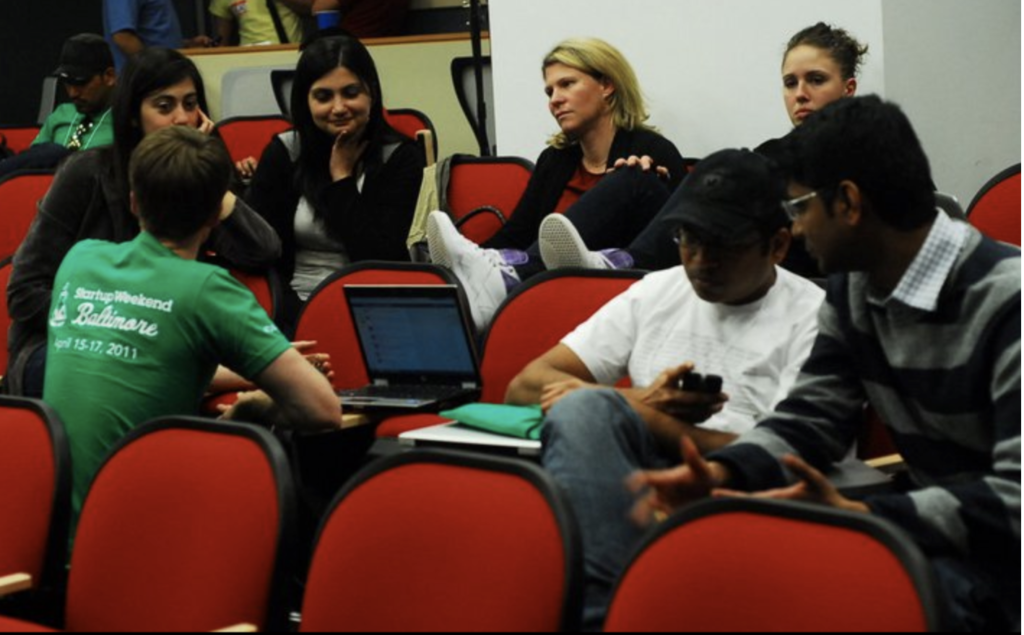
That next big tech event was Baltimore’s first-ever Startup Weekend held on April 17-19, 2011.
On Friday afternoon, I arrived at the Emerging Technology Center, Baltimore’s Technology Incubator, at 8 pm, just in time for the pitches and a quick drink of something. I chugged down an Amstel Light as I glanced around the burgeoning crowd of 150+ Type-A people. Many developers and entrepreneurs had used the time wisely over the last two hours to get to know each other and to sell their ideas. Not knowing anyone, I was already at a severe disadvantage — and I needed people to vote for my idea, or else I wouldn’t make the cut.
We made our one-minute pitches in a large hallway with no chairs and barely room to crawl — just the floor to sit on and the person next to me to lean on. There were over 75 pitches that night (more than half of the people who attended had ideas), but only about 20 would be asked to demo during startup weekend.
Entrepreneurs brainstorming at Startup Weekend
Most of the people there were business, marketing types, with less than half being developers — me being an MBA communications type and designer, finding a developer was the one critical skill set needed to make RUNINOut functional by Sunday evening.
There were lots of wonderful ideas — each one of them was an application that I surely had use for.
Mappable links, text-relationship manager, social charitable giving, checking your health online and via SMS, a mobile site that lets you rent out your driveway, crowdsourcing advice on what you should wear via Twitter, determine ad potential for sites, etc.
When my turn came up, I asked Mike Brenner, if he would allow me to tell the story of my car getting broken into. After much nagging, he relented, and I used that example to segue into my core message that it would be wonderful if I had access to an aggregator that could read Yelp reviews as well as tweets and police reports and provide a customized recommendation based on the sources I choose and the weights assigned to each one.
“I woke up Friday morning and I was delighted to see a Living Social Dollar Lunch coupon available for a myriad of restaurants all over the city.
I was on my way to Baltimore, heading to Startup Weekend, so I conveniently stopped at a renowned restaurant in Dupont Circle just prior to leaving the city.
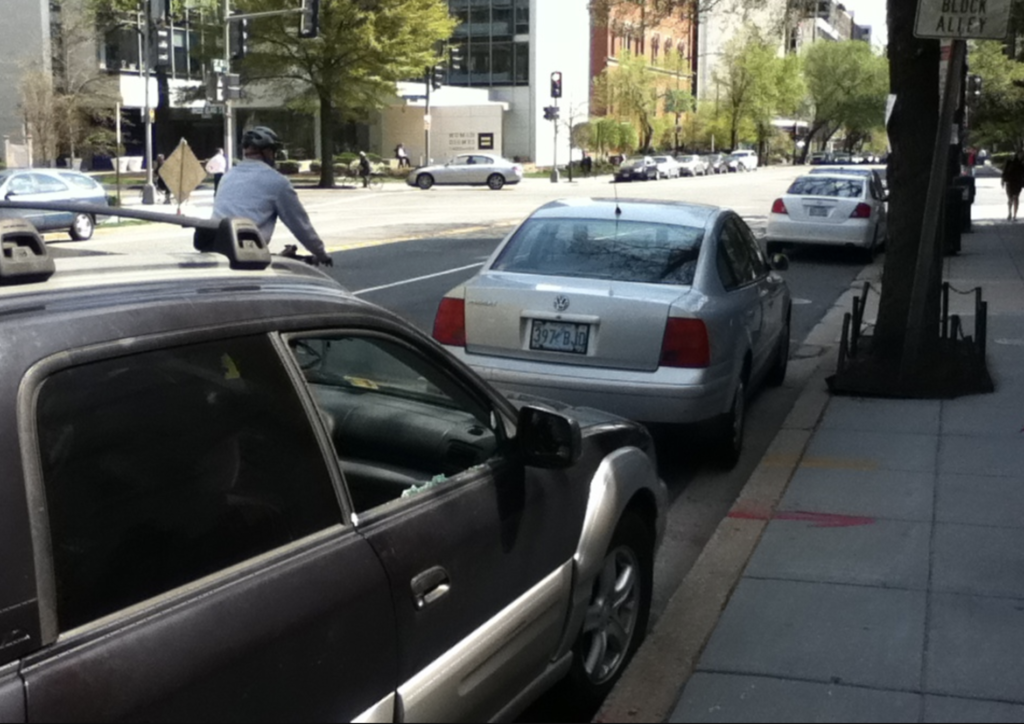
The restaurant was cozy with a lovely ambience. But because I wanted to arrive in Baltimore before the rush hour traffic, I grabbed something to go and quickly returned to my car, only to find window glass spread all over the sidewalk and my backpack with my MacBook Pro and Canon camcorder conveniently lifted from my car seat.
I would have hollered if it wasn’t for the pleasant demeanor of a young lady named Tinoi Marché who was already on the phone with the police. She was having lunch in a restaurant directly across the street and had witnessed the whole ordeal. Shortly before, a vagrant ruffian was pacing up and down 17th Street NW looking into cars.
My Subaru Baja window break-in
A moment later, he shatters my side window, and the thug is seeing running down 17th with a backpack in tow.
By the time I arrived, a mere five minutes had escaped. “If I wasn’t sitting down enjoying my meal, I would have run after him,” she said.
“It would have been worth it. That same clown could steal from me the next day or worse hurt somebody.”
When the officer arrived, he explained to me that there had been a rash of break-ins lately. If I had taken the time to look at SpotCrime, I would have found this out, but who does this?
“Well thanks for calling the cops, and no, I wouldn’t want you to get hurt over a laptop and camera.”
Furthermore, I didn’t really enjoy the lunch. I didn’t have a chance to read consumer reviews from sites like Yelp because, well, I just didn’t have the time.
The first thing I did after I called the police was to post an update on Facebook that my car was broken into and my laptop was stolen. Mike Brenner, organizer of Startup Weekend Baltimore, immediately contacted me and informed me that they could easily refund my money.
I thanked Mike for the offer but said heck no. Come hell or high water, I was heading to Bmore. I had an idea to pitch, and I wasn’t gonna let a thug ruin my day.
The pitch was well-received, but when it got time for the voting, everyone was given three sticky notes to place on the the wall pads of each idea. Because there were so many pitches, some of the pads were spread out further down the hall where less people congregated.
Pitching at Startup Weekend Baltimore
As a result, I only received six votes, one less than was needed to make the cut of 20 participants. My heart sank. I went to see Mike who informed me that although I didn’t make the cut, I was still welcomed to demo as long as I could gather a team and build a prototype by Sunday.
There were plenty of peeps with brilliant ideas and keen business acumen, but those with expertise in web programming were rarer than genius itself.
I quickly scurried around the room looking for techies — noticed that groups were already nestled away in their own groups, brainstorming ideas, hoping to change the universe. Meanwhile, there were a few poor souls, pacing around with great ideas, but no associates to fertilize the soul.
Senodja Walker
That’s when I made a quick call to my prior EMBA classmate. Senodja Walker was home in Laurel, MD., getting ready to call it a day — she had class all day Saturday at GWU and Sunday was a day of rest.
“Senodja, I need you to come and help me demo.”
“How about your classmates from Donnelly’s class?”
“They’re not interested in pursuing the startup — only for the class project.”
“Would love to help, but are you going to be ready?”
“I have no choice. It’s make or break for RUNINOut.”
I also invited Kanita Williams, to join us in our strategy session and throughout the weekend, all the different groups worked hard to refine their business models.
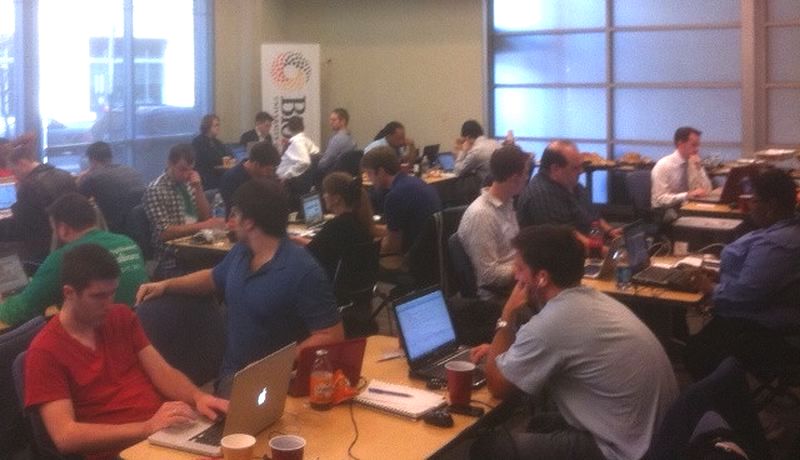
What was truly unique was how folks who didn’t even know each other before Friday night got together and collaborated so seamlessly to create a product, a business model, and a polished presentation in a mere 54 hours.
On Sunday, the event culminated with presentations by all 20+ groups. Though it would be a long night, all the presenters were highly engaging. Everyone — entrepreneur, developer, marketer — was enormously talented, and all their creative juices gushed out throughout the entire weekend.
Usually, I hate lectures, but I completely loved listening to what these innovative minds had to say. The best part of all the hard work was finally sitting down with an open mind and listening to the fantastic demos. I could see myself being a huge user of their apps one day.
“Startup Weekend proves that there is enough critical mass to build a sustainable startup culture in Baltimore,” said Ron Schmelzer, a mentor, and judge.
RUNINOut presented midway through the demos. I started out with the car break in story.
Ron Schmelzer, Techstars Mentor and Investor chats with Yasmine Mustafa
As I went down the bunny trail, Senodja deftly ran the demo illustrating its value in selecting restaurants by location, occasion and appeal (look and taste).
We are a restaurant search engine that crawls the internet for relevant reviews and trends and creates a comprehensive rating report for each individual. Our algorithm also incorporates the user’s personal preferences based on the latest input, restaurant selections, types of images clicked and user feedback. Like Pandora for music, the more you interact with RUNINOut, the better it gets to know you.
“A site that is a repository for dishes throughout the local area is a brilliant idea,” Ron Schmelzer, a Techstars mentor and investor stated. “The other day, I had the craving for a cheesesteak, and I wanted to know where I could find one.”
“And I love how your site will display the pictures of all the top dishes from my favorite Middle Eastern restaurants,” said Yasmine Mustafa, the CEO, and founder of 123LinkIt. “I was born in Kuwait and moved to Philly when I was eight.”
“As exciting as it is to look at pretty pictures, you’re still needing someone to work behind the scenes doing the coding,” Ron added.
“But can’t we just hire someone to build the site?” I asked.
“Anyone can hire a developer. Look, there are three things a startup needs to succeed — money, talent, and expertise. Right now, you’re missing two of these legs,” Ron said.
Once the demos were over, I was tremendously rewarded from hearing the great vision of these promising entrepreneurs — many of them on the verge of creating products that will change the lives of people in Baltimore, DC, and beyond.
But truth be told, it was apparent once again that we would not make the final cut.
3rd place: Dapprly + Talkchalkco — Dapprly is a Twitter application that allows a person to model outfit options and let the masses tweet-vote for which is best. Talk Chalk is a Facebook app for students, teachers, and parents, allowing for virtual homework assignments and game-style award incentives for doing them.
2nd place: ispylocal: a business that plans to put banners in vacant storefronts, providing a phone number and text system in which passers-by can call and vote for what business they’d like to see move in.
1st place: Parking Panda: a mobile app business designed to connect people who have available parking spaces and those looking for a cheap spot near a busy event
(In 2017, Parking Panda was acquired by its competitor, Spot Hero)
I loved hearing about all these fascinating ideas and best of all, meeting and collaborating with extraordinary like-minded entrepreneurs — an invaluable life experience.
Ron again explained that we didn’t place because our team lacked a technical expert. Senodja was an Army officer who would be leading her troops to battle, and Kanita was a law clerk in the DC Superior Courts, hoping to grace the halls of SCOTUS one day.
Together we knew a lot about marketing plans, SWOT (Strength, Weakness, Opportunity, and Threat) Analysis, and product life cycle models, but we lacked the knowledge of one thing that mattered the most – how to write code. What we lacked in technical expertise, we could make up for by being innovative and resourceful. I needed to head west until I found someone that could build the framework for our site.