Category: Lebanese

  • Apollo Asala

    Apollo Asala

    In 2011, I kicked off the EU Embassy Run as a casual run on a whim. I coerced a couple of friends to join and for the last several years, a small gaggle would gather at the French Embassy and run 13 miles visiting a dozen tightly-packed embassies along the way, ending up at the Austrian Embassy in Van Ness in NW D.C.

    By 2014, I wanted to expand the run, so I contacted Rick Amernick to post the event on the DC Capital Striders homepage. Surprisingly, 40 eager runners signed up.  We were indeed bursting at the seams, but there was room for one more stowaway — Apollo who would fly alongside and blithely perch on people’s shoulders.  Apollo was a veteran runner who has enjoyed going on long-running excursions with me throughout this sociable city.  Naturally, Apollo loved to fly, but with his wings clipped, he wouldn’t go too far, normally to the nearest shoulder or to a low-hanging limb.

    On May 10, 2014, the jaunt started at the Embassy of France and followed Reservoir Road through Georgetown, before climbing uphill on Wisconsin Ave.

    Then we meandered our way through Embassy Row visiting Greece, Ireland, and Romania successively.

    There were a lot of cultures to experience and of course fabulous food tastings not to mention the most magnificent, crisp lagers this side of heaven.

    Motivated by the allure of fresh hops, we steadily climbed Mass Ave until we reached Netherlands, Belgium, Hungary, Czech Republic, and Finland.

    My neighbor, Quentin Cummings ran along and was more than eager to imbibe on traditional European beer along the way.

    Throughout the run, we proudly raised the dark blue flag with a circle of twelve yellow stars and ran at a steady pace until reaching Austria and Slovakia on International Drive. There, we celebrated and rejoiced when we reached the coveted black and white checkered flag.

    “Say, the run is picking up speed with D.C. locals. Why don’t you organize an official run next year? Have people register online so people can commit ahead of time,” Rick suggested.

    “That’s a great idea. Charge a nominal fee and raise money for charity. I can also get T-Shirts printed out and put our logos on the front.

    Orlando Darden Jr 

    To have the honor to lead 45 amazing runners, along a scenic, occasionally hilly 13-mile journey starting from France and ending at Austria. All enjoyed a diverse cultural experience! Thank you Runin Out for creating such a fun and memorable event and thanks to #RunnersWorld  for enduring the busy streets to photograph our entire run! This year’s event turned out to be an awesome adventure!  Next years promises to be EPIC!

    The week after the run, I gave Rick a call.

    “Hey remember that Lebanese bistro on Connecticut Ave that we passed on the way to the Hungary and Czech Embassies?”

    “Yup, the Taverna. Love their hummus — great protein-infused snack to fuel up right before a long run.”

    “Well, we can’t make Lebanon a part of  the EU, but we can definitely host a meetup and entice runners with healthy Mediterranean cuisine paired with a  high-energy form of  dancing?”

    The following week, runners from all over the DMV came in droves to appreciate the benefits of consuming hummus with tahini and shaking hips to develop core strength.

    Asala’s willowy arms and legs moved in synch, captivating and charming Lebanese guests and runners alike.  Her trademark was attractive and personable, and she was easily able to entice hardy runners to join her.
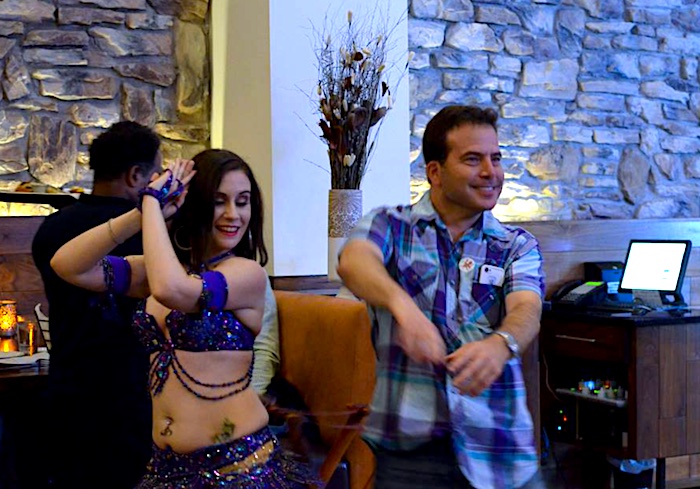
    Rick raised his arms like a ballet dancer. “Have to say, this is the most exotic event, we’ve hosted so far. Great way to train for a marathon.”

    I raised my arms in unison. “You guys are totally hot. Women dig dudes who can dance.”
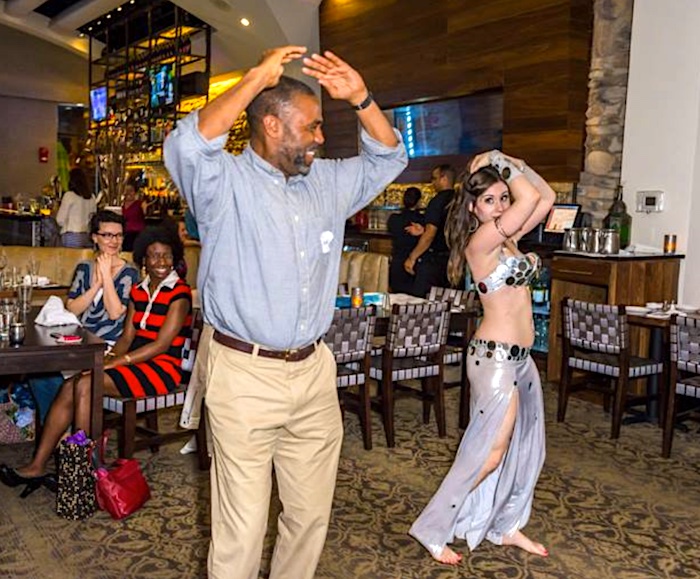
    Orlando swung his hips smoothly like Fred Astaire. “Yes, that was a blast. Enjoyed balancing the air cake on my head. That was no joke a cakewalk.”

    Asala reached over to pick up a prop. “Glad you enjoyed it. Since you thought it was cake, you can balance my sword next time. And you better not drop it on your toes.”

    Orlando picked up the curved sword and felt the sharp blade with his hand. “Yes, that does seem quite dangerous. Girl, you got talent.”

    “Next time, I’ll bring my Shamadan Candelabra. Men who incite danger are inspired by the sight of fire.” 

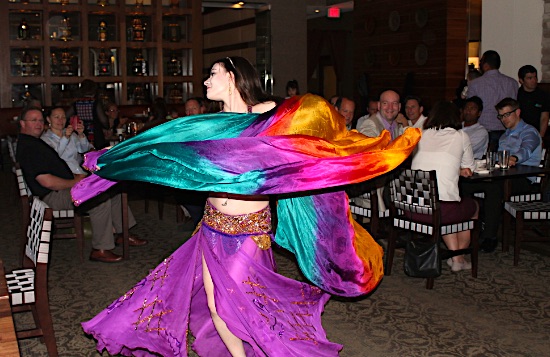
    I used a spare tablecloth to mimic Asala’s magic motions. “My personal favorite are Asala’s wings. They’re colorful and shiny and quite dramatic.”

    Rick took a large bite from his shawarma slider. “And the food was indeed healthy and appetizing. If I ate here regularly, I wouldn’t need to run every day.”

    “So happy you all enjoyed it, and I am thrilled with the audience participation. I perform every Thursday. Tell all your friends to come — it’s more challenging than yoga and more fun than running.”

    Charlie came by to check on the setting of the tables. “Yes, we need to fill up the restaurant. We love to bring in new guests who will also enjoy our food.” 

    I raised a glass of Cabernet Sauvignon to my lips. “How ‘bout we host a fundraiser here next time. We can just host RUNINOut events in conjunction with Asala’s performances.” 

    “Well get our fattoush and tabbouleh featured prominently online, and we’ll be happy to provide you with all the hummus you want for future events and fundraisers.”

    “Thank you so much, Charlie! Can I have another Almaza please?”

    “Don’t you think you’ve had enough already? BTW, next week, you should visit Grace, the owner, at the original Taverna in Arlington. Maybe she’s got more work for you to do.  I know they need a new website to feature all their locations.”

    In the following months, we held fundraisers for We Are Family Senior Outreach Network and the Association of Young Americans.  Together, we had saved the Raqs Baladi events from the chopping block.

    The working relationship with Lebanese Taverna, local meetups and Asala El Masri would pay off splendidly for months to come.
  • Raqs Baladi

    Raqs Baladi

    On November 11, 2013, Super Typhoon Haiyan slammed into the Philippines causing massive loss of life and a trail of destruction in its wake. Battering the archipelago with wind gusts of up to 168 mph, it was the deadliest cyclone on record.  I, along with my expanding network of Fil-Am friends watched in horror as the island nation struggled to bury the dead and deliver food, water, and medicine to the suffering.

    So I was encouraged with hope when I got a call from my veteran friend, Kim “Dancing Queen,” a self-proclaimed musical arts fanatic, foodie and lover of anything Asian, particularly Cantonese.

    “Have you ever visited Medaterra in Woodley Park?”

    “Afraid not. I normally stay close to downtown. I don’t venture that far north on Connecticut Ave.”

    “Well can you please reach out to the owner, Angela? She wants to host a fundraiser for the Philippines typhoon relief, and I thought you would be the perfect choice to spearhead it.”

    “I’m deeply honored that you would help out. I will contact her first thing.”

    Angela was happy that I agreed to spearhead a fundraiser.  “Post an ad on Facebook. Let them know that 50% of proceeds of food and drink will be donated to AMCROSS.”

    Angela and I also reached out to all the Filipino-American groups as well to a vast variety of meetups in the area, and we were delighted that over 100 people came to dine and donate money. By the end of the night, we had raised $1,200 for the American Red Cross, and Angela Aly was thrilled. “The event was enormous, and you executed like a champ.”

    “My heartfelt thanks to you for offering your space and amazing specials. I appreciate Kim for reaching out to me and my gratitude for everyone who showed up and provided unconditional support.”

    “Yes, the donations will help tremendously and we’ll keep praying for the victims for basic supplies, comfort, and healing.”

    “Without a doubt. Say, so how’s your cafe doing? Do you get a lot of foot traffic at lunch and after work?”

    “Some, but the young folks prefer to hang out on U St, H St, and 14th St nowadays.”

    “Well, lemme see how I can help you. We’re pretty skilled at leveraging social media so we can place butts in seats for those strolling casually down Connecticut Ave.” 

    The following week, I pitched camp at the Mediterranean bistro taking pictures of dishes and featuring them on the website.  In my free time, I would ride my pedicab through Woodley Park, picking up riders who didn’t want to walk the half-mile uphill from the Metro to the Smithsonian Zoo.  Connecticut Ave is lined with restaurants and sidewalk cafes and there was plenty of foot traffic after work and on weekends.

    I also took the opportunity to visit neighboring restaurants in the rustic enclave including the Lebanese Taverna, Open City, and the Afghan Grill. Woodley Park was a small village bounded by Rock Creek Park and the zoo.  But it was an international hamlet with ethnic cuisines from all corners of the world.

    The Lebanese Taverna serves classic, Mediterranean cuisine in a modern, contemporary setting.  In 1976, Tanios and Marie Abi-Najm boarded a cargo ship in the dead of night with their five children to escape the civil war in Lebanon.  After working at local restaurants for three years, they saved enough money to purchase the Athenian Taverna in the Westover neighborhood in Arlington, VA. They made a modification in the sign to read Lebanese Taverna and the rest is history.  Today, the business has bloomed to six restaurants, four cafes, and a market and deli.

    The chicken shawarma was roasting on the pit with onions and cherry tomatoes embedded in between slices to give it a juicy flavor.  As the inverted cone of meat turned slowly on the rotisserie, the chef deftly sliced thin shavings from the outer layer to make the crowd favorite, doner kebab.

    At the bar, a stylishly chic couple started off with the bread – a football-shaped pita of hot, chewy goodness which they dipped in hummus with the right amount of tahini and olive oil.

    Then as an appetizer, they ordered shawarma sliders with hot slices of lamb stuffed inside a soft pillow of bread.

    The entree was braised lamb shank with white wine, the tender chunks were falling off the bone.  They made room for dessert — baklava, phyllo dough stacked with honey, and pistachios to cap off a perfect meal.

    I sat at the bar and ordered an Almaza, a mild and smooth Pilsner brewed and bottled in Lebanon.

    [ Image: Screen Shot 2022-02-05 at 1.33.17 AM.png ]

    Lebanese Taverna bar

    I visited the manager, Charlie Ayoub. “What’s RUNINOut, and how do I know you’re some fly-by-night operation.”

    “Well, we have hundreds of thousands of users in the D.C. area and we were just selected ‘Best of D.C.’ in the Readers’ poll.”

    “How good are you with managing events?”

    “Well, we just organized a fundraiser at Medaterra across the street and raised $1,200.”

    “Alrighty, hot shot. Let’s see if you can arrange an Arabian nights themed party for us.”

    I looked at Charlie wide-eyed and baffled. Did he want fire dancers, sword jugglers, snake handlers?  Perhaps I could ask some of the folks from the drum circle in Meridian Hill Park to participate.  We can set up henna art and have tarot card readings.  Maybe I’ll bring Apollo and have him fly to different customers and eat their pita bread dipped in olive oil.

    “Oh certainly, Charlie, there’s no event no matter how wild or exotic that I can’t handle.”

    “Super, traditional Arab folk music with Raqs Baladi please.”

    I immediately called Sonia Herrero.

    “Raqs Baladi—that’s Egyptian belly dancing,” she informed me with a chuckle.

    “Well can you help out a hopeless fellow? I’ll let you take Georgia out for a hike.”

    “Would love to, but I just started a new job at the Department of Education, so I can’t commit right now.” However, I would love to see Apollo.”

    “Cool, let’s make a date to go biking, and he’ll tag along.”

    “Nope, busy.”

    “Well, we got the EU Embassy Run in May, and all the Embassies love to see Apollo.”

    Next, I called Angela and briefed her on my meeting with Charlie. 

    “Don’t stress out. I’ve got the perfect solution for you.” 

    She wrote down a name and number on the back of the menu. “Asala, call her, see if she’s available.”

    I dialed the number with trepidation. 

    “Hello, who’s this?”

    “Umm, this is Angela’s friend from the Medeterra. Do you know anything about an Arabian Nights performance at the Lebanese Taverna?”

    “Wait, are you the fella riding the pedicab up and down H St during the summer Fest?

    “Yes, the one with the squawking parrot that matches the color of your veil.”

    “Certainly, I would be happy to dance at your event. As long as you’re able to make the arrangements behind the scenes.” 

    Raqs Baladi is an Egyptian dance that originated several hundred years ago performed by ordinary countrymen and women during gatherings and celebrations. Women moved core body parts like the spine, abdomen, pelvis, and legs helping them to develop core strength and a healthy reproductive system. People were enthralled by seeing the women move their hips, so the dance took off, spreading all across the middle-east and into India.

    Jennie “Asala El Masri” discovered belly dancing in 2003 after enduring a knee injury from high school sports.  Belly dancing served as an excellent therapy as she developed her core. Today she still loves sports but has found that dancing feeds her passion for movement and music.  Her performances remain in high demand, and she has performed for a wide range of venues including festivals and embassies.

    It was definitely my responsibility to market the event to bring a decent turnout. Asala didn’t dance for free, and it was my job to bring in enough revenue to ensure her happiness. I, on the other hand, worked for a pat on the back and an open tab.  The golden Almaza pilsners were refreshing and crisp and they always paired nicely with shawarmas and doner kebobs — I ate like a sultan and drank like a commodore.

    And when the lights dimmed, and the majestic mejance chimed, Asala emerged from behind the red curtains, moving deftly like an eloquent diva.  Her giant wings made for a truly dramatic entrance eliciting accolades from the enthralled guests. Each instrumental note hummed in unison with the elegant strides of her toned core and her undulating belly.

    We continued every Thursday night in April, hoping the word would spread quickly and her magical allure would entire millenials in droves. Her costume was consistently glamorous and her choreography flawless. And with the succulent Lebanese cuisine and Charlie’s hospitality — I felt sure we had all the right components for a huge hit.

    True to form, she readily got diners to rise on their feet and celebrate this ancient art form from Mesopotamia. And Asala interacted remarkably well, displaying her elegant smile and keeping the audience entertained and captivated with a sensation of enigma and glamour.

    Perhaps there was no other night where her prowess was on display than on April 13.  If no courageous soul rose to the floor, Asala would pick an innocent victim. From the corner of her eye, she saw a nice gentleman smiling and seemingly enjoying himself.  So she went over to tie her veil around his head, only to notice that he was wearing a priest uniform. Charlie gasped. Asala glanced over and caught his expression and dreaded catching his wrath after the show.  Surprisingly, everyone else seemed to get a kick out the entrapment and many thought that she had planned it out from the beginning.

    All the online reviews for the food, service and performance were glowing, but sadly, the attendance continued to be sparse.  Very few mainstream Washingtonians were fans of this exotic art or were willing to drive up to sleepy hollow to participate. Instead, they congregated at the more popular hub: H Street, 14th Street, Adams Morgan, and Dupont Circle at the hip hop lounges swaying to the familiar beat of go-go, funk and R&B.

    My immediate reaction was to call Jackie Woodbury for another lifeline.  Maybe Wayne Manigo could infuse the show with light-hearted laughter.  We even discussed having Asala dance to classic rock — an idea that was immediately shot down by Charlie. But if we didn’t draw a large enough crowd, he would be scrap the rest of the shows.

  • Postmates

    Postmates

    Winter 2015

    In the winter of 2014, Postmates roared into town with the promise of being able to deliver virtually anything to anyone in the District within an hour. They charged a 10% purchase fee and a nominal delivery fee based on the distance of which 80% went to the couriers.

    The app is commonly used for restaurant food but people have been known to purchase computers, groceries, you name it. The app works fairly well and the startup had received a hefty amount of funding to hire staff and rent office space.

    But the idea of on-demand delivery is neither new nor novel. Both Seamless and GrubHub were already dominating the industry in D.C. Most people who pay the price of a good meal prefer to enjoy the atmosphere that comes with it. A $50 Prime Rib from Del Frisco’s Steakhouse somehow doesn’t taste the same on foam and plastic as it does on china and silverware.

    So many of the food purchases are for franchises and fast food restaurants like Shake Shack, Chipotle, Potbelly, and McDonald’s — those with low prices and even smaller margins.

    The app is popular with college students who may not have the best spending habits. But college students don’t tip and couriers could make as little as $5 an hour especially if they have to wait in line and make an order — like Vapiano during rush hour. And how long will college students continue to use the app, when their parents find out that their spending habits and cut back on allowances.

    Jason Morenz had been delivering for Postmates since they arrived in D.C., and recommended I give it a try. Since I’m in the Restaurant food and customer relations business, I had to see it for myself. I signed up and attended the onboarding session. And just like that, I was hired — it was fast and easy. They didn’t even check to see if I knew the city, was in shape or I was really up to this task. As long as I didn’t have a criminal record, I was hired. 

    At first, it was fun. I got to see the city and visit new restaurants while getting a workout. The customers were nice but stingy on the tip, and there was definitely a lack of transparency on how much they tipped (since it was not readily known how much their tip was)

    After completing 10 orders successfully, the company started sending me two orders at a time and that’s when it started becoming a burden. And even if you want to do one order at a time, Postmates will keep pushing it, along with the most deafening beep requiring you to accept or reject.

    You almost want to accept a second order just to keep your phone from beeping. And you can’t turn the app off since you need to keep it on for directions to your customer.

    And since Postmates have invested a lot of resources in marketing, they have way more orders than they have couriers. So if you are scheduled or if you check in for duty — you will be bombarded with orders — some of them very challenging to complete within an hour.

    The orders that I regretted taking were for made-to-order restaurants like Vapiano that would not take orders over the phone. I had to travel to the location, wait in line for 30 minutes, order, pay, pick up the food, then travel to the customer. The entire job took over an hour but my fees plus tips amounted to less than the minimum wage of $10.50/hr.

    The obvious goal was to avoid taking orders that were time-consuming, had low margins, or would take me away from the city hub. Orders for deliveries to the northern corner of D.C. such as Friendship Heights also meant not finding another order for miles. I could cancel the order. But this would come with a penalty and a negative rating.

    Knowing which orders were attractive and which were the low-hanging fruit came with experience. Usually, the newer couriers were tricked into taking them. But eventually, word spread like wildfire. To incentivize couriers to accept unpopular orders, Postmates would offer a $50 bonus if you were able to complete 20 orders in a 48-hour period. The catch was that you would have to accept every order that was assigned. You no longer could swipe left on an order that you didn’t like.

    If you experienced any issues such as the order not being ready, or the customer not answering the phone, you could call customer service to iron things out. But after a while, the company outsourced their help desk and we would generally get a canned answer that didn’t seem to solve my problem.

    To take a break from taking orders, I would often check out of duty to pick up passengers. Very rarely did I do both at the same time, though it was entirely possible unless it was pizza in which my passenger would enjoy the smell of spicy pepperoni with melted cheese on hot pizza dough.

    Because the orders took us all over D.C., MD and VA, I would rotate my mode of transportation from my Subaru, bike, and pedicab. Unlike their competitors, Postmates would deliver virtually anything: clothing from Walmart, electronics, groceries, even pharmacy prescriptions. 

    At one time, I accepted an order to carry $20,000 worth of laptops, ten miles to Bethesda. Postmates knew I was driving my car, so they assigned me the order. The customer was shocked when I arrived since they had made the purchase from Apple and not Postmates. Apple just subcontracted the order to Postmates. Needless to say, I didn’t receive a tip.

    Many restaurants are not happy with Postmates doing their delivery since Postmates does not ask the restaurant for permission. They just link the restaurants’ menus to their site and charge the customer a steep delivery fee. Some restauranteurs are not happy because they don’t trust the couriers to handle their food properly, and if there is a complaint, it most likely will be directed to the restaurant.

    On April 4, 2015, I was riding my pedicab on M St NW transporting burgers from Thunder Burger, when I was struck from behind and suffered damage to my right rear wheel. The driver stopped and was apologetic, but did not have any insurance. My bike was out of order and I wasn’t able to deliver the meal. My rating score would take a hit, but at least I got a free burger.

    I got the wheel fixed and sent a copy of my bill to Postmates for compensation. I was surprised to hear from Stephan the local area manager that they would not cover my expenses.

    “What if I got hurt and needed medical care?” I asked.

    “You’re a 1099 independent contractor, not an employee,” Stephen replied harshly. “You’re on your own.”

    “If you enjoy delivery and want all the benefits of an employee, you should consider venturing into trucking,” Jason said. 

    “That’s absurd. Trucking is a hard life and if you think the streets of D.C. are busy on a pedicab, I can’t imagine what it’s like in an 18-wheeler.” 

    The following week, I got a call from Stephen. With my recent slew of late deliveries from my pedicab, my rating had dropped below 4.6 (out of 5) and I would be terminated effective immediately.

    “Is there an appeal process?”

    “We decided in this case, you didn’t merit one.”

    It didn’t matter that I had connections to hundreds of restaurants in the area. It didn’t matter that I had received dozens of 5-star reviews. That couldn’t be fair. The way Postmates treated their couriers was a violation of labor law. The following week, I called Jason Rathod a Labor Attorney from Migliaccio & Rathod Limited Liability Partnership to see what could be done.  They agreed to file a claim, and I joined Sherry Singer et al v Postmates in the class action lawsuit.

    “If the courts rule in our favor, Postmates would have to treat its couriers as employees and pay them accordingly,” said Jason Rathod. “ A victory will have implications for other delivery companies like GrubHub as well as Uber and Lyft drivers and GrubHub food carriers.“

    Labels don’t really matter; it’s the economic realities,”co-counsel, Nicholas Migliaccio said. “Giving workers labels to deny them protections is an injustice worth fighting against.”

    * * *