Category: Fundraiser

  • A Home in Joplin

    A Home in Joplin

    Started like any other Sunday in Joplin, Missouri. People went to church and gathered with family and friends. The Joplin High School had just held its graduation, and families were returning home. But as dark clouds gathered above, a severe storm was brewing. At 5:41 PM, an EF-5 tornado touched down in the southern part of the city and tracked east, cutting a 13-mile swath through the heart of downtown.

    It struck the campus of the Missouri Southern State University, where the local high school was holding its graduation ceremony. One hundred fifty people were still in the arena and swiftly evacuated to the basement. But others were already returning home and in stark danger. Tragically, the storm claimed the lives of seven students (including one of the recent graduates). 1

    After weeks-on-end of studying and exams and tweaking my business plan, I was ready to head west on my cross-country bus trip, looking for that elusive web developer who would be my last cog in the wheel.

    The journey which would take me through the heartland of America would seem interminable — four gritty days and sleepless nights. Could I tolerate the middle-of-the-night disruptions, filthy bathrooms, the constant chit-chat from disheveled vagabonds? 

    On May 25, I boarded a Greyhound from Baltimore heading west. I would stop in San Diego to run a marathon with Janine and her hubby before I headed north to Vancouver to find a web developer for my site. 

    But at the last minute, I decided there was a more significant calling than just running a road race. The city of Joplin had taken a heavy toll, and they desperately needed help.

    A full-figured woman in her early 20’s sat a few rows behind me in a rowdy bus where a couple of boisterous fellows were cracking us up like a lobster claw. The jokes were coming at a feverish pace, exactly what we needed to establish the right mood for the long journey. One rugged hooligan was getting too fresh for comfort, causing the girl to pitch a fit. 

    “Young lady, please get up and sit somewhere else then. The rest of you brats – if I hear another peep from you, I’m gonna pull over and drop ya’ll off on the side of the highway where you’re gonna have to thumb your way home,” the bus driver announced indignantly.

    The commotion subsided, but, I still didn’t get a lick of sleep for the next few hours. At the transfer in St Louis, I joined the other backpackers lounging on the floor. I would be stopping in Joplin for tornado relief – my body and my mind yearned for respite.
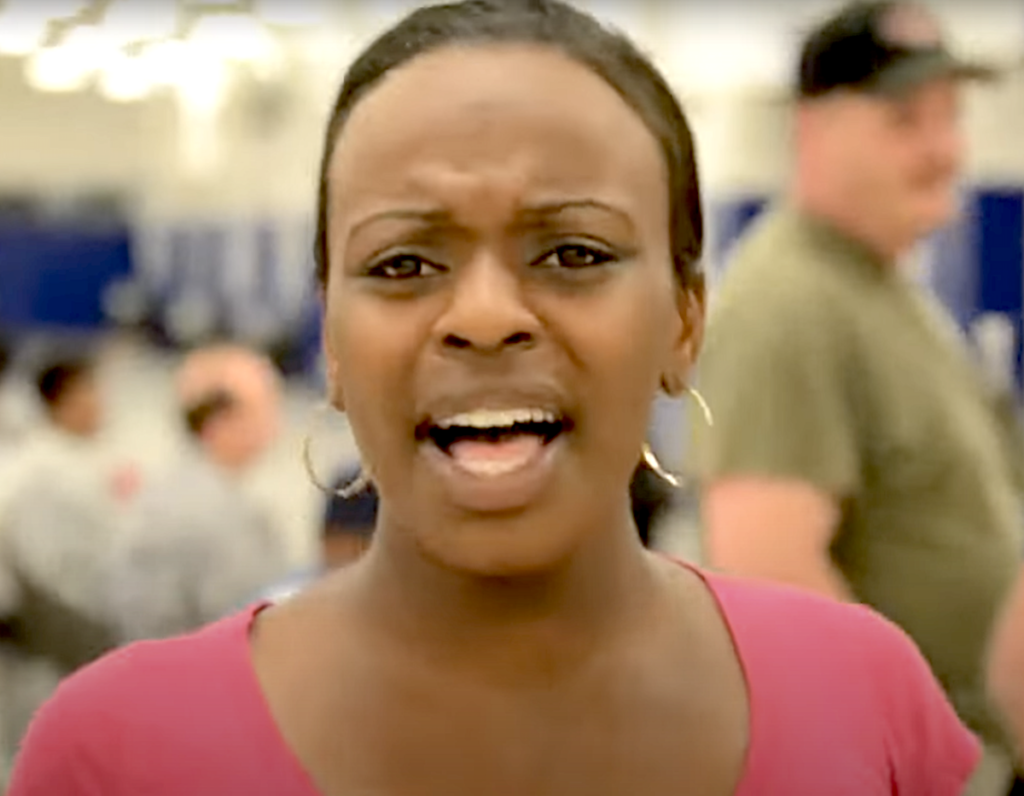

    Damaris singing @ the St Louis Greyhound station

    Suddenly my siesta was interrupted by a soft rendition of Keyshia Cole’s “Love”. She had a voice that could move mountains and a face that could launch a thousand trucks.

    “Wow, you sound just like Whitney Houston.” 

    “Thank you. Maybe my delightful croon will make me rich and famous one day.”

    “I certainly hope so. What’s your name and where you’re going?” 

    “You can call me Dee for Damaris. I’m heading to Ok. City to visit my aunt, Mimi.”

    “Right on my dear. You should be going to L.A. You have a face of a movie star. I hope you’ll remember me when you record your first album.”

    “How ’bout you — how far west are you going?”

    “All the way to California, but first, I’m making a stop in Joplin.”

    “Yeah, I heard about the tragedy – many precious lives were lost, thousands of homes destroyed.”

    Then as I boarded the bus in St Louis, the bus driver started to give me a hard time.

    “Are you sure you want to get off in Joplin — the entire town has been wiped off the map.”

    “Absolutely, tens of thousands of survivors desperately need our help.”

    “Ok, but your bags are going to San Diego.”

    “Can’t do that, Ma’am. I have a foldable bike in the baggage compartment, and I’ll need that to navigate my way around the disaster area.”

    “You’re outa your mind. That’s against Greyhound policy. Since the town is completely devastated, I’m sure they could use your help — what little support you can provide.”

    Thankfully, the driver relented, and as we entered the town, I felt road-weary but headstrong for whatever lay ahead. I hugged Damaris goodbye, hoping she would suddenly decide to come along.

    “Stay safe,” As she wiped a tear from her eye. “I hope we’ll meet again soon.”

    “Well, eventually, I’ll be heading to California to find someone who can help me create a restaurant search directory. Maybe something that you can find useful one day.”

    Damaris rolled her eyes, doubtful that would be in the cards.

    When I stepped off the bus, my sour, sweaty smell of three days of rolled-on antiperspirant evaporated like steam in the scorching Missouri sky. There was no one to greet me, not even a soul on the street. It was a lonely bus stop in a mid-sized municipality, some parts showing virtually no signs that a deadly EF-5 Twister had rolled through a few days ago.

    Despite lugging an extra bag around from bus to bus I was now deeply grateful that I had decided to bring my Dahon foldable 12-speed roadster along.

    President Obama and his entourage and Governor Nixon had just visited and showed compassion. “This is a national tragedy,” Obama said. “We’re not gonna stop until Joplin is back on their feet.”

    Flags were flying at half-mast. Emergency response vehicles and T.V. trucks filled up a parking lot at the downtown mall. A National Guard hummer drove through the desolate downtown like it was in Iraq after the Battle of Ramadi.

    The campus of the Missouri Southern State University, where the AmeriCorps had set up their task force, was four miles from downtown, and taxis weren’t readily available during a crisis. I loaded all my luggage on the bike (Macbook Pro, Nikon 5100, sleeping bag, and thankfully only a few pieces of clothing) and pedaled my way to the Volunteer Relief Center.

    By the time I arrived on campus, the volunteers had already departed for the day, scraping the thick crust of grime covering their arms and legs. The staff was putting things away, and in the cafeteria, a large throng of AmeriCorps members was busy debriefing the day’s events. 

    I was fortunate to catch the tail end when the staff decided to recognize each other for their hard work and dedication. I pulled out my camera and started filming, unbeknownst that I would witness something quite remarkable. This is where I met Quinn, Julie, Abby, and Will — incredible people who sacrificed tremendously to serve Americans in need. They called on each other and recognized their contributions. Then they presented a rose as a token of appreciation. I choked as I held back tears for people I didn’t even know. But after sharing with us something special from the inside, I felt that they would be dear friends for life.

    Just a month before the tornado, a Memorandum of Understanding was signed that established Missouri Southern as an approved American Red Cross Shelter. The timing was perfect, and the campus turned out to be an excellent resource and accommodation. I didn’t have a rack to sleep on, and hot foot was limited. But the building was new, and the couch that I slept on was firm and comfortable. I was blessed to have a roof over my head, considering the thousands of people who were left homeless. I made sure I got some rest because tomorrow would be a big day.

    Julie was one of the first team members that I met. Incidentally, she was from College Park, Maryland. I could tell that she had a lot on her plate, so I asked how I could be of help.

    The overflow of support from Americans everywhere had been enormous. Thousands of people called United Way and American Red Cross, offering their homes, vehicles, services, etc. AmeriCorps then posted this info on their Facebook page.

    “We’re getting dozens of calls a day from people offering to donate goods and services to survivors. People are offering their cars, computers, cell phones, tents, food, clothing,” said Julie. “We’re simply posting these offers on our Joplin Tornado Relief Services Facebook page, and it’s first come, first served.” 

    The issue with these postings was that there were not sortable or searchable nor user-friendly. There was not one clearinghouse that gathered all the information. As a result, many of these donations were not managed effectively or were simply wasted. So I took the initiative to create an online database where the AmeriCorps could easily track all donations and match them specifically with survivors depending on their exact needs.

    So I spent the first two days on campus creating an online database with Drupal (which I literally learned on the go). After a lot of painstaking research and trial and error, the database was created — a small but momentous cause for celebration.

    * * *

    My next goal was to document the heroic contributions of the AmeriCorps’ disaster relief teams. Spending the last three days working alongside them, I had nothing but wonderful things to say about this dedicated group of young men and women. They were bright, innovative, and selfless, never counting the costs of uprooting their lives to serve our country in need with very little pay. With people like Abby, Julie, Will, and Melissa, I was left impressed and thankful for their sacrifices.

    But there was only one problem: I didn’t have any closed-toe shoots. Traveling on Greyhound, I had to travel light. Thank goodness, Abby came to the rescue and lent me her boots for the day.

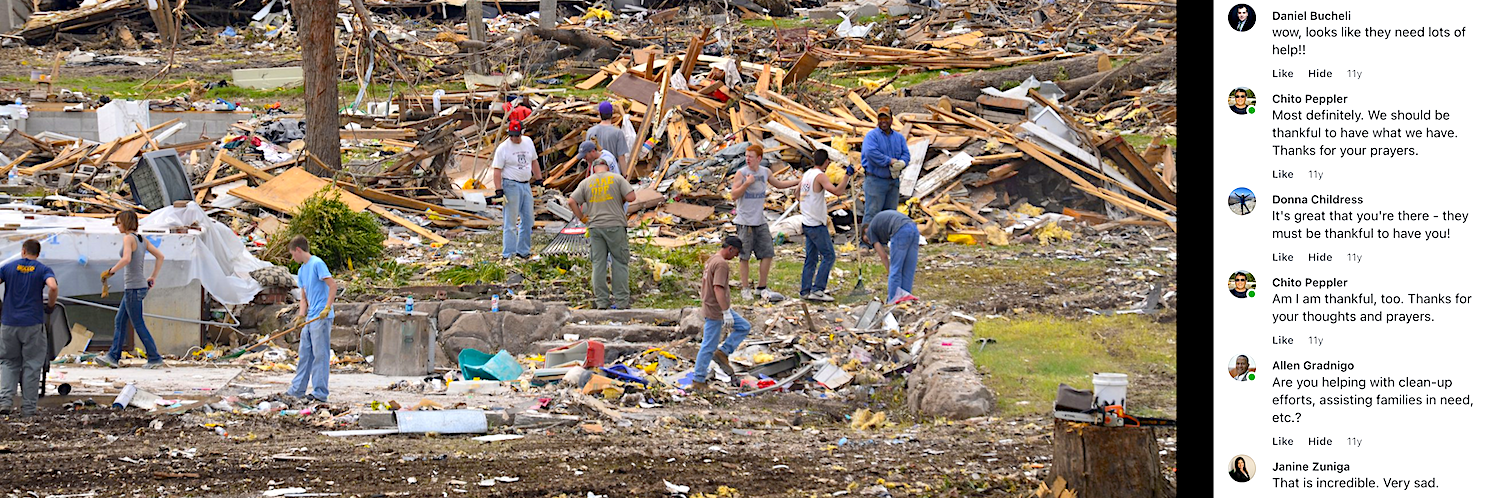
    The next day I visited the site ravaged by the tornado and met some of the victims. The first time I got to see the damage, I was shellshocked. Trees that were left standing were stripped bare by the intense winds. The images brought back forlorn memories from Haiti after the 2010 earthquake. It had already been an amazing whirlwind tour in what has already been a very long journey for disaster relief for one of the deadliest single tornadoes in America.

    I met Christina on the bus going out to the field. Originally from Georgia, her mother owned a house an hour from here. An outdoor person with a warm heart, she loved to snow ski, windsurf, sail and pitch a tent and enjoy nature at its finest. Christina would be spending the next month sleeping in tents and volunteering for both the AmeriCorps and the Ozark Food Harvest. After this stint, she would be heading north to Alaska to go glacier camping.

    I listened to Christina as she cleared debris and collected memorabilia. One of the hardest parts of the relief effort was recovering personal belongings.   Many of the pictures, some over a generation old, would be digitized and posted online in hopes that someone would claim them. Christina found some dental records, books, videos, and a porcelain figurine.
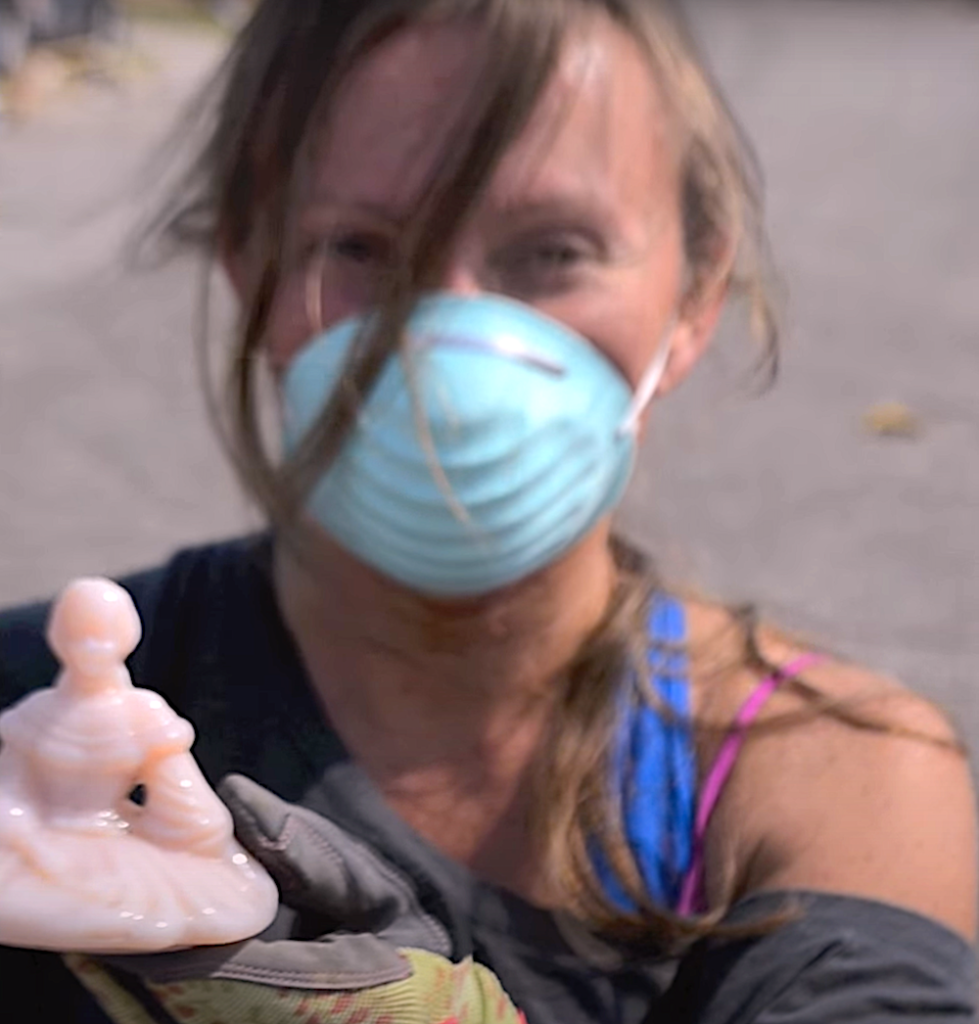
    Debris piled near the street would be picked up by the U.S. Army Corps of Engineers.

    I also spoke to Chelsea, another volunteer who lived in the area.

    “Many people think we’re a small town. The population in Joplin is 50,000, but actually, 300,000 people work and shop here,” she said. “Lots of folks commute from neighboring town — just like me.”

    I was humbled and honored to meet Jerry and Debby, one of the homeowners who lost two houses: theirs and their daughters. Jerry was actually in his truck when the deadly twister hit. He was lifted up and spun around before being dropped in front of his house. His house was pulled straight out of the foundation and blown to bits. House after house for miles in all directions was literally reduced to slab. Cars and trucks were crushed like soda cans. Jerry was fortunate to have made it out alright. His house was reduced to shreds, but he was blessed to have his life and that of his lovely family.

    “It’s slowly sinking in,” said Debby, as she looked through some old photos. “It’s taken a week for me.”

    “Yes, we really need to come here and experience it. Watching it on T.V. is not enough,” said Chelsea.

    Christina looked through some pictures she found. “And it’s important to look at your belongings as just items that come and go. They are not attached to you personally — it’s time to move on.” 

    I was deeply touched when I visited St. John’s Regional Medical Center. Every window in the hospital was blown out, and the top two floors were ripped away. The staff had only minutes to pull patients from their rooms and into hallways before the storm struck. The entire building had been moved four inches off its foundation and six people died. Because there were concerns that the structure might collapse, the building was evacuated.

    Soon, the relief effort would come to an end and the city would shift into a reconstruction phase that would last for many years.
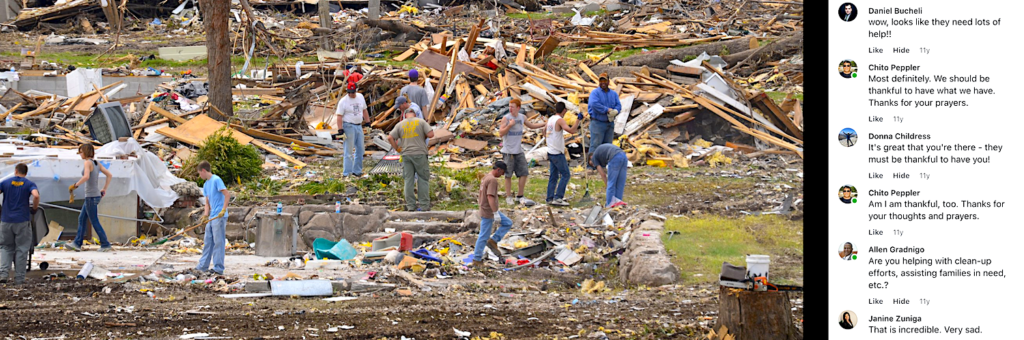
    I was proud and happy to see Sailors from the USS Missouri (SSN-780) clearing rubble and assisting homeowners with retrieving their belongings. Like the humanitarian assistance deployments to Haiti after the deadly earthquake last year, the U.S. military is always there to assist whenever disaster strikes. 

    Soon, the relief effort would come to an end, and the city would shift into a reconstruction phase that would last for many years.

    With damage estimated to be $3.18 billion, the Joplin tornado is the costliest single tornado in U.S. history (adjusted for inflation). 553 businesses and 7,411 homes were damaged or destroyed, affecting more than 17,000 people. The storm reached a maximum width of nearly one mile during its path through Joplin, killing 161 people (with an additional eight indirect deaths).
  • The Skies are Gray

    The Skies are Gray

    Donald “Clay” Clay, an Air Force veteran, was enjoying his stogie while chit chatting with friends, watching boats slipping by. On every weekday afternoon when the weather is fine, he and a half dozen of his perennial friends such as Robert “Bleu” Jones and Kimo Tavares gather at the Slip Inn to chill, booze up and snack on the crowd-favorite George wings. No one knows for sure why they call them George, but rumor is one of the cooks from the earliest days in the 80s came up with the secret breading.  

    The Tiki bar and restaurant wasn’t located in the Navy Yard, Old Town Alexandria or the National Harbor — places packed with tourists. Instead it was tucked away at the edge of Joint Base Anacostia Bolling, a well-kept secret amongst retirees.  That’s why Clay, Bleu and a handful of old timers made it a daily ritual when the clouds are clear and the skies are blue.

    And the weather forecast for the next three days was bright and promising. There was a ton of activity as military personnel and their families kicked off the glorious weekend with Country Western Night featuring a local, up-and-coming talent.

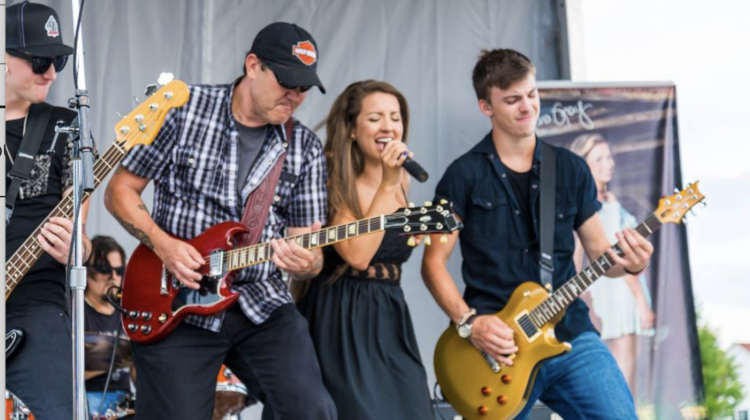
    Sara Gray is a singer, song-writer from Indian Head, MD., just down the beaten river in Southern Maryland.  The first time she sang in public was at the age of three on a cruise ship — from the soundtrack of the Teenage Mutant Ninja Turtles. She watched her father sing in his local band, then started performing at church and has rendered the National Anthem at various community events.  At 16, she wrote her first song and her budding repertoire focuses on country and classic rock.  For the last year, her schedule has been in high demand, opening for country stars such as Toby Keith, Dierks Bentley, the Zac Brown Band and Luke Bryan and performing all over the DMV.

    Sara Gray covering”Cowboy Take Me Away”

    Sara Gray loves audience participation

    “I’m so happy to be on the stage where I feel right at home. I love getting the crowd involved, clapping, dancing and singing along. They inspire me.”

    Justin Voskuil bartending at the Slip Inn Tiki Bar

    Sara Gray singing her original “One of A Kind”

    Photos by Skvora limited media

    Screen-Shot-2022-04-03-at-11.10.36-PM
    Screen-Shot-2022-04-03-at-11.10.51-PM
    Screen-Shot-2022-04-03-at-11.11.24-PM
    Screen-Shot-2022-04-03-at-11.11.43-PM
    Screen-Shot-2022-04-03-at-11.10.17-PM
    Screen-Shot-2022-04-03-at-11.09.46-PM
    Screen-Shot-2022-04-03-at-11.08.43-PM
    Screen-Shot-2022-04-03-at-11.08.59-PM
    Screen-Shot-2022-04-03-at-11.09.18-PM
    Screen-Shot-2022-04-03-at-11.08.25-PM
    Screen-Shot-2022-04-03-at-11.08.12-PM
    Screen-Shot-2022-04-03-at-11.09.33-PM
    Screen-Shot-2022-04-03-at-11.07.33-PM
    Screen-Shot-2022-04-03-at-11.07.59-PM
    Screen-Shot-2022-04-03-at-11.07.15-PM
    Screen-Shot-2022-04-03-at-11.05.40-PM
    Screen-Shot-2022-04-03-at-11.05.14-PM
    Screen-Shot-2022-04-03-at-11.12.11-PM
    Screen-Shot-2022-04-03-at-11.05.55-PM
    Screen-Shot-2022-04-03-at-11.32.51-PM
    Screen-Shot-2022-04-03-at-11.33.42-PM
    Screen-Shot-2022-04-03-at-11.26.06-PM
    Screen-Shot-2022-04-03-at-11.26.42-PM
  • Raqs Baladi

    Raqs Baladi

    On November 11, 2013, Super Typhoon Haiyan slammed into the Philippines causing massive loss of life and a trail of destruction in its wake. Battering the archipelago with wind gusts of up to 168 mph, it was the deadliest cyclone on record.  I, along with my expanding network of Fil-Am friends watched in horror as the island nation struggled to bury the dead and deliver food, water, and medicine to the suffering.

    So I was encouraged with hope when I got a call from my veteran friend, Kim “Dancing Queen,” a self-proclaimed musical arts fanatic, foodie and lover of anything Asian, particularly Cantonese.

    “Have you ever visited Medaterra in Woodley Park?”

    “Afraid not. I normally stay close to downtown. I don’t venture that far north on Connecticut Ave.”

    “Well can you please reach out to the owner, Angela? She wants to host a fundraiser for the Philippines typhoon relief, and I thought you would be the perfect choice to spearhead it.”

    “I’m deeply honored that you would help out. I will contact her first thing.”

    Angela was happy that I agreed to spearhead a fundraiser.  “Post an ad on Facebook. Let them know that 50% of proceeds of food and drink will be donated to AMCROSS.”

    Angela and I also reached out to all the Filipino-American groups as well to a vast variety of meetups in the area, and we were delighted that over 100 people came to dine and donate money. By the end of the night, we had raised $1,200 for the American Red Cross, and Angela Aly was thrilled. “The event was enormous, and you executed like a champ.”

    “My heartfelt thanks to you for offering your space and amazing specials. I appreciate Kim for reaching out to me and my gratitude for everyone who showed up and provided unconditional support.”

    “Yes, the donations will help tremendously and we’ll keep praying for the victims for basic supplies, comfort, and healing.”

    “Without a doubt. Say, so how’s your cafe doing? Do you get a lot of foot traffic at lunch and after work?”

    “Some, but the young folks prefer to hang out on U St, H St, and 14th St nowadays.”

    “Well, lemme see how I can help you. We’re pretty skilled at leveraging social media so we can place butts in seats for those strolling casually down Connecticut Ave.” 

    The following week, I pitched camp at the Mediterranean bistro taking pictures of dishes and featuring them on the website.  In my free time, I would ride my pedicab through Woodley Park, picking up riders who didn’t want to walk the half-mile uphill from the Metro to the Smithsonian Zoo.  Connecticut Ave is lined with restaurants and sidewalk cafes and there was plenty of foot traffic after work and on weekends.

    I also took the opportunity to visit neighboring restaurants in the rustic enclave including the Lebanese Taverna, Open City, and the Afghan Grill. Woodley Park was a small village bounded by Rock Creek Park and the zoo.  But it was an international hamlet with ethnic cuisines from all corners of the world.

    The Lebanese Taverna serves classic, Mediterranean cuisine in a modern, contemporary setting.  In 1976, Tanios and Marie Abi-Najm boarded a cargo ship in the dead of night with their five children to escape the civil war in Lebanon.  After working at local restaurants for three years, they saved enough money to purchase the Athenian Taverna in the Westover neighborhood in Arlington, VA. They made a modification in the sign to read Lebanese Taverna and the rest is history.  Today, the business has bloomed to six restaurants, four cafes, and a market and deli.

    The chicken shawarma was roasting on the pit with onions and cherry tomatoes embedded in between slices to give it a juicy flavor.  As the inverted cone of meat turned slowly on the rotisserie, the chef deftly sliced thin shavings from the outer layer to make the crowd favorite, doner kebab.

    At the bar, a stylishly chic couple started off with the bread – a football-shaped pita of hot, chewy goodness which they dipped in hummus with the right amount of tahini and olive oil.

    Then as an appetizer, they ordered shawarma sliders with hot slices of lamb stuffed inside a soft pillow of bread.

    The entree was braised lamb shank with white wine, the tender chunks were falling off the bone.  They made room for dessert — baklava, phyllo dough stacked with honey, and pistachios to cap off a perfect meal.

    I sat at the bar and ordered an Almaza, a mild and smooth Pilsner brewed and bottled in Lebanon.

    [ Image: Screen Shot 2022-02-05 at 1.33.17 AM.png ]

    Lebanese Taverna bar

    I visited the manager, Charlie Ayoub. “What’s RUNINOut, and how do I know you’re some fly-by-night operation.”

    “Well, we have hundreds of thousands of users in the D.C. area and we were just selected ‘Best of D.C.’ in the Readers’ poll.”

    “How good are you with managing events?”

    “Well, we just organized a fundraiser at Medaterra across the street and raised $1,200.”

    “Alrighty, hot shot. Let’s see if you can arrange an Arabian nights themed party for us.”

    I looked at Charlie wide-eyed and baffled. Did he want fire dancers, sword jugglers, snake handlers?  Perhaps I could ask some of the folks from the drum circle in Meridian Hill Park to participate.  We can set up henna art and have tarot card readings.  Maybe I’ll bring Apollo and have him fly to different customers and eat their pita bread dipped in olive oil.

    “Oh certainly, Charlie, there’s no event no matter how wild or exotic that I can’t handle.”

    “Super, traditional Arab folk music with Raqs Baladi please.”

    I immediately called Sonia Herrero.

    “Raqs Baladi—that’s Egyptian belly dancing,” she informed me with a chuckle.

    “Well can you help out a hopeless fellow? I’ll let you take Georgia out for a hike.”

    “Would love to, but I just started a new job at the Department of Education, so I can’t commit right now.” However, I would love to see Apollo.”

    “Cool, let’s make a date to go biking, and he’ll tag along.”

    “Nope, busy.”

    “Well, we got the EU Embassy Run in May, and all the Embassies love to see Apollo.”

    Next, I called Angela and briefed her on my meeting with Charlie. 

    “Don’t stress out. I’ve got the perfect solution for you.” 

    She wrote down a name and number on the back of the menu. “Asala, call her, see if she’s available.”

    I dialed the number with trepidation. 

    “Hello, who’s this?”

    “Umm, this is Angela’s friend from the Medeterra. Do you know anything about an Arabian Nights performance at the Lebanese Taverna?”

    “Wait, are you the fella riding the pedicab up and down H St during the summer Fest?

    “Yes, the one with the squawking parrot that matches the color of your veil.”

    “Certainly, I would be happy to dance at your event. As long as you’re able to make the arrangements behind the scenes.” 

    Raqs Baladi is an Egyptian dance that originated several hundred years ago performed by ordinary countrymen and women during gatherings and celebrations. Women moved core body parts like the spine, abdomen, pelvis, and legs helping them to develop core strength and a healthy reproductive system. People were enthralled by seeing the women move their hips, so the dance took off, spreading all across the middle-east and into India.

    Jennie “Asala El Masri” discovered belly dancing in 2003 after enduring a knee injury from high school sports.  Belly dancing served as an excellent therapy as she developed her core. Today she still loves sports but has found that dancing feeds her passion for movement and music.  Her performances remain in high demand, and she has performed for a wide range of venues including festivals and embassies.

    It was definitely my responsibility to market the event to bring a decent turnout. Asala didn’t dance for free, and it was my job to bring in enough revenue to ensure her happiness. I, on the other hand, worked for a pat on the back and an open tab.  The golden Almaza pilsners were refreshing and crisp and they always paired nicely with shawarmas and doner kebobs — I ate like a sultan and drank like a commodore.

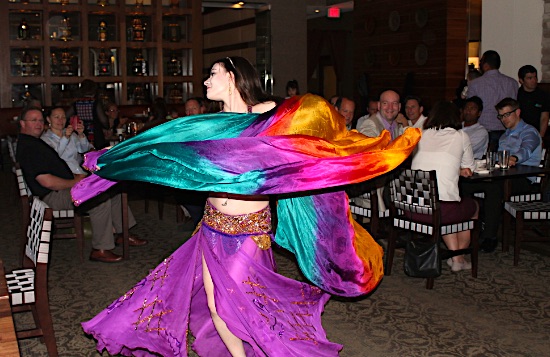
    And when the lights dimmed, and the majestic mejance chimed, Asala emerged from behind the red curtains, moving deftly like an eloquent diva.  Her giant wings made for a truly dramatic entrance eliciting accolades from the enthralled guests. Each instrumental note hummed in unison with the elegant strides of her toned core and her undulating belly.

    We continued every Thursday night in April, hoping the word would spread quickly and her magical allure would entire millenials in droves. Her costume was consistently glamorous and her choreography flawless. And with the succulent Lebanese cuisine and Charlie’s hospitality — I felt sure we had all the right components for a huge hit.

    True to form, she readily got diners to rise on their feet and celebrate this ancient art form from Mesopotamia. And Asala interacted remarkably well, displaying her elegant smile and keeping the audience entertained and captivated with a sensation of enigma and glamour.

    Perhaps there was no other night where her prowess was on display than on April 13.  If no courageous soul rose to the floor, Asala would pick an innocent victim. From the corner of her eye, she saw a nice gentleman smiling and seemingly enjoying himself.  So she went over to tie her veil around his head, only to notice that he was wearing a priest uniform. Charlie gasped. Asala glanced over and caught his expression and dreaded catching his wrath after the show.  Surprisingly, everyone else seemed to get a kick out the entrapment and many thought that she had planned it out from the beginning.

    All the online reviews for the food, service and performance were glowing, but sadly, the attendance continued to be sparse.  Very few mainstream Washingtonians were fans of this exotic art or were willing to drive up to sleepy hollow to participate. Instead, they congregated at the more popular hub: H Street, 14th Street, Adams Morgan, and Dupont Circle at the hip hop lounges swaying to the familiar beat of go-go, funk and R&B.

    My immediate reaction was to call Jackie Woodbury for another lifeline.  Maybe Wayne Manigo could infuse the show with light-hearted laughter.  We even discussed having Asala dance to classic rock — an idea that was immediately shot down by Charlie. But if we didn’t draw a large enough crowd, he would be scrap the rest of the shows.