Category: DC

  • Alba Osteria

    Alba Osteria

    I was going for a run around Chinatown and Mount Vernon Square when I sensed the unmistakable gamey smell of roast pig. I followed the scent and arrived at an outdoor patio with a bocce parklet on I Street. A small crowd was enjoying happy hour while a suckling pig turned a crisp brown on a spit roast.

    I’ve never played bocce, but I knew it started in Italy, and it’s really taking off in the US. What struck me was seeing a famous chef joining in on the fun. How could I not recognize him – the renowned chef from Al Dente with his signature spectacles, white coat, long apron, and familiar smile.

    “Chef Donna?”
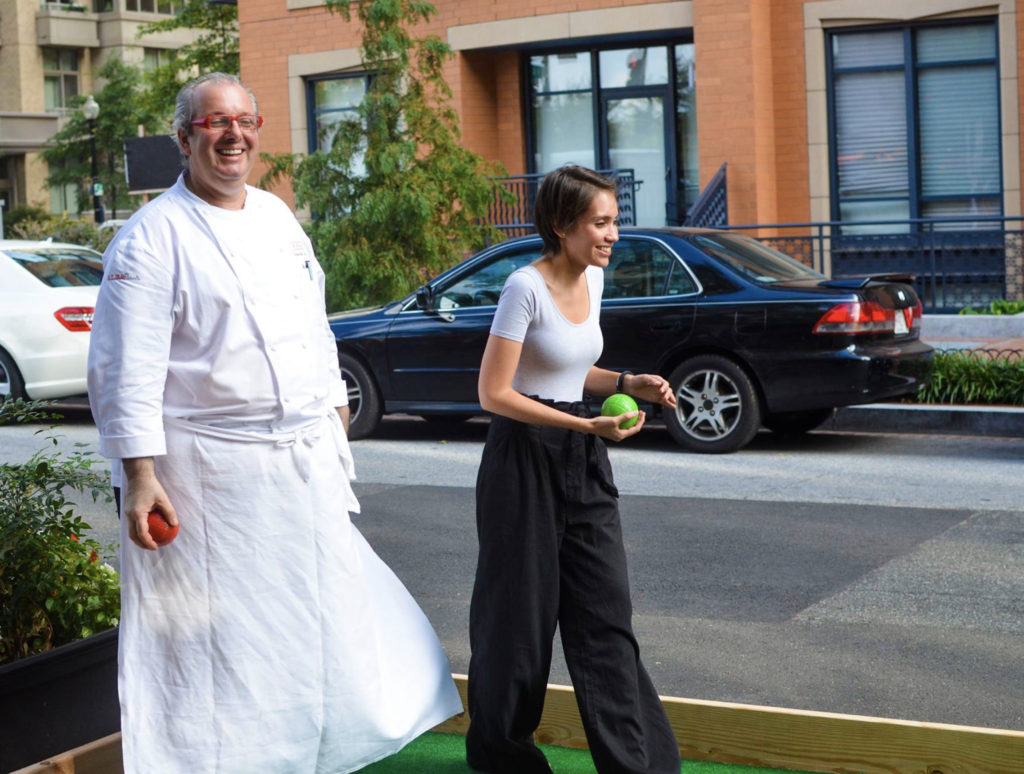
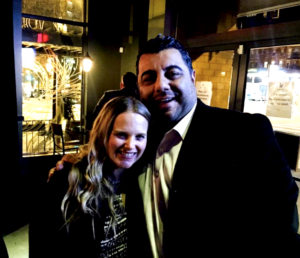
    Chef Roberto Donna & Angie Duran

    “Si, unico e solo”

    “From Galileo and Al Dente?”

    “Among many others, yes.”

    “Nice to finally meet you. I’ve heard wonderful things about you. So you’ve moved to up-and-coming Mount Vernon Square.”

    “I’m excited about this locale. Hotels and condos are going up and people are taking a chance. We want to be their neighborhood restaurant.”

    “Who did you bring along?” 

    “Well, Amy Brandwein, my Chef de cuisine, who worked with me from Galileo, and Angie Duran my manager from Al Dente.”

    Please join us, grab a piece of pork and crackle and check out our enormous space,” said Angie, as she opened the door and welcomed me in.

    “The name Alba refers to a town in Roberto’s native Piedmont. With 226 seats, we are Chef Donna’s largest restaurant thus far. To make the atmosphere feel more intimate, we have sectioned spaces throughout, like a pizza bar, a dining room enclosed in a wine cage, a 12-personal communal table for chef dinners, and of course a 62-seat bar area with local beers and four wines on tap plus more than 200 Italian bottles.”

    “Totally rad, this bar space would be perfect to host an event.”

    “Well, I’m also the event manager so just let me know when and the size of the group.”

    “We normally draw a large crowd and the majority of us are foodies, so providing complementary apps and side dishes is part of our MO.”

    “I can definitely ask my boss Hakan (Ilhan) if we can provide some panini and pizza. Our oak-fired pizza oven turns out pies super fast. But we’ll want to make sure that our bartenders will stay busy.”

    “Of course, we’re a very social group, some even brokering deals. So every one of us will have a drink in the hand, and for people like me, they’ll have two.”

    “Perfect our happy hour is from 4-7 pm when draft beers are $4 and select wines by the glass are $5.”

    “Quite impressive. Is all this information plus your food and drink menu updated on your website?”

    “We try our best. But we have a lot on our plates at the moment.”

    “Well if we shoot pictures of the event as well as your dishes, we’ll share them with you so you can post on your site and social media.”

    On Sept 30, 2014, the turnout for our event was phenomenal with nearly 100 people in attendance.

    Chris Cooks is an IT consultant, social media enthusiast, networker, and self-professed comic genius. I met him at a PR Flacks happy hour, a meetup for PR professionals and communicators, and he has attended a few of our events over the years.

    Chris and I bellied up to the bar sipping on our Belgian-style pale ales. “Hey Chris, are you all caught up on watching ‘Game of Thrones’?”

    “Finally, can’t wait till next week and see which characters survive the series.”

    “Well, I haven’t had the pleasure of seeing any shows in a long time, so please don’t spoil it for me.”

    “I envy you, cuz you still have a lot ahead to look forward to.”

    Angie Duran was busy running back and forth to the kitchen picking up appetizers and keeping guests happy.

    “So Alba Osteria prides itself on authentic Northern Italian cuisine from the Piedmont region, the home of Chef Donna. The region abounds in land for grazing animals and for wine production.” 

    But braised meats, veal, and beef dishes from Piemonte cattle were not the only staples served.  

    For the first time in her life, Judy Castiglia ate escargot “Mmm, I love the taste and texture. And it goes well with the parmesan risotto.“

    Next Judy tried to grab a baked octopus in creamy polenta from Angie, but they went fast.

    “I’m embarrassed as an Italian to say I have never tried polenta. Argh!”
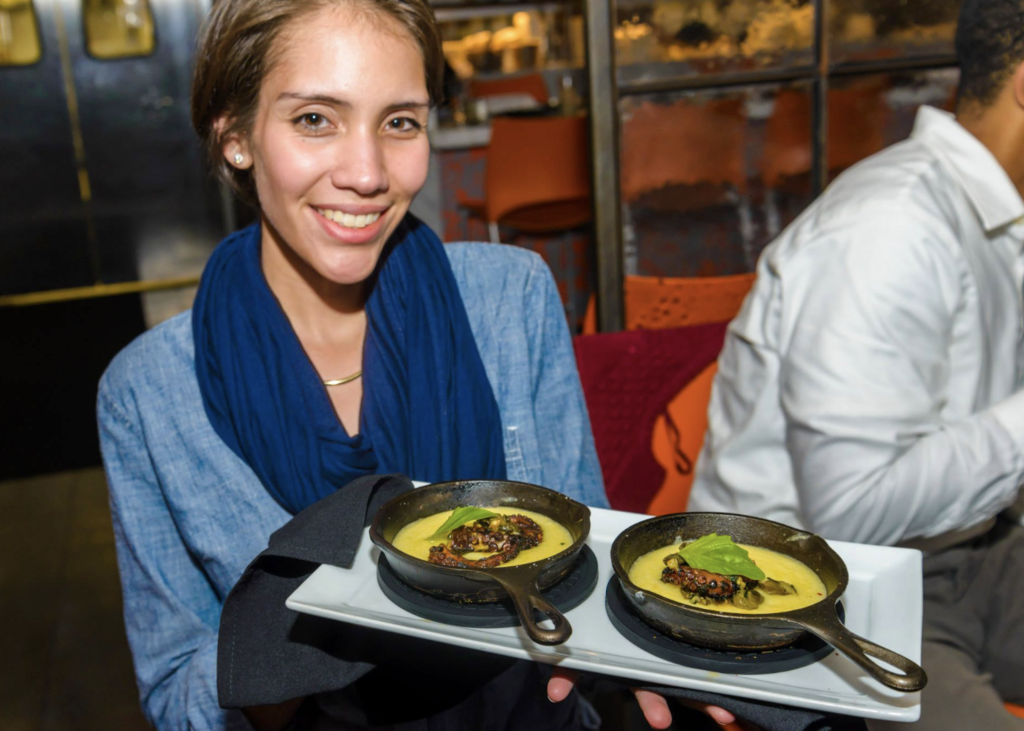
    Angie Duran serving Baked Octopus in Creamy Polenta

    Wayne Manigo scarfed down a capunet (cabbage-wrapped braised duck). “Yeah, there’s only two HBO shows I like better than GOT – that’s ‘VEEP’ cuz it satirizes the political world, and ’The Wire,’ cuz it got it all right about Baltimore.”

    “Baltimore is a city that I haven’t spent much time visiting. But maybe she’s the next terrain.”

    Christine Bach grabbed a slice of veal carpaccio with citrus oil. “It’s a beautiful place — The Inner Harbor is one of my favorite. There’s a lot of wonderful Italian eateries there.”
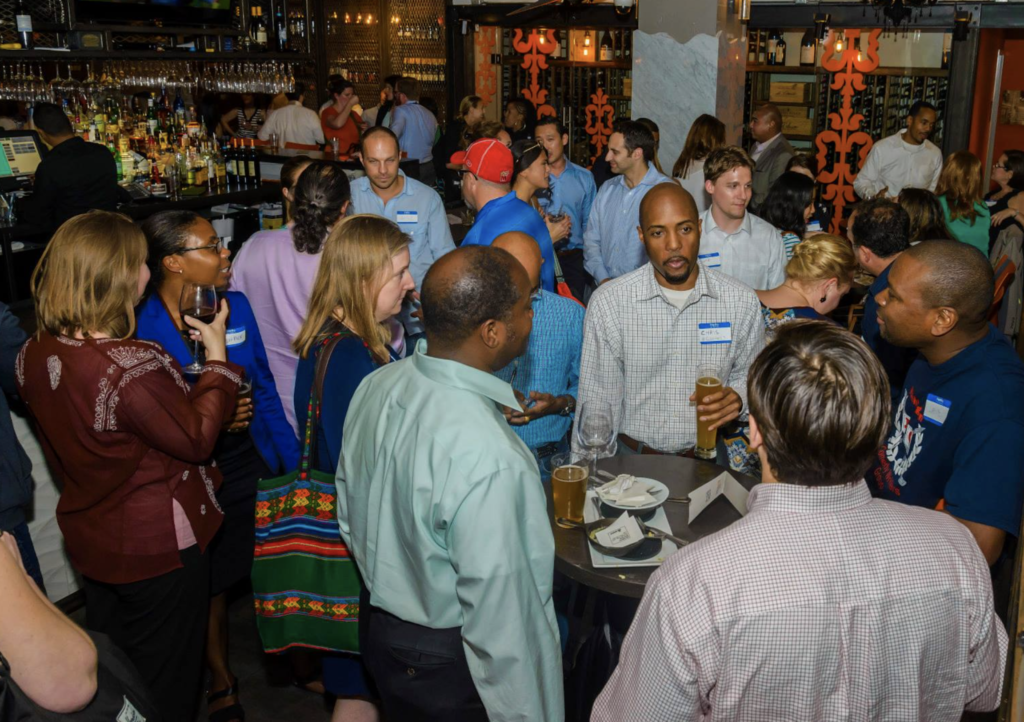
    Judy, Chris and Wayne

    Prior to becoming a chef, Amy Brandwein was doing political research for a lobbying firm in DC. Growing up in Arlington, VA, her dad was a good home cook and vegetable gardener who was always inspiring her. So when she came to the fork in the road of her career, Amy decided that rather than go further into politics, she would pursue the field that she had a passion for. She attended L’Academie de Cuisine and then applied for an externship at Roberto Donna’s Galileo. In 2000, she started in the pastry department, eventually becoming a saucier, then moved up to be a sous-chef. Then in 2005, she was named Donna’s first chef de cuisine.1

    “Amy has a passion for Italian food who goes to the bottom to really find the heart of it,” said Roberto. “She’s very driven and likes to make her point in the kitchen.”

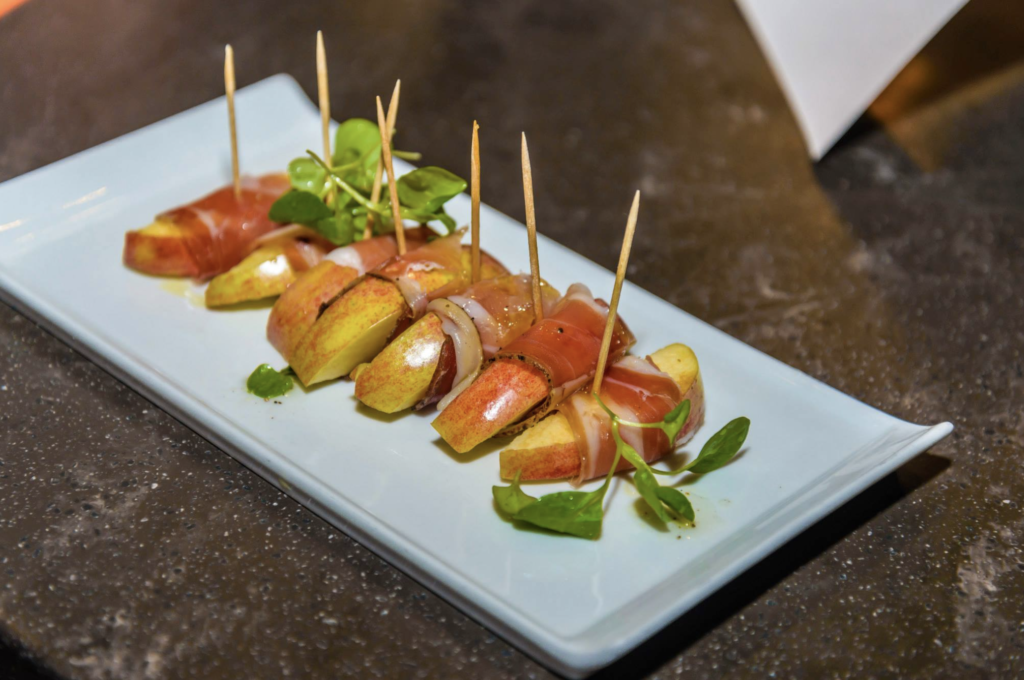
    Wayne picked up a piece of house-made salami from the imported Charcuterie board “So Chef Amy, how is it like working for a James Beard Award-winning chef?” 
    “Roberto is an amazing chef who is intense and highly demanding. He taught me to be true to myself and to my cooking. I definitely learned a lot from him.”

    Judy raised a glass of Barolo wine. “So Amy, you’re really shaking things up. Wish there were more innovative female chefs like you.”

    “Some people call me Roberto’s sidekick. I don’t think so. I’m his chef, not his chic. I run his kitchen, and that’s a huge responsibility.”

    “We’ll drink to that!” Chris raised his pint of pale ale.

    Jason “Foodgeek” was enjoying a chestnut trifle pasta dish. “The food is fresh. Who sources your produce?”

    “We buy from local farmers’ market or cooperatives, specifically what’s in season — we have a passion for responsible and locally sourced ingredients.”
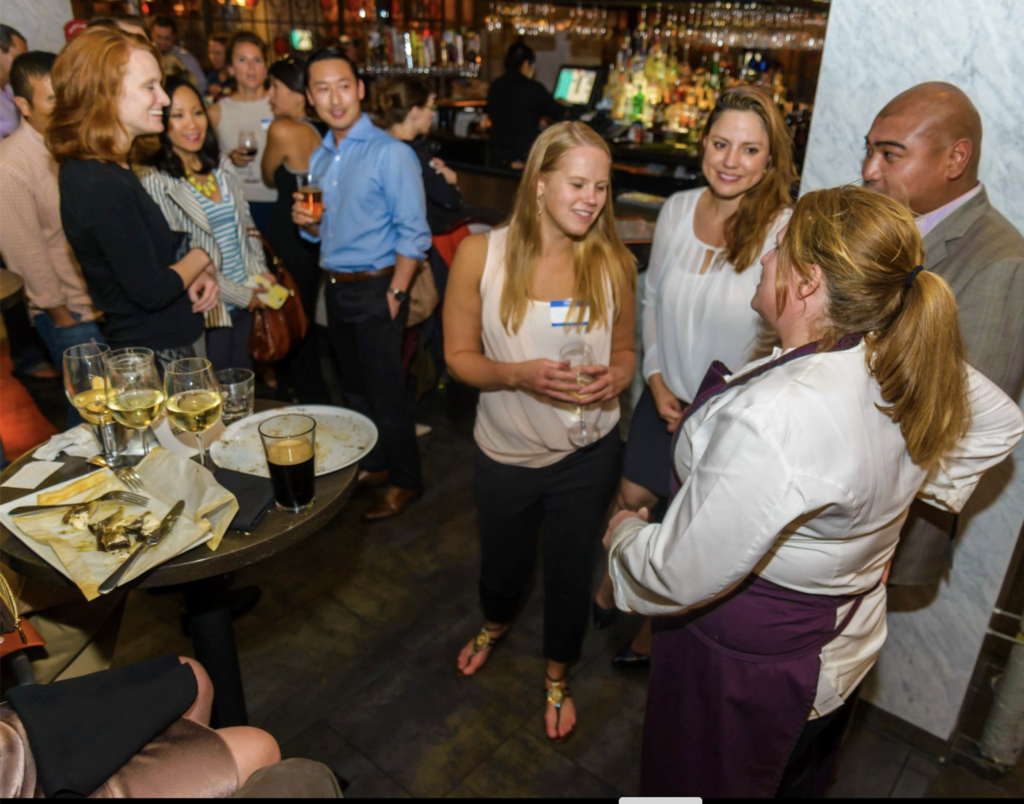
    Chef Amy Brandwein meeting guests

    “This is wonderful Amy. Thanks to you and Angie for making this an incredible experience,” Jason said.

    “Yes, I definitely feel like we’re in a family-run restaurant in Alba, nestled away in the hills of Piedmont, enjoying traditional cuisine,” Judy said as she dug into the braised beef and beef jus, sprinkled with bone marrow.

    “Well come back and join us on Thursday nights for Chef’s Table. It’s a six-course tasting menu where I want to go beyond cooking and create an experience with flavor profiles and wines to enhance the cuisine. The menu will draw from all parts of Italy and incorporate a lot of fresh, sustainable ingredients in both the cooking and cocktails.
  • Meskerem

    Meskerem

    When Meskerem opened on March 15, 1985, there wasn’t much of Ethiopia in D.C. Its owners were amongst the first wave of immigrants who fled their homeland after a Marxist military junta overthrew Emperor Haile Selassie in 1974.1 That coup triggered the civil war between Ethiopia and Eritrea that lasted until 2000 with the final peace agreement not being signed until 2018. 

    Both Ethiopian and Eritrean refugees settled down near the Adams Morgan neighborhood in D.C., a culturally diverse neighborhood known for its eclectic dining scene. The name AdMo is derived from two formerly segregated elementary schools and when the sun goes down, the laid-back 18th St transformed into a mile-long party zone. 

    The popularity and vibrant nightlife led to higher rent prices so a lot of the Ethiopian entrepreneurs moved out purchasing dilapidated properties on U and 9th Sts NW that were devastated by the 1968 riots following Martin Luther King Jr’s assassination.

    Eventually, the number of Ethiopian eateries got so dense on 9th St that several community leaders petitioned the D.C. government to rename the block “Little Ethiopia.” That petition was overruled since its location in Shaw was near Howard Theater and doing so would replace the “Black Broadway” moniker. 

    There’s always a lot of excitement in AdMo. On weekend nights, hoards of party-goers can be seen getting drunk and boisterous, raising a ruckus into the early morning.

    On Sunday, Sept 29, 2008, a man walked into Meskerem, greeted the owner, Mohaba Mohammed, with a hug, and then started chatting.  Everything seemed normal between the longtime friends. Suddenly and without provocation, the man took out his Beretta and then shot Mohaba in the neck. 2

    “Everybody don’t worry!” He yelled, then fired two shots into the ceiling before shooting himself in the head.

    Mohaba recovered from his injuries, and through the years, he and his sister, Nafisa Said kept the restaurant running, through the good times and hard, even as others around them closed.  They did that for 3o years, eventually becoming the oldest Ethiopian restaurant in the US — instrumental in shaping the personality of Adams Morgan into the vast melting pot that it is today.

    Supplies used to be tough to come by. Mohammed could not find any teff, an Ethiopian grain used to make injera.  So he used wheat flour and let the dough ferment for days in plastic buckets.  Today, Ethiopian Airlines flies daily to D.C. carrying injera, teff, spices, and much more. 

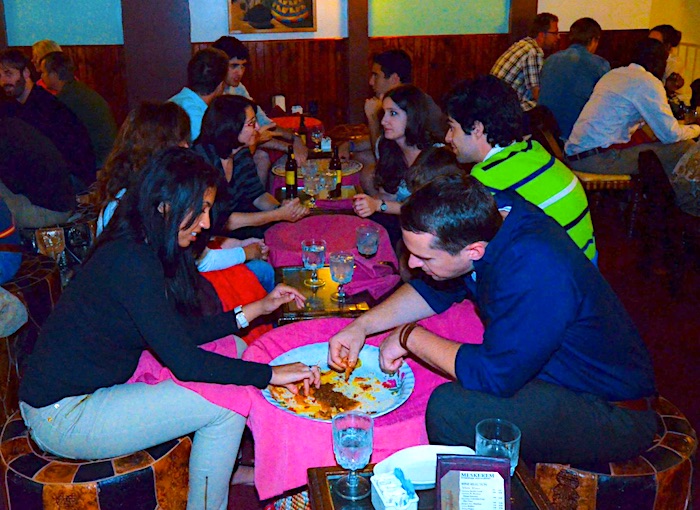
    So when Jackie invited me to join her for a Sept 2014 Ethiopian dinner at Meskerem, I was delighted to attend. There was a fairly large group of diners who were mostly Ethiopian cuisine neophytes. We didn’t sit on elegant wooden chairs or eat from pristine table tops. We were seated instead on traditional cushioned low chairs next to knee-high round tables made out of basket weave.

    Jackie Woodbury, Sept 25, 2014

    Join me tomorrow night for our Ethiopian dinner at Meskerem in Adams Morgan!

    Did you know Ethiopian New Year was Sept 11? Celebrate Meskerem, the name for the first month of the Ethiopian calendar. It ends the 3 month rainy season in Ethiopia (Jun-Aug) and celebrates more pleasant weather! We asked owners Mohaba and Nafisa to bring back their coffee ceremony for Bookalokal Inc.. Can’t wait! D.C. #DCeats #dcdining 

    Most of our group ordered the Meskerem Messob — mixed special which included beef, chicken, lamb, veggies, and unlimited injera all for $13.50 per person. A few ordered the veggie-only version. The dishes were anything but boring. The healthy portions included ruby beets, lentils, salad, carrots, green beans, and chickpeas and were flavored with garlic, paprika, and rosemary. The platter was fairly big and it was meant to be shared with others at your table.

    Sharing with others meant teamwork, better conversation, and synergy. We enjoyed our spicy palette of delicious curry-like stews accompanied by honey wine or St George, the national beer of Ethiopia. 

    The soft, stretchy, spongy flatbread doubled as an eating utensil and the hands still get plenty messy.

    “Is this the messiest you’ve ever gotten eating with your hands?” I asked my friend Yoomie Huynh.

    “Close, but not quite. The messiest I’ve ever gotten was at the Ben’s Chili Bowl half smoke eating contest during the H Street Festival. I didn’t win, but I ate everything in sight.” 

    Jackie enjoyed working with Mohaba and Nafisa in organizing the event. 

    “It brought lots of people from all different nationalities together to share a meal, a chat, and a smile,” she said. “Ethiopian cuisine is very communal.”

    I am forever awed by the resourcefulness and resiliency of the Ethiopian people.  Just like Tadiwos Belete from Boston Spa, the owners of Meskerem were innovative and resourceful in building their business and keeping it running despite limitations and setbacks.

    Less than a year later, Meskerem — after being opened every day since March 15, 1985, suddenly closed. The owners held down the fort and watched as one after another, Ethiopian eateries closed or relocated to U St or the burbs in Maryland and Northern Virginia. And after 30 years, they decided to sell the property to developers and retire from the limelight.

    And with that according to Tim Carman, food reporter at the Washington Post, “the neighborhood’s connection to that first wave of war-weary immigrants appears to be severed forever.”

    * * *

    1 Carman, Tim. “R.I.P., Meskerem: The Ethiopian restaurant that shaped Adams Morgan”, May 4, 2016

    2 “Manager of Meskerem Restaurant in D.C. shot, wounded”, Ethiopian Review, September 30, 2008

  • Apollo’s Flight

    Apollo’s Flight

    DC is a town full of festivals, and there’s no better time to celebrate festivals than in the summer. I had the perfect companion to attend my annual Folklife Festival, Capital Pride and Fiesta Asia. Apollo loved everyone and sang in front of Embassies and he was the character. I should have put Apollo as the star.

    On May 20, 2013, I took Apollo on a run again at the National Mall.  Apollo took flight as he often does, but this time, he went higher and further than ever before. Oh my goodness, I conveyed an expression of blunder. I had gotten so careless that I had forgotten to trim his wings, and suddenly high above the Mulberry trees along the scenic mall, Apollo found freedom.

    I looked everywhere for Apollo, even bringing along his cage, his Bonka Bird toy, rattling in the wind.  I scattered sunflower seeds and peanuts everywhere and had to fight off the squirrels who had a field day. Sadly, he was nowhere to be found.  Like a menacing tween, he had skipped school, and he was not yet ready to reunite with his distressed patriarch. The massive magnolias along the miles-long cinder path served as an ideal refuge for him and the Capitol dome and the Monument obelisk served as his landmarks.

    “Apollo, Come home to Papa!” I screamed at the top of my lungs. As sunset beckoned, I came to the sad conclusion that my wails were been drowned by the hustle and bustle of the young people and tourists mingling on the grassy fields. 

    Soon the sun was shadowed by the majestic, iron dome of the Capitol, and I would have to return the next day to make my unwavering attempt.  At daybreak, when the sun’s rays bathed the Lincoln Memorial in golden sunlight, I was roving up and down the grassy turf searching for my wanderlust feathered friend.  I played a scratchy recording of his chirping. It sounded promising, but after a while the raspy screams only commingled with the purrs from the cormorants and the buzz from the sparrows.

    GW University just so happened to be hosting their commencement ceremony at noon, so soon there would be several hundred black robes and caps with excited families scurrying all over the mall.

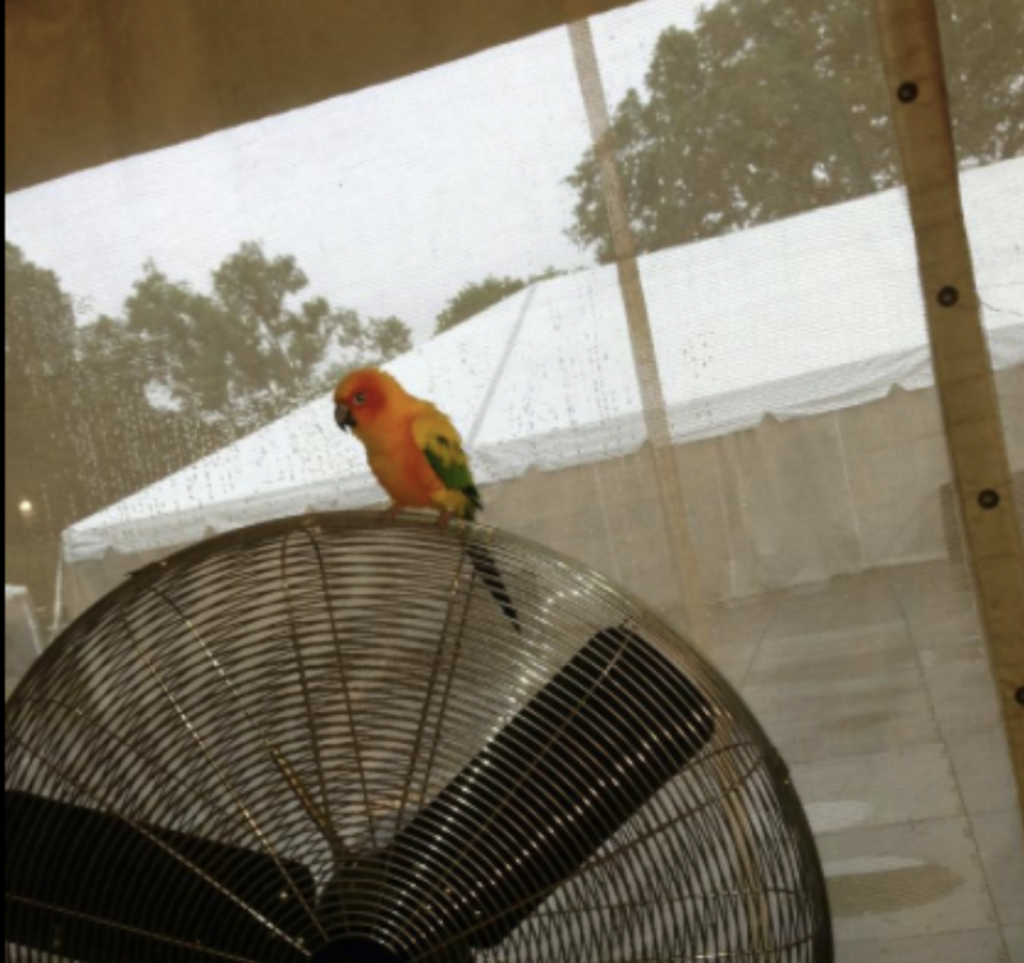
    If I couldn’t physically search, I would leverage social media. My Facebook posting gained some traction and a friend of mine mentioned that a student graduating from GWU saw Apollo hanging out on top of a standing fan, just screaming away. So she called the Washington Humane Society who readily captured him.

    Picture taken by GWU student of Apollo at the graduation.

    I immediately called them and was overjoyed when I found out that they had poor Apollo in safe keeping. 

    Apollo was home now, and he would join me on more runs and escapades throughout D.C..  But this time, I would make sure his flight feathers are well manicured and his favorite Bonga Bird toy is within arm’s reach.

    * * *

  • Best of DC

    We applied for the GWU Business Plan competition three times, hoping that indeed the third and last time was the charm.  Unfortunately, all the leprechauns in the world could not help us. Each time, we advanced to the semifinals, but the finals turned out to be our tough mudder. 

    The second time, was the most promising, where we came in 9th, so we served as a back-up just in case one of the top eight teams couldn’t present.  Unfortunately, we weren’t asked to pinch-hit and we went back to the drawing board for the following year. 

    Then, on April 2, 2013, I got the dreaded news that once again we didn’t make the cut.

    * * *

    April 2, 2013

    Chito,

    I was shocked that RUNINOut did not advance to the finals, since you were ranked #9 last year!  I didn’t read your 20-page business plan this time, but the feedback from the judges this year will give you more insights into why this happened, and you will receive it much sooner than before.  That’s all because I put an emphasis on upgrading this year to an online scoring/commenting system which means no re-keying of the judges’ comments.

    Please let me know if there’s anything I can do to help RUNINOut continue to grow and thrive.

    John Rollins 

    * * *

    Professor Rollins explained to me that the independent group of judges (mostly non-faculty business leaders) may not have had the insight to select the top teams. The business school was pulling for me, but since they had to keep the competition objective, they had no say in the matter.

    Not only did the rejection sting, but the elimination kept us from securing funding. That’s because the university published the results online so venture capitalists (VC) were privy to this info.

    My alma mater wasn’t the only one that rejected us.  We were also spurned by D.C.’s VC firm and accelerator Fortify as well as Baltimore’s Emerging Technology Center.  An accelerator takes an early-stage startup that has already developed a minimum viable product and helps them secure resources and capital funding. They also provide a nominal amount of funding in return for a small equity stake, normally 5-10%.

    So was acceptance to an accelerator the right path for RUNINOut? Without mentorship and funding, our chances of reaching rapid growth were slim to none. It didn’t mean that our business model wasn’t sound or that we would never be profitable. But it likely meant our company would focus on lifestyle instead of growth, on income rather than revenue, on bootstrapping instead of venture capital, and instead of advertising, we would rely on face-to-face guerrilla marketing.

    This new path was right up our alley.  Since we hosted several events a month, we had developed a knack for gaining traction and creating a buzz.  We provided value, engagement, and fun, and in return, our attendees spread the word virally and gave us raving reviews online.

    A week after receiving the bad news from GWU, Suzannah woke me up with some glad tidings.   We were selected as the “Best Restaurant App” in the Washington City Paper Readers’ Choice poll.

    After dozens and dozens of events, miles, and miles of pedicab rides, and tons of food blogs, the hard work seemed to have paid off. 

    I called Gregg Coppen, the web developer from Vancouver, and he almost fell off his chair.  “I’m so glad we decided to add the faceted search at the last minute — this feature must have been popular with restaurant-goers.”

    He was so proud to add the new “Best App” tag to his portfolio and exuberant that he could make a tremendous impact thousands of miles away.

    “When you approached us two years ago, we were hesitant to take on this project on a shoestring budget. But looking back, I’m damn glad we trusted our intuition.”

    “Yes, it’s amazing what we can accomplish if we all work together, communicate and innovate.”

    Soon, I shared the news with Professor Rollins. 

    “What, you beat Yelp, Foodspotting and Urban Table?”

    “It’s hard to believe — it was really the matter of getting name recognition and we did that by gaining traction.”

    “I tell you what. You guys didn’t advance, but your company has shown user-acceptance and income – that’s really what matters, not a trophy.”

    “But we still will not get a chance to present at the coveted New Venture Competition.”

    “Not if I have any say in it.”

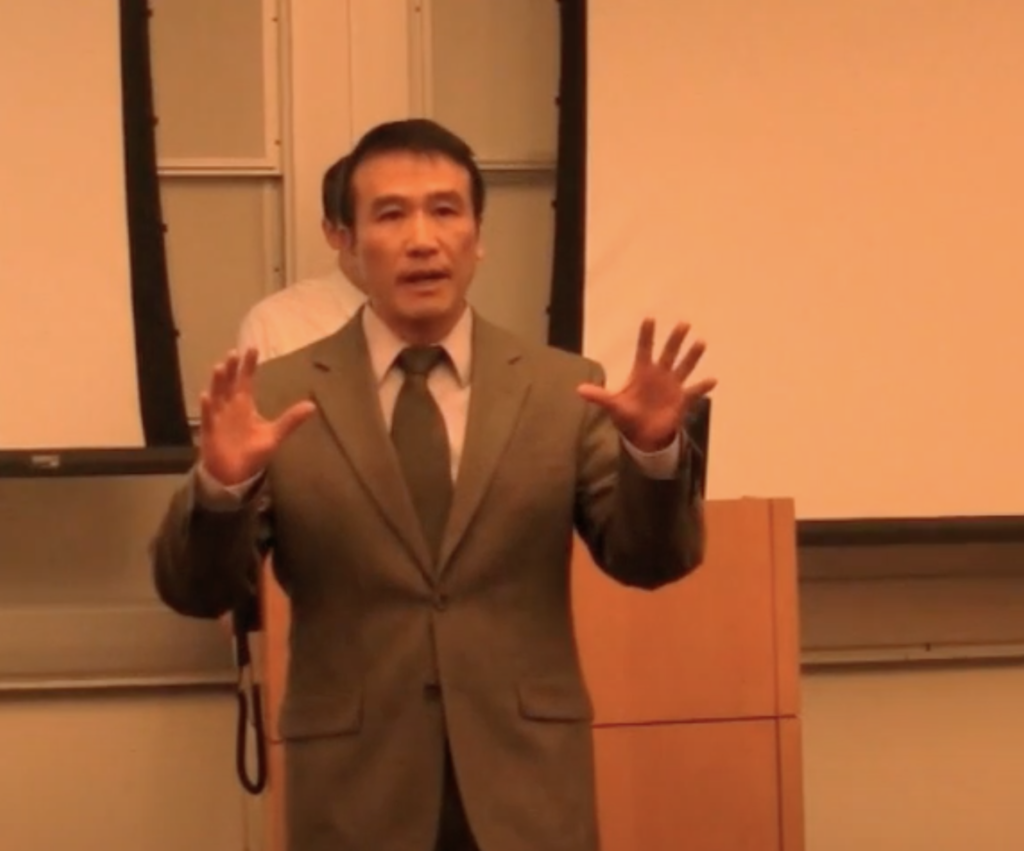
    On April 22, 2013, I got the chance to do just that. I was delighted to have the opportunity to present my business and demo my site to the University where the idea was born. And that was really the most important thing — acceptance and validation from an academic institution. The consumers, we already had them in the bag.

  • Iron Chef

    Iron Chef

    One sunny weekend during the fall of 2013. The restaurant scene in G-Town was abuzz with tourist activity. I passed Georgetown Piano Bar and then Jinx Tattoo parlor, soothing sounds of reggae music emanated from the brown brick establishment. Bandolero was next and this is where I hoped I would cut my first big deal.

    I was taken aback by the “Day of the Dead” atmosphere complete with metal cemetery gates and faux animal skulls hanging eerily on the walls. The interior was dark, the music deafening, the entire ambience spooky and western-chic.

    I sat at the bar and ordered suckling pig tacos and grilled corn on the cob. The bartender poured me “El Bandolero”, their house Margarita on tap. He garnished it with lime and it was delectably rimmed with citrus salt. 

    After my meal, I waited anxiously, wondering whether I should order another cocktail. 

    Luckily, when I turned around, I came face to face with the Top Chef, himself, Mike Isabella. He wore his usual gray short sleeve chef coat, his right arm adorning a brass-knuckled pizza cuter tattoo, and on his left a brand new Mexican Cowboy. He was clean-shaven and wore a big smile. But his voice was gruff and he seemed dismissive.

    “Thank you for showing me your website, but we’re not interested in your service. We have our own publicist and graphic designer. Our business is doing just fine.”

    “How ’bout hosting an event here, say 20-30 people, select appetizers, social media coverage, you name it?”

    “You’re welcome to speak to our manager to arrange an event. But we’re quite busy as it is, and we won’t be comping any meals.”

    Shortly, after Isabella went back to the open kitchen, I returned to my pedicab and quietly rode to my next stop. As I steered down L St towards the GWU campus, I passed Bar McFadden’s to my left and 51st State Bar to my right, both great establishments to catch a game after work. But for now, I had seen my share of D.C. eateries. Tomorrow, I would venture into the Commonwealth to engage with other Top Chefs.

    Crystal City, VA. has for many years been the home of military contractors and govies. During lunch and happy hour, they perennially congregate on restaurant row or at José Andrés’ Jaleo enjoying traditional as well as cutting-edge flavors.

    Adjacent to Jaleo on Crystal Drive was Chef Morou’s Kora, a trattoria-style Italian restaurant that opened a couple of years ago. 

    As I approached the street-side glass doors, fondant blue jays chirped from olive trees that billowed over the sidewalk.

    When I entered, I was greeted with dangling tree branches. Glowing tree canopies created a sense of intimacy. On the wall behind the kiln-fired pizza oven, decal tree branch silhouettes conferred a feeling of calm and relaxation. 

    I sat at the bar and ordered a Dark & Stormy. Then devoured a slice of the chicken pesto pizza.

    Minutes later, Chef Morou entered with his crisp, white chef coat.

    I sat at the bar and ordered a Dark & Stormy. Then devoured a slice of the chicken pesto pizza.

    Minutes later, Chef Morou entered with his crisp, white chef coat.

    I immediately recognized him. Slim and handsome with a pencil-thin mustache and goatee. The winner of an Iron Chef America competition in D.C., Chef Morou challenged Bobby Flay in Season 3.

    “Love the ambience. It’s so sophisticated and chic.”

    “Thank you, I got your email and looked over your site.”

    Chef Morou who grew up on the Ivory Coast cooks like he talks “American with an accent.”

    “So would love to build a new website for you to go with your contemporary design.”

    “Well, I know a thing or two about tech, I studied computer science in college. But lately I’ve been quite busy scouting a location for another restaurant in D.C. and launching my African spice lines.”

    “I understand that you’re very busy. That’s why you should hire us to promote your restaurant and feature your dishes.”

    “Yes, I have a big event tonight in Farrah Olivia that I have to plan.”

    “Super, Bien, et toi.”

    Although Morou was still contemplating, his response was more favorable and warm. I returned to my batmobile and rode through restaurant row

    The following week, I got a text message from Morou.

    “Thanks for visiting. My wife, Heather, says your service is nice but not needed.”

    “I know that marketing and social media is considered the low-hanging fruit, but it’s extremely valuable to increase sales.”

    “We have a lot of overhead. Our restaurant is gigantic and our ceilings are 24 feet high – you can fit a church in here. Our utility bill alone is sky high.”

    “I totally understand Chef, but what if we hosted an event. We would invite 20-30 people, you comp the meals and we in return will feature your cuisine all over social media.”

    The next day, I contacted Michael Galang, founder of Thursday Connect to see if he would help promote the event. Each person would pay $20 and we would split the proceeds. 

    Morou was born and raised on the Ivory Coast in West Africa and learned how to cook by watching his mother prepare feasts for their large family of 33 children. When he immigrated to America in 1988, he was hired as a dishwasher at Ristorante I Ricchi and was eventually promoted when a co-worker quit an hour before opening. Eventually, Morou was hired as the executive chef for Signature. Lobbyist Abramoff, who owned the restaurant, frequently provided free meals to sway lawmakers. Tom DeLay, Bob Ney and John Doolittle were his favorite guests

    But after the scandal hit the news, politicos no longer wanted to be seen at the restaurant, and the restaurant was doomed to join D.C. Eater’s list of Closures.

    On the morning of the event, there were only 10 RSVPs and a few more that indicated interest. But we had room at our table for 20, and we needed butts in every seat.

    It was then, that I gave my good friend Jackie a call. 

    “Hey Hon, we need a big favor. How quickly can you contact your friends to come to an Italian dinner at 7?”

    “I’ll go through our listserv with BookaLokal (marketplace for group dining experiences) and see what I can arrange.”

    “You helped me tremendously with the Chinese feast at Ming’s, if you could pull a monkey out of the hat, I would be indebted to you for life.”

    Two hours prior to the event, Michael and I waited anxiously hoping for a decent turnout. We paced up and down the restaurant along the purple walls, passing the colorful Andy Warhol-like portrait of his three-year-old daughter, Farrah.

    We nibbled on calamari and sipped on Heavy Sea Lager. Little by little people started to trickle in. By dinner time, over 25 guests had shown up. We had met and exceeded all expectations.

    We were able to photograph all the dishes and were able to garner all the content necessary to feature them on RUNINOut.

    Unfortunately, Suzannah couldn’t make it. She birthed the idea of visiting celebrity Chefs but she was now working on her own startup idea. I didn’t expect to keep someone that talented for very long.

    And Jackie, who came through in the clutch, did not have to pay a dime. All her food and beverages were comped by me. She had become my go-to miracle worker, and someone I would rely on whenever I got in a jam.  There would be many more jams and like a 9th inning relief pitcher, we hoped to escape them all.

    “What a smashing event. What’s next on your plate?” Michael asked.

    “Haven’t given it much thought. It’s football season, so perhaps a Florida Gators watch party?”

    “Yeah, sports is nice, but you can’t always rely on me to help out,” Jackie commented.

    “I could use ten of you, frankly.”

    “Then you should interact with the D.C. food bloggers. Chef Morou and other restauranteurs like him needs lots of coverage and publicity.”

    After dinner, there wasn’t much nightlife activity on Crystal Drive, so Jackie and I and a few others crossed Route 1 to 23rd St where there is a small, bustling enclave with a bundle of hookah shops and international eateries

    Right in the center stands Freddie’s Beach Bar, Northern Virginia’s longest-running gay bar.  The beach-themed, purple-lavish bar is adorned with rainbow flags and pink flamingos.  Freddie Lutz, who grew up down the hill, has owned the business for over 12 years. He is an affable man, a respected community leader, and has been working in the industry for over 35 years.

    He opened Café Italia 20 years ago and then decided to open up a Gay bar up the road.

    Before the repeal of “Don’t Ask, Don’t Tell” many gay service members were in the closet. All it took was someone to even think you were gay to report you.  That’s why Freddie’s served as a safe refuge because it was advertised as a “straight-friendly” bar.  This gave everyone protection – they won’t have to worry about being seen because straight people went there too.

    When we walked in, we knew right away we were going to have fun.  The bar was filled with patrons knocking back pints of Devil’s Backbone. A Ballard from Doris Day was belting in the background.

    We found Freddie himself going table to table, mingling with customers like he was a council member.

    “Freddie’s is the most diverse bar that I know of. It bridges the gap between the straight and gay communities – that’s one of the most magical things about us,” he said.

    After chatting with Freddie and ordering our cocktails, I came upon two of my friends who had actually been my tenants for eight years.

    Dywayne and Ty were enjoying the music, ambience, and cuisine.  

    “We just came from dinner at Kora across the street. You guys need to come to one of our events,” I suggested. “How’s Wade Road?”

    “Everything in the apartment is fine. Will pencil that in on our calendar. By the way, you can come by Home Depot sometime and pick up your rent,” Ty said. “Unless you just want me to mail it to you.”

    “Home Depot is fine. I gotta buy some supplies anyway. Can I find you at the Customer Service Desk?”

    “Absolutely. You know which days I’m off. I can’t hide from you.”

    “Freddie’s is such a great place to get together. We need one of these in every city,” Dywayne said.

    “Couldn’t agree with you more. It’s such a great atmosphere.”

    Despite Freddie’s popularity, gay bars today are dwindling since many bars have accepted the LGBTQ culture and have adopted drag shows to their regular performances.  Freddie’s has been a huge building block for the community and fortunately will be here to stay.

    “Next time, you have a craving for pasta, visit Café Italia down the road. They’ve been a fixture here since 1976.”

    “Will do. And thanks for bridging the gap in our community.”

    “Thanks for coming over,” Freddie said. “See you at Freddie’s Follies on Saturdays.”

    Back then, Freddie’s and the D.C. sports bar Nellie’s were one of the few venues that featured drag brunch. Now it’s so popular that mainstream venues are serving up drag with their eggs benedict like it was just a cover band.

  • A Site is Born

    During the spring of 2010, I enrolled in Professor Richard Donnelly’s New Ventures Class at the George Washington University (GWU) School of Business.  Students had to create ideas for a new venture, form groups of four and present the idea to the entire class at the end of the semester.

    My teammates were Daniel Lonnerdal, Jing Xe, and Mustafa Onerci.

    “What I learned from the Foodspotting eatup at Burma Restaurant was the need to provide faceted search where users can choose their cuisine, type of dish, ingredients, and taste preferences,” I said.

    “Not only that, but you can choose your mood and ambiance,” Jing added. “Last weekend, I went on a date with my boyfriend. I tasked him to find something romantic with a pleasant view and no distractions, and thank goodness he didn’t disappoint.”

    “Lucky for him, he came through. And if you’re a fan of sports like me, you can select the team that you like to watch, and the site will tell you which pubs to visit.  A Falcons fan definitely doesn’t want to stumble blindly into a Saints bar.  Unless you’re game for an ass whooping contest.”

    “Perfect example — what shall we name it?” Daniel asked

    We brainstormed for a few..”How ‘bout Food Runner?” Mustafa suggested.

    “Nah, some people drive or catch a cab.”

    “How ‘bout Run this Town?” Jing asked.

    “Nah, not a big fan of Jay-Z.”

    “How ‘bout Dining Out?” Daniel asked.

    “Meh, how ‘bout RUNINOut?” I suggested.

    “That’s a weird name. Like running out of food, groceries, things to do?” Mustafa asked.

    “Umm, yeah that’s an accurate expression.” I began to write the name on the notepad.

    “Strange…Looks too much like RUIN tho. And isn’t running spelled with two N’s and one G?” Jing asked.

    “Yeah, but that’s just too long to fit in an address bar. I like the shortened version even if we’re ruining the spelling.”

    “It’s kinda catchy, but I think people will get confused and misspell it. Then they won’t be able to find it on Google,” Jing replied.

    “Well tell that to Larry Page and Sergey Brin when they came up with Google or Jerry Chang with Yahoo.”

    “Too bad we’re not in Silicon Valley. So are you going to hire someone local to develop the site?” Daniel asked.

    “Would love to, but the prices in this town are up in the stratosphere due to high demand from government contracts.”

    “Then why don’t you outsource the work to India, the Philippines, or Africa?” Mustafa suggested.

    “We can outsource the content management once the structure is in place. But to build the foundation, I want to find a team from North America who understands our culture, our cuisine, our history, our beliefs, and attitudes. Someone who I can physically reach out and touch if I need to and someone that won’t break our piggy bank.”

    “Where can you find such gifted talent whose willing to work below market price?” Daniel asked.

    “Dunno, but maybe we can find a technical co-founder at the next tech meetup.

    “That’s possible. And I hope we get good feedback from Professor Donnelly and the class during our capstone presentation next month.”


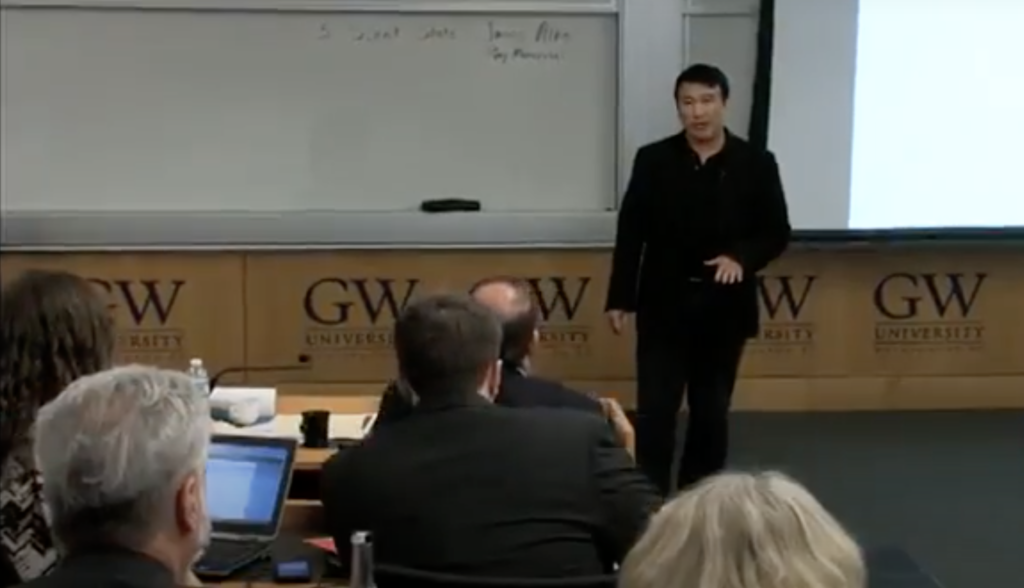
    Presenting RUNINOut at the New Ventures Class at The GWU University
  • TAPS

    TAPS

    Suzannah was a godsend who turned out to be a perfect sales rep and event organizer for our fledgling startup. Originally from Charleston, she carried the charm of a genteel Southern hostess and a transcending smile of a graceful beauty queen. She arranged a meetup with Biergarten Haus, a German beer garden on the newly revitalized H Street corridor known locally as the Atlas District. Suzannah reached out to Arturas “Jeepo” Vorobjovas who also co-owns the Russia House in Dupont Circle.  

    “Have you googled your restaurant lately?” Suzannah asked. “Your online reputation can either be an asset or a liability, and we’re here to help.”

    “Germans love their pilsners and already flock to our beer gardens. Our reputation is flawless.”

    “But there are so many beer lovers, who are not familiar with the art of drinking Bavarian beer. We’re here to make the introductions.”

    Jeepo was easily persuaded by Suzannah’s charm and got her in touch with Ali Loo, the general manager who agreed to provide free food for our event. 

    Now the difficult chore of attracting people fell squarely on my shoulders. I immediately visited the Meetup website and noticed the D.C./Metro Area Reddit group was hosting an Oktoberfest event and searching for a venue. I contacted them, and they agreed to co-host the event with us as long as we would share with them our favorite Subreddit group.

    “Beer Drinkers!” I answered enthusiastically. “And German beers reign!”

    Biergarten Haus

    The Biergarten prosts German brews by the stein.  And since the beer drinker’s paradise is home to over 200 yeast strains, 40 sorts of malt, and 100 different hops, there’s a different taste for every day for the rest of your life.

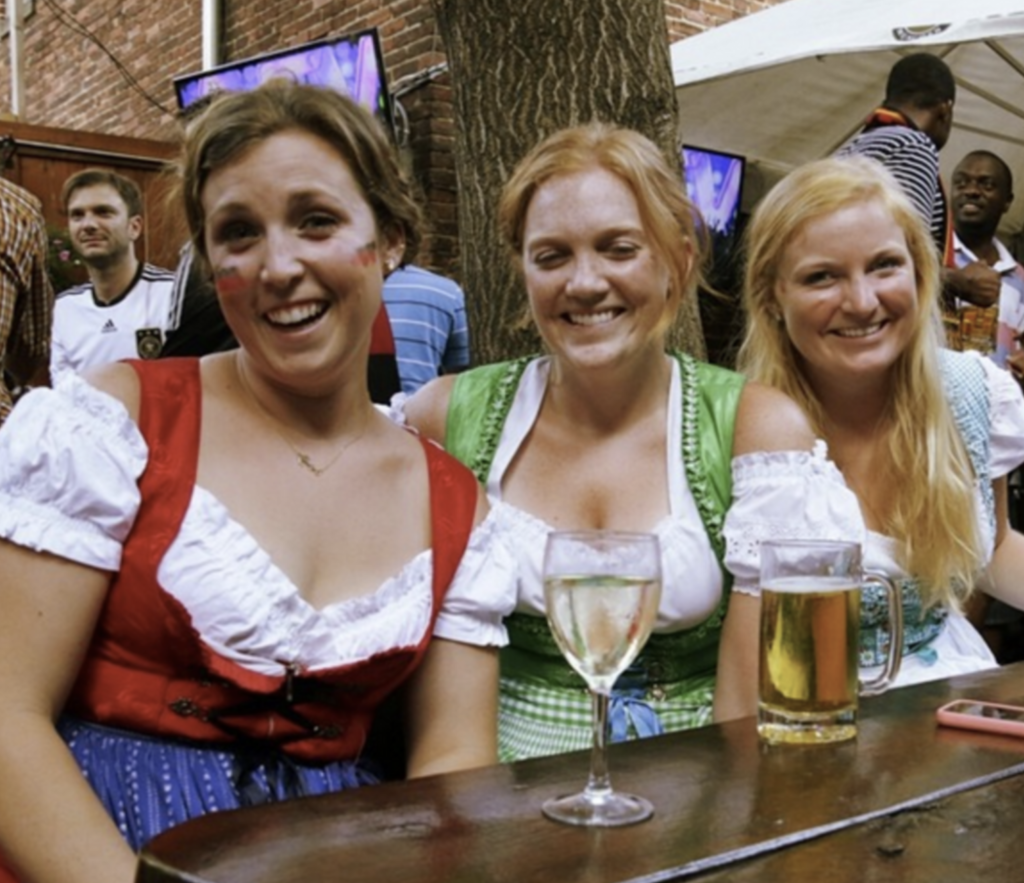
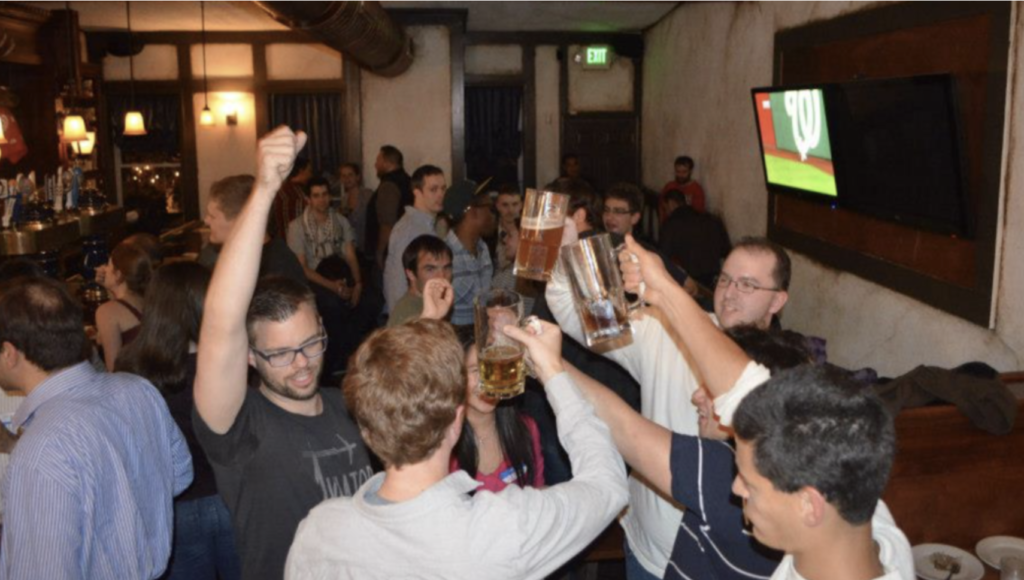
    The Biergarten is beyond spacious. There are three bars spread throughout the entire grounds: outdoor, indoor, and on the rooftop all with phenomenal views. There was floor-to-ceiling vintage art decor that brought back fond memories of fun times at a Stuttgart beer hall. German -enthusiasts sat beside long, rustic wood tables, while many held foot-tall beer steins congregating around repurposed bourbon barrels. Outside an oompah-pah band played traditional Oktoberfest music and women in blue polka-dotted dresses danced the Schuhplattler. 

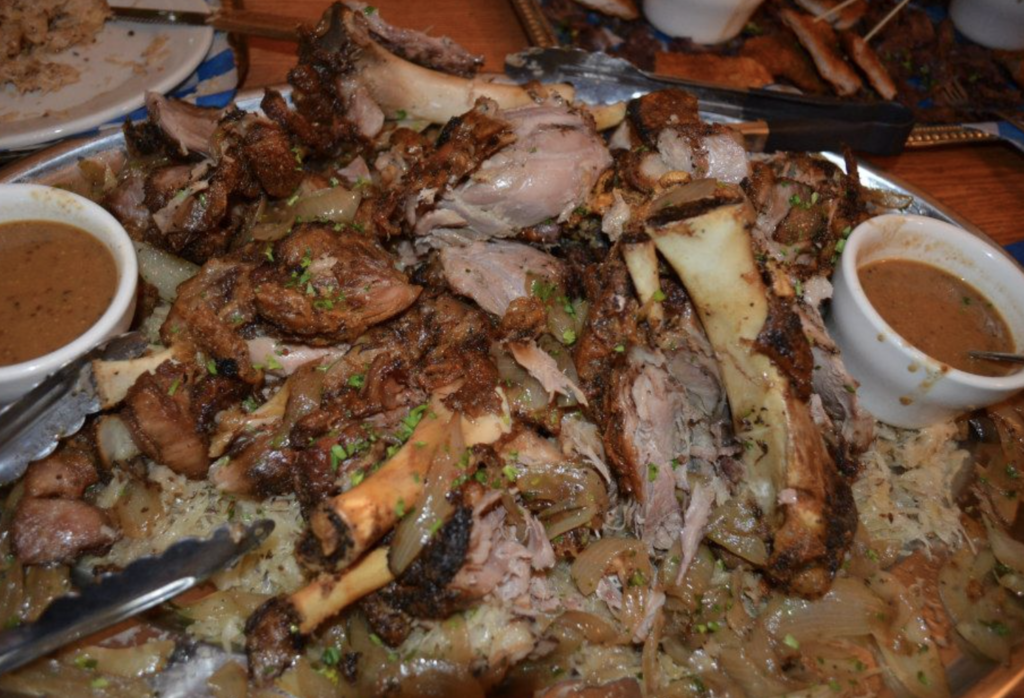
    Pork Knuckle (Schweinshaxe)

    Ali brought out the pork knuckle served in a puddle of malty beer gravy. The lip-smacking rich meat wrapped in a golden sheath of crackling easily fell off the bone.  It was the perfect dish that served a large, rambunctious group of techies in a boisterous beer hall.

    Suzannah raised her stein to Ali and me. “What a lively event, kudos on our first one together.” 

    Reddit / RUNINOut Meetup at Biergarten Haus

    “Danke schön,” I replied. “I picked up a phrase here and there at my last duty station in Stuttgart.”

    “Well I know no Deutsch, but my Grandma was born and raised in France, and she made sure we spoke it fluently.”

    “Super, maybe you should visit Bistrot Du Coin in Kalorama for our next event. We can all mingle over Foie Gras.”

    “That’s quite a hike. There’s nothing French in the Atlas District?”

    “Unless you consider Louisiana French?”

    “Absolutely, Cajun is a combination of French and Southern cuisines, which is kind of like me, since I’m a Carolina girl with French descent.”

    “True dat. Well there’s TruOrleans, the new Cajun restaurant on the west end.”

    The following week, I met with James “Tru” Redding who just opened his bi-level Cajun restaurant just over the H Street Bridge.  Redding is also a partner in Arlington’s Sushi Rock and Dupont Circle’s Public Bar and Lupe as well as Landover’s Stadium Club, a steakhouse and strip gentlemen’s club.

    The previous tenant was a run-down radio station where Petey Greene, the legendary ex-convict turned radio talk-show host, worked and was instrumental in calming the people of D.C. in the aftermath of Martin Luther King’s assassination. 

    Today, the building is beautifully renovated with exposed bricks and an airy New Orleans-style veranda giving it an authentic French Quarter vibe. A sign painted on the side of the building shows a retro-looking advertisement for ginger mint julep.

    Tru Redding met me at the patio and gave me a spirited tour of his new digs.  I admired all the wall art that Redding picked up from Bourbon Street, reflecting the character and soul of the Big Easy.

    We sat upstairs on the veranda enclosed by ornate wrought iron railings with a commanding view of the Capitol. Overhead, large fans rotated above us, ushering in a cool breeze.  He offered me an Abita Purple Haze and we sat down by a stained-wood table with bottles of Tabasco sauce and “Slap Ya Mama” Cajun seasoning.

    “So what made you open up a Cajun restaurant in D.C.?”

    “During a local golf tournament, I met the East’s, a third-generation Louisiana family who invited me to a duck hunting trip in the Creole Nature Trail. After a long day, we would return to their family home where they would cook up a storm.  It was the best Cajun Creole food I’ve ever tasted – not the fancy stuffy you find in the French Quarter. And after that, I was on a mission to bring back a slice of N’awlins to the Nation’s Capital.”

    “Has everything gone as planned?”

    “We made a lot of mistakes.  We opened up way too early and there were disruptions in service and food.  We need to reach out to folks who were not pleased with our services and give us a second try.”

    “Do ya’ll think H Street is ready for a block of the Big Easy?”

    “We certainly do. We want to be good neighbors, though, and we hope that we can bring the right balance of Mardi Gras festivities while been courteous and considerate of our neighbors.  Hopefully, they will see us as good citizens, and we need your help in spreading that message.”

    The following month we co hosted “The Taste of TruOrleans” with Eventstir, a crowdfunding platform for events, and over a dozen people met up at the patio to devour D.C.’s best Cajun-style cooking.

    We parked the pedicab outside and foodies piled in to devour pistolettes, andouille-studded gumbo and crawfish étouffée, jambalaya, and gator tenders, compliments of Chef Andre Miller, a Ruth’s Chris Steakhouse alumnus.


    Suzannah enjoying TruOrleans cuisine

    Both Wayne Manigo, a local entrepreneur and comedian, and I were enjoying the Abita Purple Haze beer on tap.

    “I want to go back to the people of N’awlins and thank them for the birth of their food,” said Wayne 

    “And I want to them for their interesting cocktails and stiff drinks. The Sazeracs really packs a punch,” I said. “Wanna try the Hurricane next?”

    “How strong do you want it? They range from a mild level 1 to gale force 3 which is topped with Bacardi 151-proof rum,” the bartender said.

    I squinted back at him and made a confused face, and the bartender immediately knew which one to pour.

    “So what’s the next project Chef?” I asked.

    “We hope to be serving breakfast soon with beignets and jambalaya-stuffed biscuits.”

    “Laissez les bons temps rouler.”


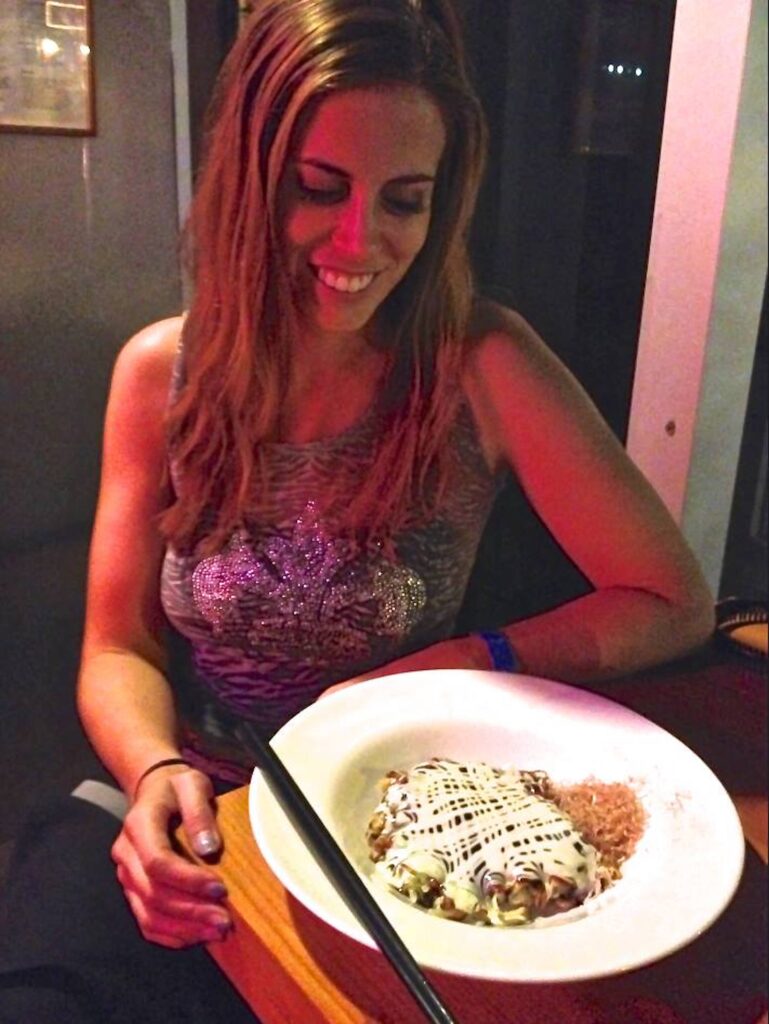
    Suzannah enjoying Japanese Okonomiyaki

    Suzannah was the perfect adventurer in discovering and enjoying new cuisines.  She was someone who could make something as benign as eating crepes look attractive.  And beyond the bountiful platters of beef bourguignon and chocolate soufflé, she maintained her stunning, hourglass figure like Raquel Welch.

    It definitely helped that she was an ardent fan of cardio, and she kept reminding me of the importance of cutting back on drinks and staying active.

    “C’mon Chito, you’ve been drinking too much Abita. It’s time to work it out.”

    If we weren’t walking to restaurants, we were sprinting to them and often joining other casual joggers around the expansive (National) Mall. D.C. happens to be one of the best cities for runners due to its walkability and abundant access to parkland. 

    n one of our weekly rituals, we crossed paths with the Marine Corps Marathon runners at the Rock Creek and Potomac Parkway by the glamorous Kennedy Center for the Performing Arts. We enjoyed making small talk with other runners and meeting new friends along the way just like we did at neighborhood restaurants.

    As we approached the scenic Hains Point peninsular, we saw hundreds of volunteers in blue, waving American flags with tribute posters commemorating the fallen.  What an inspiring and emotional way to honor and remember those who made their ultimate sacrifice.  I knew I would be sweating today, but no one told me that I would be weeping also. 

    I was honored to meet Monica Velez who lost two brothers—one in 2004 in Iraq and one in 2006 in Afghanistan. She was running her first marathon to raise money for TAPS, a non-profit organization that helps families nationwide cope with the deaths of their fallen soldiers. 

    José “Freddy” Velez

    José “Freddy” Velez

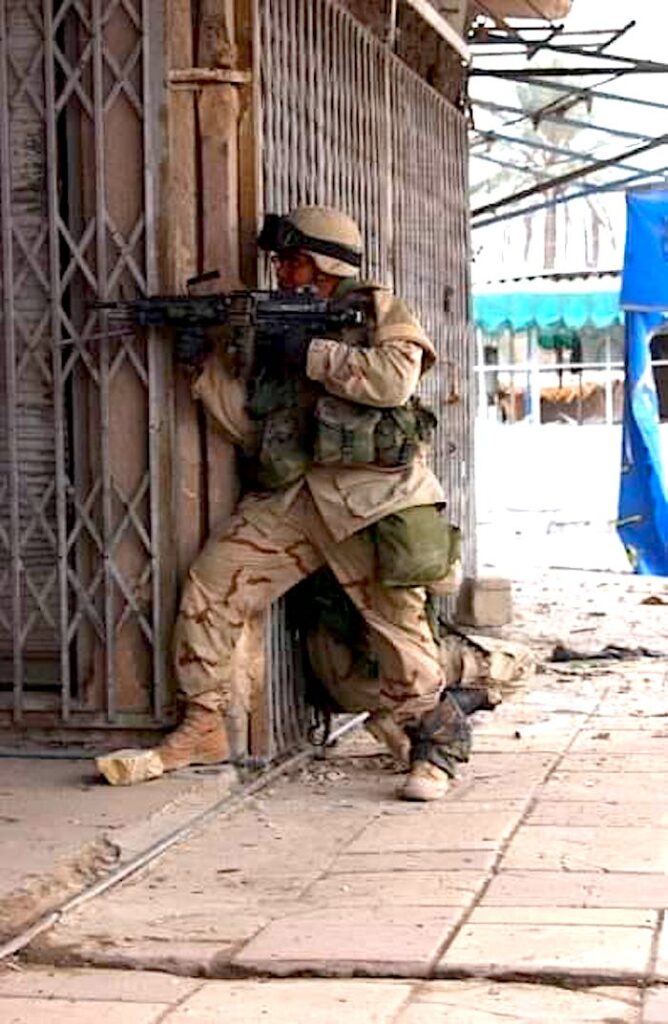
    Corporal José “Freddy” Velez was killed in action in Fallujah in 2004 and was posthumously awarded the Silver Star.

    “Oct 31st, 2004 was the last day we spoke to Freddie. His final words to us are, ‘Be Strong, Don’t Give Up.’ Still holding on to those words and that moment.” 

    Specialist Andrew Velez had the difficult task of escorting his brother’s body back to the United States. Two years later, he committed suicide in Afghanistan.

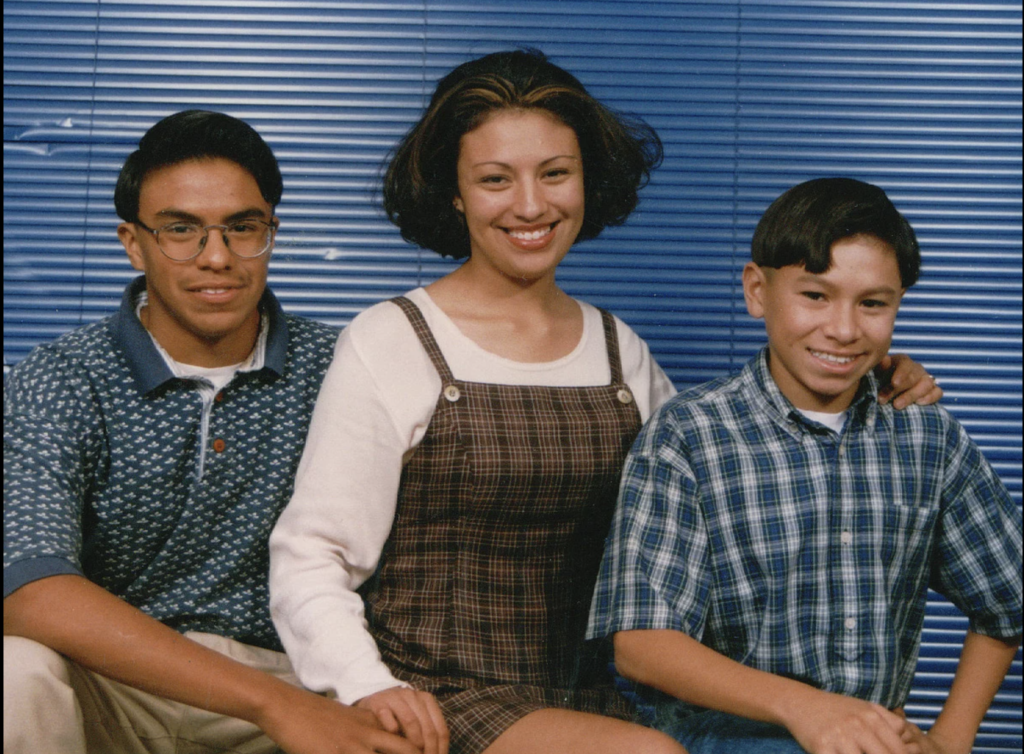
    Left-Right: Freddie, Monica, Andrew Velez

    “Tell me more about TAPS.”

    TAPS helps brothers and sisters, fiancés, and battle buddies by providing counseling and grief support.  They get us all connected so we can talk about our grief and work through it together.”

    “Being a sibling is a lot more than being a spouse and parent.  I expected to have my brothers with me for the rest of my life. With TAPS, I’m able to share my stories and help other family members. I’m able to reach two different spectrums of grief and help them go through the coping skills to get through each day.”

    “Monica, your story really touches my heart. I want to thank both Freddy and Andrew who made their ultimate sacrifice You are a special angel – thank you for your service of gold.  Continue on your journey.”

    “I remember our long runs together. I can hear my brothers cheering for me now.”

    I stopped to give Monica a long embrace.

    As we said our goodbyes, I promised myself to return next year.  If not to run, then to cheer runners along the course. I was deeply moved and inspired by their spirit and drive.  And for those who gave their lives, their sacrifices will not go in vain.

  • Folklife Fest

    Folklife Fest

    July 7, 2007

    I was running vigorously along a cinder path, flanked by the Smithsonian Castle and the Museum of Natural History, when I suddenly realized that running was my heaven on earth. It was also the optimal time to be in D.C. during the pomp-filled Smithsonian Folklife Festival, showcasing Northern Ireland and the Mekong Delta. The most northern country of the U.K. was experiencing a watershed moment following ten years of stability and peace. Over 100 participants from Ulster — performers, artists, storytellers, craftspeople, cooks, etc. — traveled to the Nation’s Capital for several months to teach, demonstrate and display their lifestyle in their Celtic homeland.

    Running and sweating profusely along my well-worn path, it’s very rare to have a chance to enjoy a cold one. 

    Noticing that the Northern Ireland display had an actual outdoor bar and dehydrated after an arduous run, it was hard to resist the cooldown. I ordered a creamy pint of Guinness that would surely quench my raging thirst.

    This is where I met Jamie, a cute, cheerful brunette who had an avid interest in anything Celtic. This was her second year volunteering for the Folklife Fest, and she enlisted so that others could enjoy her passion for folk.

    “Some people have volunteered for 30 years. Once you serve for 10, you get a pin. Some say that the pin’s diamond is a shaving from the Hope Diamond on display at the Natural History Museum.”

    The Irish love to drink, toast, and chat, and soon Mark Wilson and Lee Lawson, stylish musicians strutted out, showing off their remarkable set of drums. The two could twirl the drumsticks like a cheerleader’s baton and never miss a beat. There was a variety of other musicians and bagpipers at the festival, but Mark was one hell of a drummer who could put on a captivating show leaving the crowd in awe.

    Mark introduced me to Tommy Sands — a legendary Irish-ballad singer whose bariton Irish Gaelic voice could calm even my most excruciating painful runs. I could listen to him endlessly and grieved when the show concluded. I gave Tommy one of my signature military coins, and he presented me with one of his CDs that had not yet been released — I felt royally honored and overjoyed by such a heartfelt gesture from such an endearing musician.

    Mark and Lee, snare drummers, during the Smithsonian Folklife Festival

    Mark picked up a drum stick and gave it a twirl. “Why don’t you join us at the Key Bridge Marriott after the festival.” 

    “Yeah, it’s the after-hours entertainment in the ‘Olympic Village’ for all the performers,” Lee added.

    When I arrived in the drab brown ballroom I was immediately met by Scottish bagpipers and colorfully dressed people from the Bahnar tribe of central Vietnam. There was lots of music, dancing, multicultural harmony, and of course traditional ethnic food.

    Mark picked up a traditional French baguette with what looked like deli meat inside. “What kind of sandwich is this?” 

    Jamie picked up a slice of pate. “It’s a Banh Mi, a Vietnamese baguette.”

    “Wow, the crust is super thin and crispy. What’s inside?” Lee asked.

    “That’s precisely what makes a Banh Mi different than an American sub. It has pork belly, grilled pork, pate, cucumbers, cilantro, and jalapeños,” Mr. Nguyễn, who was responsible for narrating the tall tales of the Mekong Delta, replied.  

    Mark took a bite and chewed softly. “Geez, I’ve grown up loving corn beef and Ulster fry, but I appreciate the opportunity to try different cuisines.”

    We stayed up late meeting new people, dancing, and consuming Guinness and Harp. At 2 am, we hung out by the pool and went for a dip.

    “Have you visited Irish pubs in the area?” Jamie turned and asked.

    “Don’t believe I have, except maybe on St Patrick’s Day. Any recommendations to get a good pint of Guinness?”

    “In Virginia, there are Ireland’s Four Provinces, and in D.C., there’s the Irish Channel.

    “Super, word of mouth is the most reliable restaurant guide.”

    Tommy raised a pint of Guinness. “The mark of a true Irish pub is not the cottage pies or stouts, but real Irish drinking music.” 

    “And real football, not the fake one that goes spiral through the air,” Mark said. “There’s nothing like Ulster rugby — the Americans just copied us.”

    You guys should take a tour of the Pentagon tomorrow,” I suggested. “Would love to show you where I work.”

    “Really, didn’t know they were giving out tours now after 9/11.”

    “Well, we’ll visit the Sept 11 Memorial and chapel as well as the Hall of Heroes featuring the names of all the Medal of Honor recipients, but I’ll also give you a personal tour and show you the DOD (Department of Defense) press offices and briefing room.”

    “Would love that,” Mark replied. “And one day, I hope to show you my stomping grounds and spectacular countryside of Northern Ireland.”

  • The Gentle Giant

    The Gentle Giant

    Sarah Berghoff was out with friends and wanted to visit a brand new spot in Shaw for cocktails and Asian-inspired cuisine. Upon entry, a 1920’s style mural with an icon of Charlie Chaplin came into view. The space was elegant with a speakeasy vibe. On the wall above the bar, The Tramp played on a reel. 

    A tall, burly man with a big smile came over and greeted them.

    “Hi, I’m Armin. Welcome to Chaplin’s. We’re a ramen, cocktail, and dumpling bar.”

    “What does Charlie Chaplin have to do with Ramen?” Sarah asked.

    “Well, the legendary silent film star was adored in Japan. That’s because he could make people laugh without uttering a word.”

    “What a charming connection. What do you recommend?”

    “If you like your spirits strong, I recommend the Tramp. It’s Bourbon with a burnt orange peel. For ramen, I recommend the ASS.”

    “Excuse me?”

    “ASS – Asian Spicy Sour. chicken chashu, coconut milk, chicken broth, and pork butt. It’s our take on the ever-popular Tom Yum soup with noodles imported from Japan.”

    Several minutes after Sarah and her friends sat down, the bartender with a cool Chaplin-style outfit served them their classy cocktails.
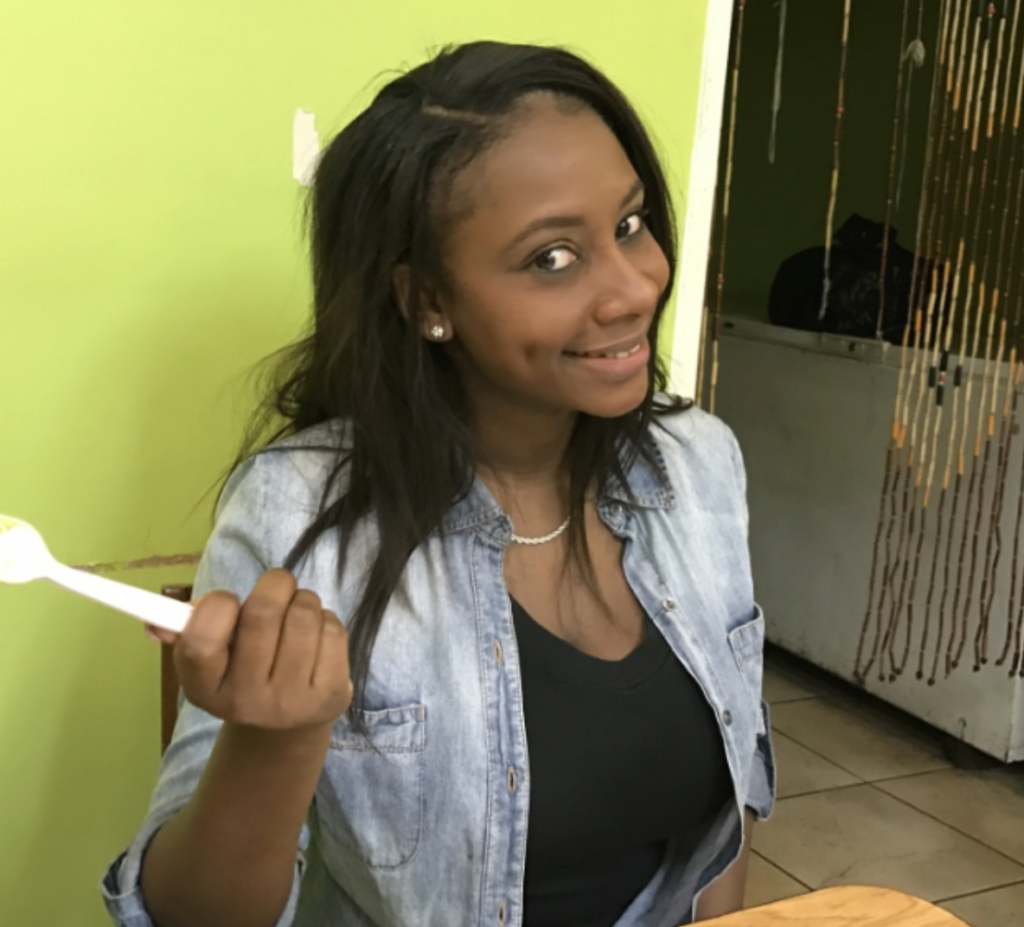
    Armin came by again to see what they thought of the innovative cocktail menu. 

    “Fabulous. I can see you have broad experience in this industry.”

    “Yes, I’ve worked in this business for over 20 years. At the Capitol City Brewery and most recently at the Saint Arnold’s Mussel Bar.”

    “Amazing sounds like you’re a powerful force in the restaurant industry.”

    “Well, the co-owners are bartender brothers, Ari and Micah Wilder – owners of Red Light on 14th Street – we’re a star-studded class.”

    “You know there’s someone you should meet that’s an up-and-comer in this industry. He’s a quintessential foodie and has a finger on the pulse in this industry.”

    The next day I got a call from Armin. 

    “So Sarah speaks highly of you. I thought I was the Big Man on Campus.”

    “You’re a rockstar, Armin. All I do is promote restaurants and host some events. You’re the brains behind your brand and do all the heavy lifting.”

    “Well, we sure could use some help with marketing and developing our web presence.  When we opened a few months ago, we were named The Chaplin. Now his estate is threatening a lawsuit so we changed it to Chaplin’s”

    “I can help with the name change and ensure that your website and social media reflects the new and improved branding.”

    The following week, I met with Armin and his co-owners, brothers Ari and Micah Wilder as they gave me a spirited tour of their cozy space. 

    The vibe and ambience were warm and welcoming and the Laughing Gas cocktail I ordered was potent and bursting with flavors.  

    “We figured out a way to compress carbon dioxide with helium,” said Micah. “You’re gonna sound really funny and everyone’s gonna be laughing at you.”

    I also met Chef Myo Htun, a native of Burma who cooked under a Master Ramen Chef in Tokyo for 30 years.

    “Chef Myo is a tireless worker,” Armin said. “He’s worked every day since we’ve opened. We should make him a co-owner one day.”

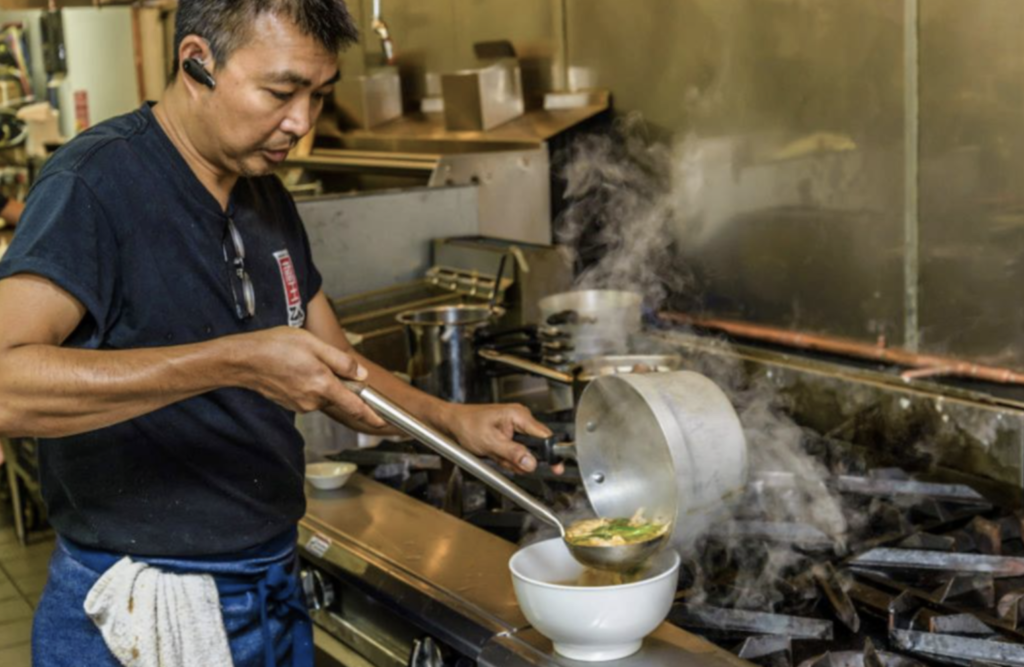
    Chef Myo Htun

    Chef Myo served me the Tonkotsu Ramen with the broth made from boiling pork neck bones – the collagen in the connective tissue transforms into gelatin, which gives the broth its silky texture. Inside the bowl were melt-in-your-mouth chasu pork belly and soft boiled eggs with custardy egg yolk.

    “Your ramen kicks ass, Armin. I would love to host our next get-together here and invite all ramen enthusiasts to celebrate Shaw’s hottest, new setting.”

    “Sounds like a fabulous idea. If we could also do a fundraiser for Bread for the City, that would be great also.”

    The next month on October 22, 2014, dozens of ramen and cocktail fans converged at the downstairs bar for a private event. 

    Christine arrived early as usual and secured a spot at the bar. 

    “Hey Chris, good to see you. How was the military ball with Khoi?”

    “The Vietnamese-American Military Banquet was an overwhelming experience with lots of shiny uniforms, great food, and formal traditions — we had a blast.”

    “I can picture that. I’ve been to a few military balls myself. They can be quite fun. “

    “Met so many amazing Vietnamese Americans and they gave each of us a commemorative coin.”

    “Carry it around with you — it’s a good luck charm.”

    “And I wish the best to Khoi as he heads to Kosovo for a six-month peacekeeping mission.”

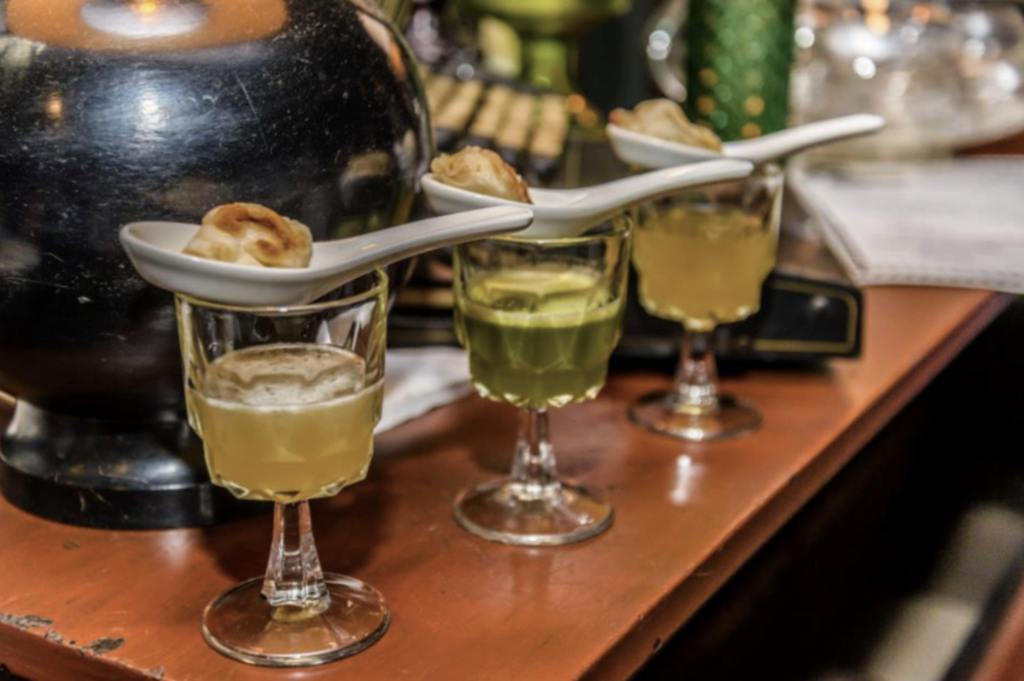
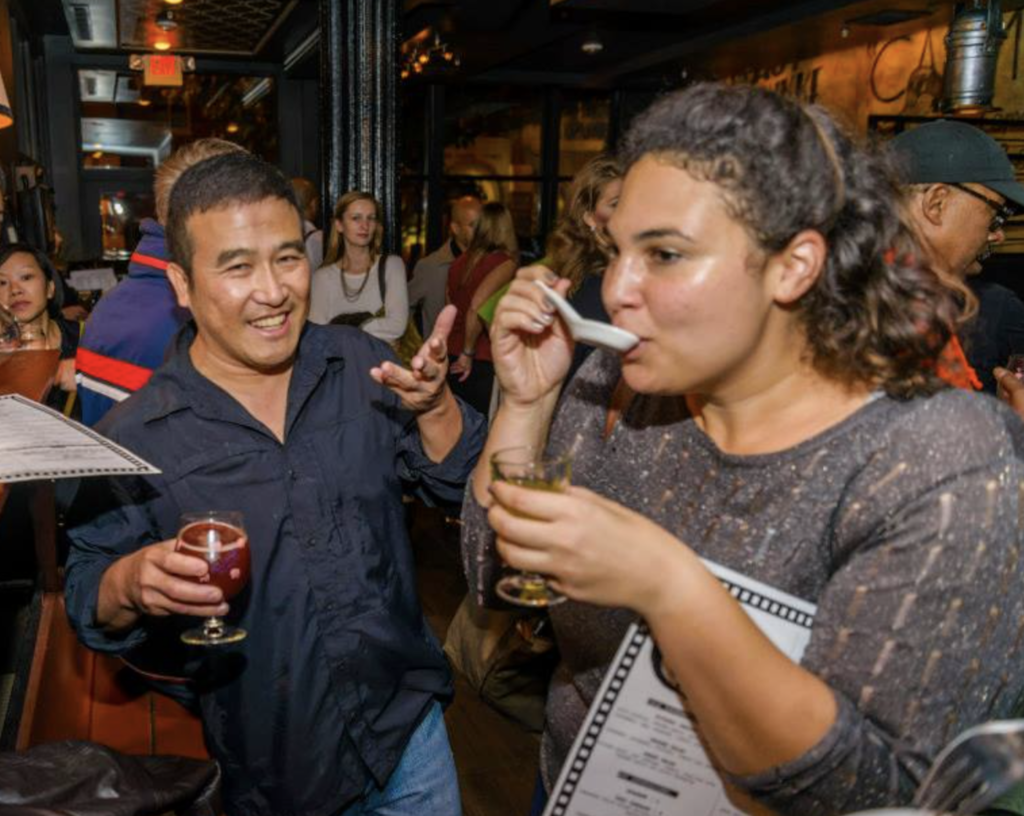
    To kick things off, many guests were introduced to the payday adult-only dumplings — infused with Japanese whiskey. You could choose from a steamed shrimp dumpling on a whiskey sour named The Cold War, a hot pork dumpling on a lemon emulsion, or a hot beef dumpling with Japanese whiskey.

    “This is what happens when a couple of bartenders open up a restaurant,” Micah declared.

    I’ve tried all three, and Micah told me to tap on the brakes. So I was happy to entertain guests to see which one they preferred. 

    BJ enjoying the dumplings

    BJ McDuffie sampled The Cold War. “Mmm, the shrimp shooters are savory and boozy–a perfect combination. I’m ready for the next one.”

    I ordered a Payday from Margaux behind the bar. “How was Drink the District BJ?”

    “Meh, could be better — it was a scorching, hot day. But this is even hotter.”

    “So, what have you been up to lately?”

    “Bowling, bocce, and brunch — that ’bout sums it up.”

    “Have you been to Alba Osteria in NOMA? They serve an awesome brunch and have a bocce parklet outside.”

    “Not yet, but I’m a fan of Roberto Donna.”

    “How about Myo Htun – what do you think of his culinary skills?”  

    Christine Bach enjoying the Cure & ASS

    “By the juiciness of these dumplings, Chef Myo ranks up there with José Andrés and Richard Sandoval.”

    As expected, our resident comic made a showing.

    “One of my favorite indie chefs is Erik Bruner-Yang,” said Wayne Manigo. “And with my cooking skills and an endless supply of ramen, I could give  Toki Underground a run for their money.” 

    “What if you’re a butterfly, but you’re too busy being a caterpillar?”

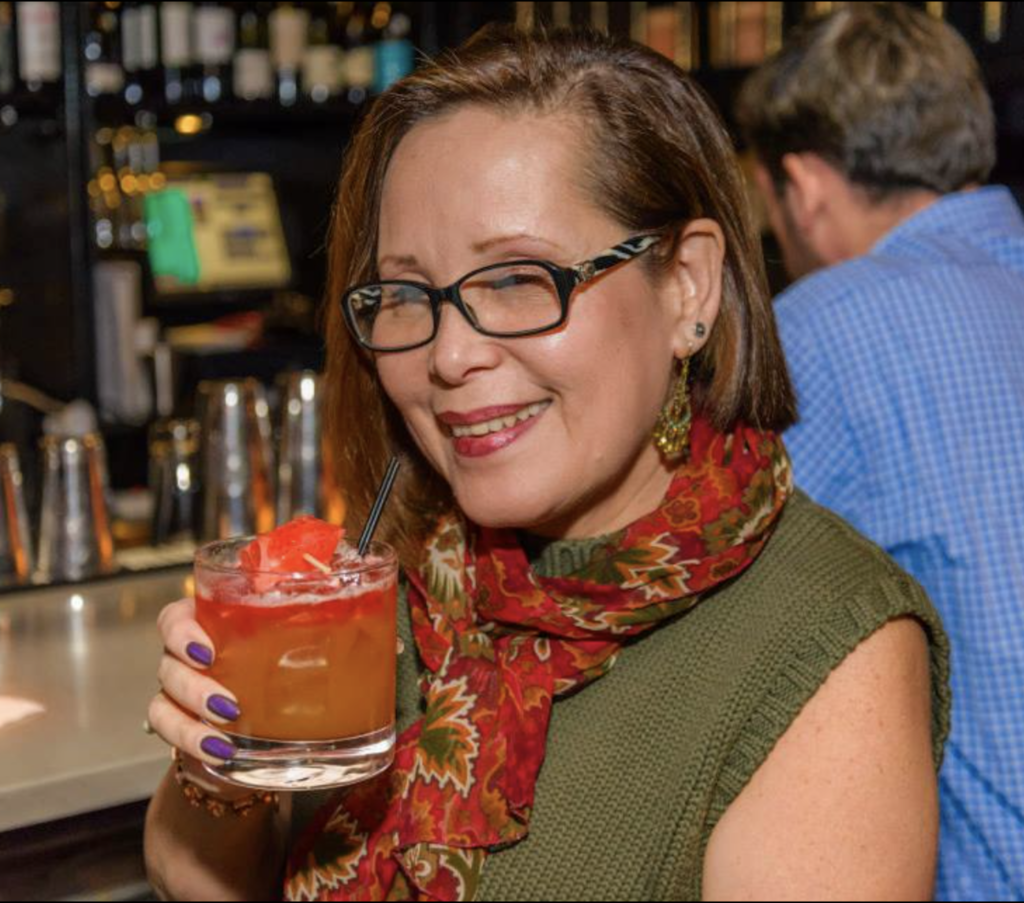
    “Mine is Chef Anh Luu, who cooks Cajun/creole with Vietnamese ingredients,” Christine said. “And I like my ramen spicy, so I’m here to kick some A.S.S.” While she waited, she ordered the Cure, and Micah blow-torched a piece of rosemary on her fruity cocktail. 

    “Yeah, I know it’s all presentation, but I swear it does taste better,” she said.

    Wayne took a taste of Christine’s Cure. “Please pour me a damn drink !! Do not put any herbs and spices in my cocktail that is only for food and also don’t light the dam thing on fire either!”

    Armin put a hand on Wayne’s shoulder. “What makes Chaplin’s stand out from all the rest is the personality of our bartenders. People come from near and far just to have Jake (Jacob Simpson), Said, or Margaux pour them a drink, ask them how their day is going and tell a kickass joke. You’re hired.”

    Margaux Donati mixed a Vagabond cocktail. “We love you boss. You’re a true friend.”

    It was also good to see Deb Santos again. 

    “Hey Big Shot, how’s your growth?”

    “A long, hard struggle and still tripping.”

    “That’s normal. It’s important to show some self-compassion for your blunders.  Don’t regret the things you have done as much as the things you never did.  It’s better to get up and do something rather than nothing, and right now, you’re the big-time host of this fabulous party, so you should be grateful.”

    “I can always rely on you for wise advice Deb. Still haven’t cut back on my drinking though.”

    “Alcohol is a depressant and keeps us at a lower vibration. Try limiting yourself to two drinks and take small sips and plenty of water in between.”

    “Limiting myself to two drinks is like telling my pitbull, he can’t eat my ice cream.”

    “What if you’re a butterfly, but you’re too busy being a caterpillar?”

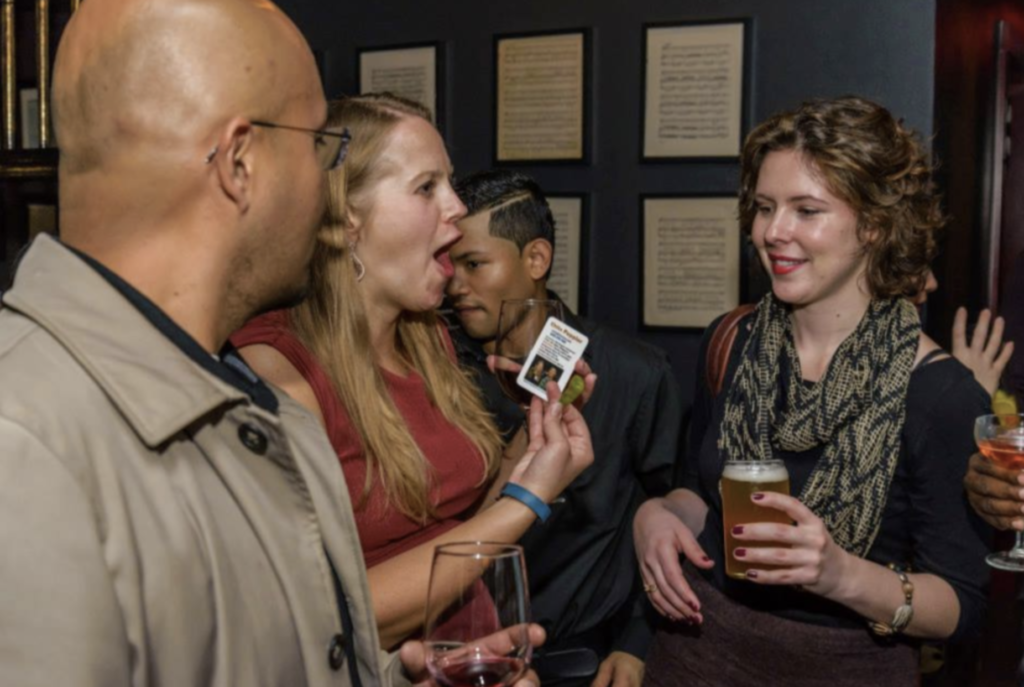
    When Sarah arrived, I was pleased to show her my new business card. She liked the running Orangutan logo popping out on a yellow background. But when she turned it over, she nearly flipped out. 

    Sarah showing her picture to friends

    “Whoa, you put my picture on the back!!”

    “Well, you said you wanted to see the picture of us at Toro Toro.”

    “But not on your business card.”

    “But, your face is more interesting than mine,” I explained. “No worries, you’re not the only one — I also put Kanita and Jackie on there, too.”

    “Well, I’m honored to be promoting your website,” she replied in jest.

    “And I’m honored to have you serve as our de facto brand ambassador. After all, you introduced me to Armin and Chaplin’s.”

    Later that evening inside the Opium Den, Armin and I were slurping on some ASS.

    “So what do you do for fun?” He asked.

    “Besides running and drinking, I like to go paddleboarding on the Potomac. I normally launch from the Slip Inn on (Joint Base) Bolling.”

    “Right on bro. I love boating myself. We like to take the Chaplin’s crew and launch from Edgewater (MD).”

    “So the neighborhood is continuing to change. What are your plans moving forward?”

    “Perhaps adding a sushi joint next door or building an American diner across the street.”

    I took a sip of the Kid cocktail “Would it be another Hollywood-inspired name?”

    “Yes, Shawshank Diner comes to mind–one of the best movies ever made..”

    “And Shaw is one of the city’s hippest up-and-coming neighborhoods,” I said.

    “Indeed, my beloved community is still very much on the move. This is why I love this city.” 

    “I’ll drink to that — another round of yummy shooters, please. Take it easy on the whiskey.”

    I looked over my shoulders and could swear I saw the stern eyes of Deb keeping me in check.

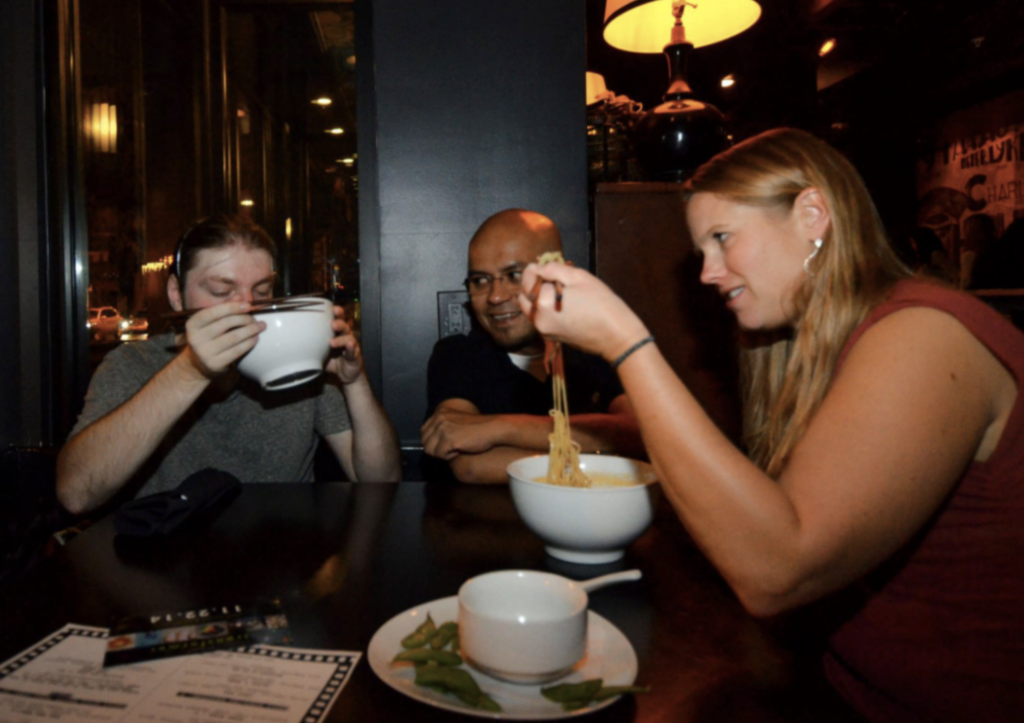
    The A.S.S. is so savory, you can drink it by the bowl

  • Mmm Sumah’s

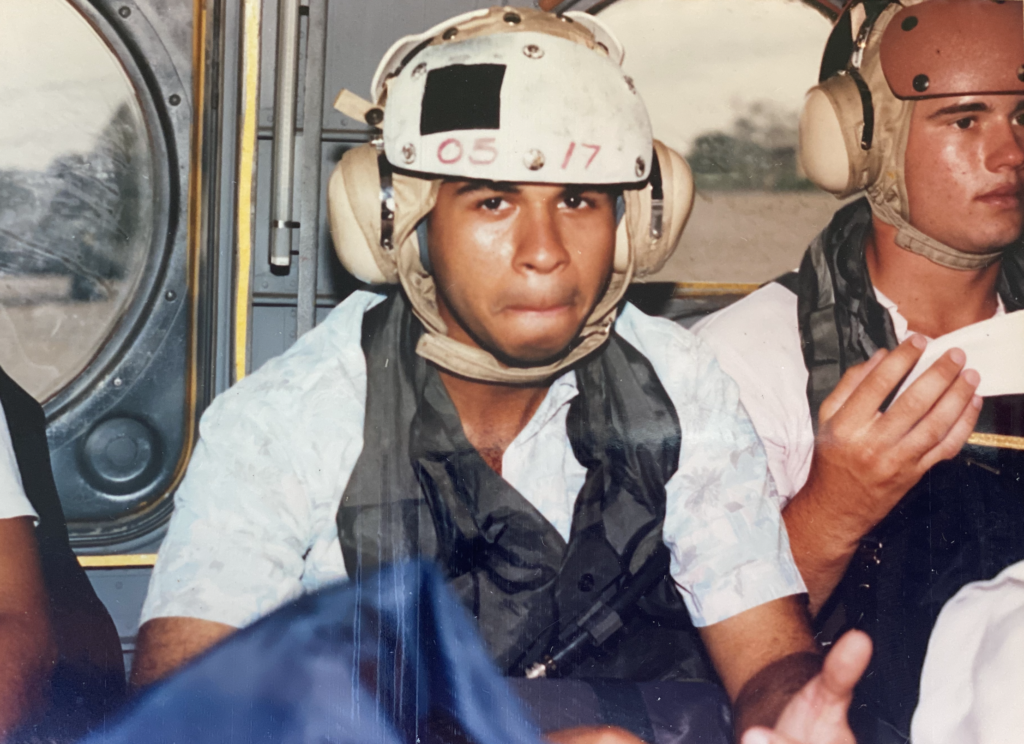
    In the summer of 1990, a half dozen U.S. Navy 2nd class midshipmen from different parts of the U.S. were excited to be spending their summer in the Mediterranean. They would be embarking aboard USS Peterson (DD 969) which was scheduled to visit Italy, Spain, France, and Israel. 

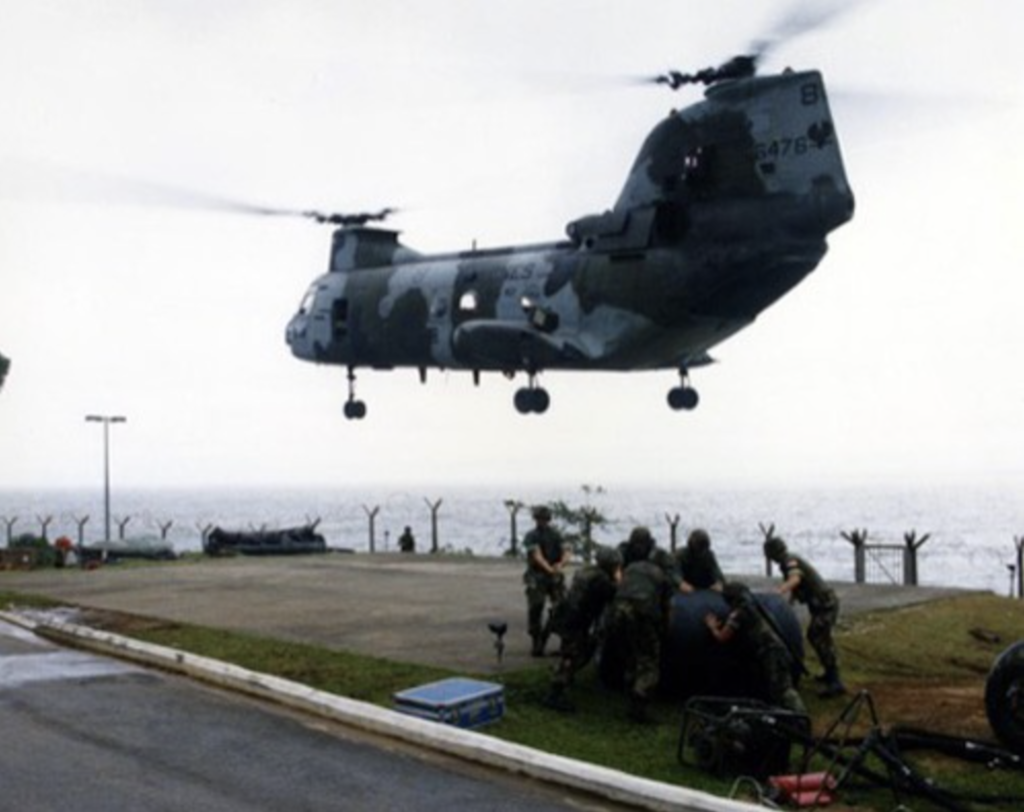
    Then suddenly civil war broke out in Liberia and Peterson was called upon to make a high-speed transit off the coast with Marines on board to evacuate American citizens trapped in the fighting. The six illustrious midshipmen were rerouted to Rota where we boarded a CH-46 Sea Knight and flew over West Africa. 

    MIDN Dave Trotman aboard CH-46 Sea Knight

    I remember flying over the savannas in Senegal, elephants grazing in the sparse grassland. Then over the dense mangrove forest in Guinea traversing the Great Scarcies River which borders Sierra Leone. Barely a soul was seen until we arrived in the capital city of Freetown. There we flew over dozens of shantytowns packed with makeshift shelters squeezed on the banks of rivers, on the face of steep mountains, and on the precipice of the sea. The rainy season was pending and due to overpopulation and deforestation, the risk of mudslides was great. I wished we could visit the tenements and the bustling street markets. But we were there due to war in Liberia and to support Operation Sharp Edge, so we headed to the Lungi Airport to await our SH-60 Seahawk to transport us to our ship. 

    Marines evacuate Americans from Liberia. (Courtesy of DoD)

    While we waited, we were tired and famished, so we purchased some smoked herring and fried plantains washed down with mango juice from an eager street food vendor. Though it was just a slice, the food was mouthwatering and fresh, and I craved for a little bit more. That was the last time I ate West African food.

    My contractor working on the boiler on my rental in Lebaum St told me about a Jamaican girl who just arrived in Virginia and was looking to move into the city.

    “Do you have a room?” He asked candidly.

    “Not here in Lebaum, but at my other property at Bruce Place, perhaps.”

    The next day, I drove 50 miles south on the congested 95 to the exurb of Fredericksburg to pick her up.

    “I’m just hanging out in the countryside working at Firehouse Subs, bored and wasting time.”

    “So what are your plans while in D.C.,” I asked Kimara.

    “Meet city peeps, git ah job, try sum criss cooking.”

    “Anything in particular?”

    “I’m feeling homesick, so I want to get some cassava and curry — something that reminds me of home. 

    I showed her RUNINOut and did a search for Jamaican food. She was impressed but then asked me to search for cassava. The nearest spot was a West African restaurant in Petworth. 

    She pointed to a spot on the map. “Sumah’s — I want you to take me there.”

    When Isata and Amara Sumah immigrated here from Sierra Leone 40 years ago, they had very little possessions and money. They worked hard every day at local restaurants and rented a $100-a-month apartment across the street from where Sumah’s stands today.

    Since 1993 when Isata and Amara opened up their West African restaurant, Sumah’s, they have been serving Jollof rice and West African stews daily. They typically start their day at 8 am and work until 10 pm then drive to their house in Southern Maryland, where their two college-aged daughters live.

    “We’ve worked hard so we could buy a house and put our two daughters through college,” said Amara.

    Sumah’s is a modest seven-table restaurant with neon green walls adorned with hand-carved wood beaded masks.

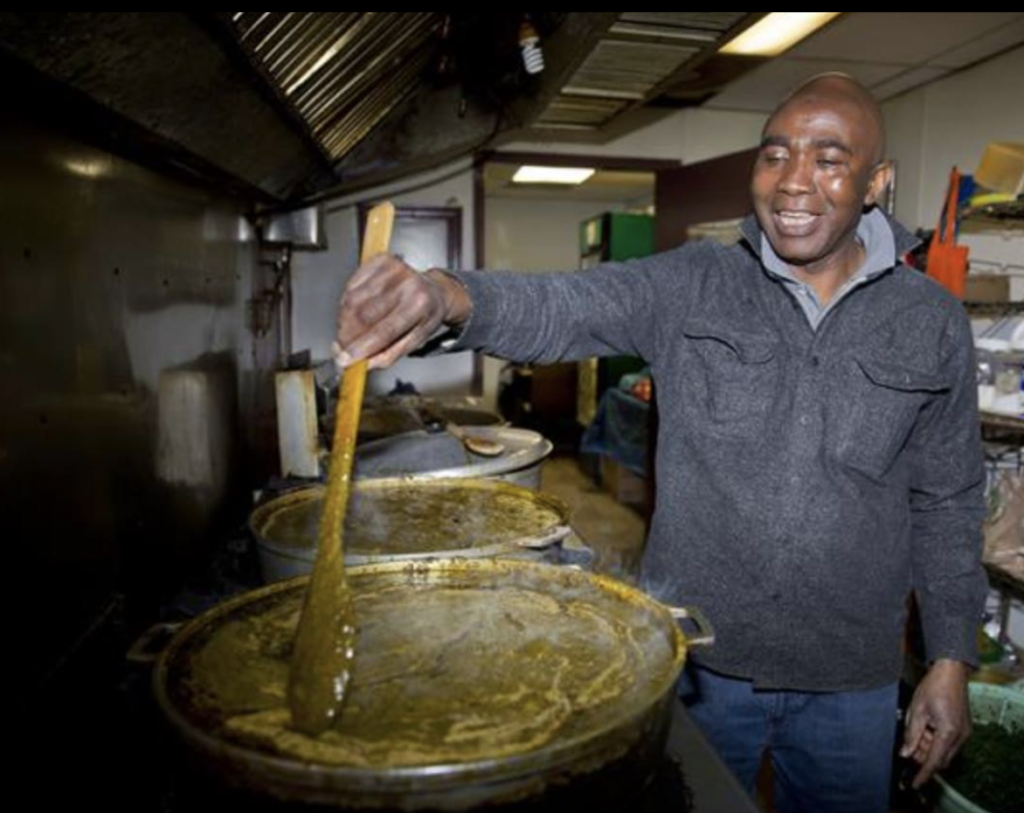
    When Kimara and I walked in, we could immediately sense the aroma of African spices and the fragrant smell of nuts. We followed the savory scent to the kitchen where we found Amara smiling while gently stirring a large pot of cassava that would be quickly consumed by his loyal lunchtime clientele.

    Amara Sumah

    Both Amara and Isata were very pleasant and cordial. They believed in bestowing authentic customer service and took great joy in introducing Washingtonians to West African cuisine, steeped in history and geography.

    “This is my new friend Kimara from Jamaica,” I said. “She adores West African food.”

    “Of course, I grew up with it. Jamaican cuisine is a fusion of African, Creole and Latin American,” Kimara replied. “Where do you think jerk sauce comes from?”

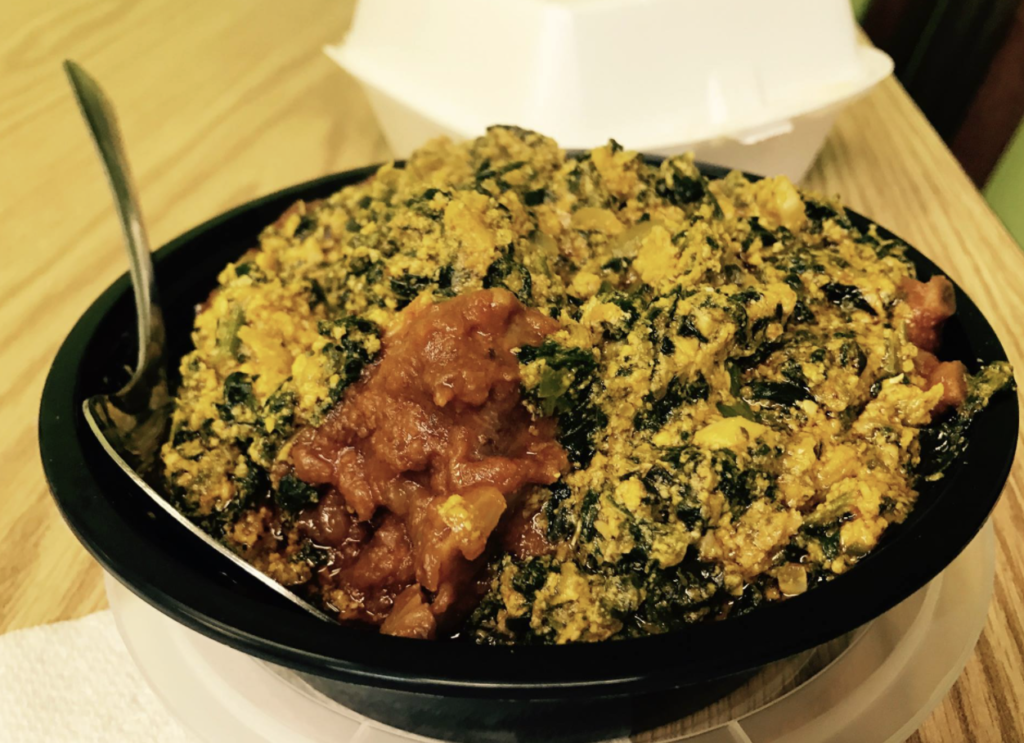
    “Well, we treat all first timers to a free sampler of our delectable cuisine,” Isata said as she dished up a plate of jollof rice with seven other sauces along with egusi and peanut butter stew.

    “That’s very kind of you. I’ve been craving for cassava-leaf stew for the past two months since I arrived in the US,” Kimara said delightfully. “A large bowl please and plenty of peanut butter gravy — my favorite.”

    “Of course,” Isata stated. “We always serve our customers a healthy plate. Whatever you can’t eat, take it home and enjoy it there.”

    We sat down, admiring the African wall art. The canvas displaying ethnic African women and the handmade pieces were eye-catching and fascinating. 

    Another customer next to us was deeply engrossed in his stew. This goat with jollof is so spicy and tender,” he said. “I’ve eaten everything on this menu, and I come here at least twice a week.”

    One patron from Liberia told me that he came here in 1990, and there were no West African restaurants or stores in D.C. Thankfully now there is a handful and he visits Bukom in Adams Morgan on weekends for dancing and drinks.

    “Hey Amara, when did you arrive in the US?” I asked.

    “Nov 28, 1978 — with nothing but a dollar to my name.”

    “May 28, 1990 — was the day I set foot in Freetown,” I mentioned. “A hidden gem, but sadly with thousands of impoverished people, overcrowded and in need.”

    “Have you been back to Africa since?”

    “No just Egypt and Ethiopia, but I would like to travel to West Africa and enjoy her mountains and rainforests and tour national parks to witness wildlife.”

    It didn’t take long for our steamy hot food to come out along with soothing ginger juice on ice.

    “Made with Love from Freetown,” Isata stated. “Our ingredients are imported directly from West Africa.”

    “Mmm,” Kimara exclaimed “My Mother would be amazed.” Kimara didn’t wait long to start digging in.

    “Easy now, this isn’t a cassava eating contest,” I said with a smirk as I dished some of my Jollof onto her plate. “Just as this scrumptious meal was slow-cooked, we have to consume it slowly.”

    Cassava-leaf stew

    Kimara took another bite and smiled warmly. “I should order a gallon of this egusi and peanut butter stew.”

    “You got it, and I’ll add a bowl of krain-krain and some fufu,” Isata said. 

    “We love our customers,” Amara said. “Some drive hundreds of miles just for a warm bowl of Jollof. They are all considered family.”

    Kimara reached over and gave the Sumahs a warm hug. “You guys are so incredibly sweet and charming. This brings back wonderful memories from home. #HugsnKisses”

    “Thank you soooo much Mama & Papa Sumah,” I said as I joined them in the hug. “And please send my regards to your whole family.”

    Kimara enjoyed the cassava

    After being satiated I asked Kimara where she would like to go next.  

    “To the mall to visit the museums. Then I need to fine ah job.”

    “What kind of work?”

    “Waitress, but eventually attend Bartending school.”

    “Do you enjoy bartending?”

    “It was my first job at the age of 16, right on the corner of Windward Road in Kingston.”

    “Any particular restaurants?”

    “Caribbean of course. But really I can work anywhere. Beach bars, sports bars, I’m flexible baby love.”